

More news on this day
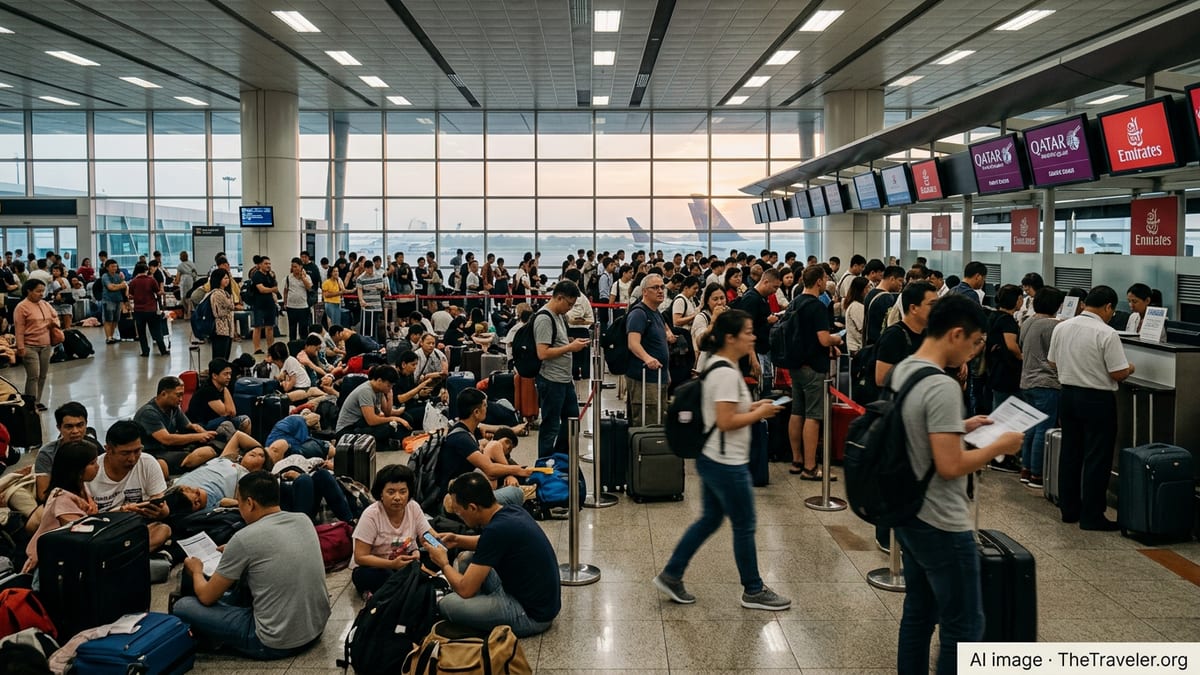
Thousands of travellers were left sleeping on terminal floors across Asia on March 11 as sweeping flight cancellations by Qatar Airways, Emirates, Saudia, AirAsia, United and other carriers disrupted routes to Doha, Abu Dhabi, Riyadh, Honolulu, Dubai, Jakarta, Bali, Kuala Lumpur and beyond amid ongoing Middle East airspace restrictions.
Get the latest news straight to your inbox!
Regional Tensions Ripple Through Asia’s Air Corridors
The latest wave of disruption follows the closure or severe restriction of key Middle East airspace in late February after strikes on Iran, a move that forced airlines to reroute or suspend services linking Asia with major Gulf hubs. Data from aviation trackers and airport authorities across the region on March 11 point to hundreds of cancellations and delays concentrated at hubs that typically funnel traffic onward to Europe, Africa and North America.
Travel and Tour World reported that 774 flights were cancelled and more than 2,100 delayed across 16 major airports including Singapore, Bangkok, Tokyo, Shanghai, Jakarta and Doha in early March, with knock-on effects now intensifying at secondary Asian gateways such as Denpasar in Bali and Kota Kinabalu. While not all of those flights touched the Middle East, the biggest bottlenecks were at Hamad International in Doha, Dubai International and Abu Dhabi International, where capacity has been slashed as airlines wait for more stable overflight permissions.
For carriers like Qatar Airways and Emirates, whose networks are built on high-frequency connections through Doha and Dubai, the sudden loss of key air corridors has forced a shift to limited repatriation-style operations. Schedules that once offered multiple daily departures from Asian cities have been temporarily replaced by sparse rotations that prioritise stranded passengers and critical links.
Industry analysts say the disruption has exposed just how dependent long-haul travel between Asia, Europe and the Americas has become on Gulf hubs. With many travellers now stuck midway through complex itineraries, airlines are scrambling to add capacity where possible without breaching evolving safety restrictions over conflict zones.
Scenes of Chaos in Bali, Jakarta, Kuala Lumpur and Hong Kong
In Indonesia, images distributed by Reuters last week showed long queues and floor-sleeping passengers at Bali’s I Gusti Ngurah Rai International Airport after flights to Doha, Dubai and Abu Dhabi were abruptly cancelled. Travellers bound for Europe and the United States via Gulf hubs reported being told to return “in several days” while airlines worked to secure new slots or confirm alternative routings.
Jakarta’s Soekarno–Hatta International Airport has seen a similar pattern. Recent operational tallies cited by regional media showed at least a dozen cancellations and well over one hundred delays in a single day as airlines adjusted to longer routings and reduced frequencies. Passengers connecting from Indonesian domestic destinations onto Qatar Airways, Emirates, Saudia and AirAsia long-haul services have been particularly vulnerable when onward legs are scrubbed at short notice.
Further north, Kuala Lumpur International Airport has emerged as both a pressure point and a limited lifeline. AirAsia and its long-haul unit have trimmed services to the Gulf and Honolulu while trying to protect core regional routes, but ground staff at the Malaysian hub say last-minute schedule updates have left travellers confused about which departures are actually operating. Long lines have formed at transfer and ticketing desks as people attempt to rebook or reclaim baggage from cancelled flights.
Hong Kong International Airport has also reported mounting disruption, with a tightening squeeze on flights linking the city to Doha, Dubai and other Gulf gateways. Airlines have been forced to consolidate services and prioritise passengers already stranded over new bookings, leaving some travellers unable to secure seats for days despite holding valid tickets.
Qatar Airways, Emirates and Saudia Move to Limited Schedules
Qatar Airways, which has been at the centre of the crisis given Doha’s role as a global connecting hub, has shifted to a rolling announcement of limited flight schedules. Updates from the airline over the past several days outline carefully curated lists of destinations operating on March 11, 12 and 13, including a handful of services from Doha to Asian cities such as Hong Kong, Bangkok, Kuala Lumpur and Jakarta. These flights are framed explicitly as temporary measures to help stranded customers rather than a full resumption of normal commercial operations.
Emirates has taken a similar approach from Dubai, layering in repatriation-style flights to major Asian cities. Internal communications and airline advisories circulated to passengers in recent days describe a reduced network focused on key markets including Hong Kong, Kuala Lumpur, Jakarta and Bali, with priority boarding for travellers whose original flights were cancelled. Even so, with only a fraction of pre-crisis capacity in the air, many passengers are being rebooked several days out or offered refunds instead.
Saudi flag carrier Saudia has maintained a partial suspension of services to and from key Gulf capitals including Abu Dhabi, Doha and Bahrain, alongside adjustments on routes touching Riyadh and Jeddah. The airline has warned that its schedule will remain fluid at least through March 12 as it responds to evolving airspace permissions and coordinates with regional authorities.
United Airlines and other long-haul carriers that typically route North America–Asia passengers through partner hubs in the Gulf and Southeast Asia have also trimmed services. In some cases, flights to Honolulu and mainland US cities from Asia have been pulled or rerouted, adding further uncertainty for travellers who booked complex multi-stop journeys months in advance.
Stranded Travellers Face Long Delays, Patchwork Workarounds
For those on the ground, the practical impact has been brutal. At Bali’s Ngurah Rai airport, travellers described spending two or three nights in the terminal as they waited for confirmation of scarce seats on Qatar Airways or Emirates flights to Doha and Dubai. Others have been told to self-fund hotel stays and keep monitoring airline apps for signs of rebooked itineraries that could still change again at short notice.
In Kuala Lumpur and Jakarta, some passengers have managed to bypass the Gulf entirely by rerouting via Singapore, Bangkok or Tokyo, where carriers such as Singapore Airlines and Japan Airlines continue to operate more stable schedules to Europe and North America. However, these alternatives can be significantly more expensive, and seats on popular departures are selling out quickly as word of the workarounds spreads.
Travel agents across the region report being inundated with requests to salvage disrupted trips to destinations as varied as Honolulu, London and Cape Town. Many say published schedules are effectively “aspirational,” with final decisions on whether a flight operates often coming only a few hours before departure. This uncertainty has made it difficult for stranded passengers to plan even basic needs like accommodation and onward connections.
Ground transport networks around affected airports have also come under strain. In Bali and Kuala Lumpur, taxi and ride-hailing queues have swelled as travellers repeatedly shuttle between hotels and terminals, while airport staff grapple with crowd control and information requests in departure halls filled with tired families and anxious business travellers.
New Updates Offer Hope, But Recovery Will Be Gradual
Despite the grim scenes, there are tentative signs of improvement. Qatar Airways has steadily expanded the list of destinations it plans to serve from Doha between March 11 and 13, including more flights to major Asian and European hubs. Emirates has indicated it aims to restore a much larger share of its pre-crisis network in the coming days, subject to safety assessments and available air corridors.
Regional travel advisers caution, however, that the recovery will be uneven. While some high-demand routes such as Doha to London or Dubai to Singapore may see capacity return relatively quickly, thinner city pairs involving secondary Asian airports are likely to remain at the mercy of last-minute operational changes. Airlines are also grappling with aircraft and crew positioning challenges after more than a week of irregular flying.
For now, authorities and industry bodies continue to urge passengers to check flight status repeatedly before heading to the airport, to expect long waits, and to consider alternative routings that avoid the most affected hubs. With no firm timeline for a full reopening of all affected airspace, Asia’s stranded travellers may be relying on patchwork schedules and hastily arranged extra sections for some time yet.