

More news on this day
Passengers across Asia from Indonesia and Malaysia to Hong Kong and Taiwan are facing cascading travel chaos today as dozens of flights to Doha, Abu Dhabi, Riyadh, Dubai, Honolulu and other key hubs are cancelled or heavily curtailed, leaving many stranded in airports with little clarity on when full schedules will resume.
Get the latest news straight to your inbox!
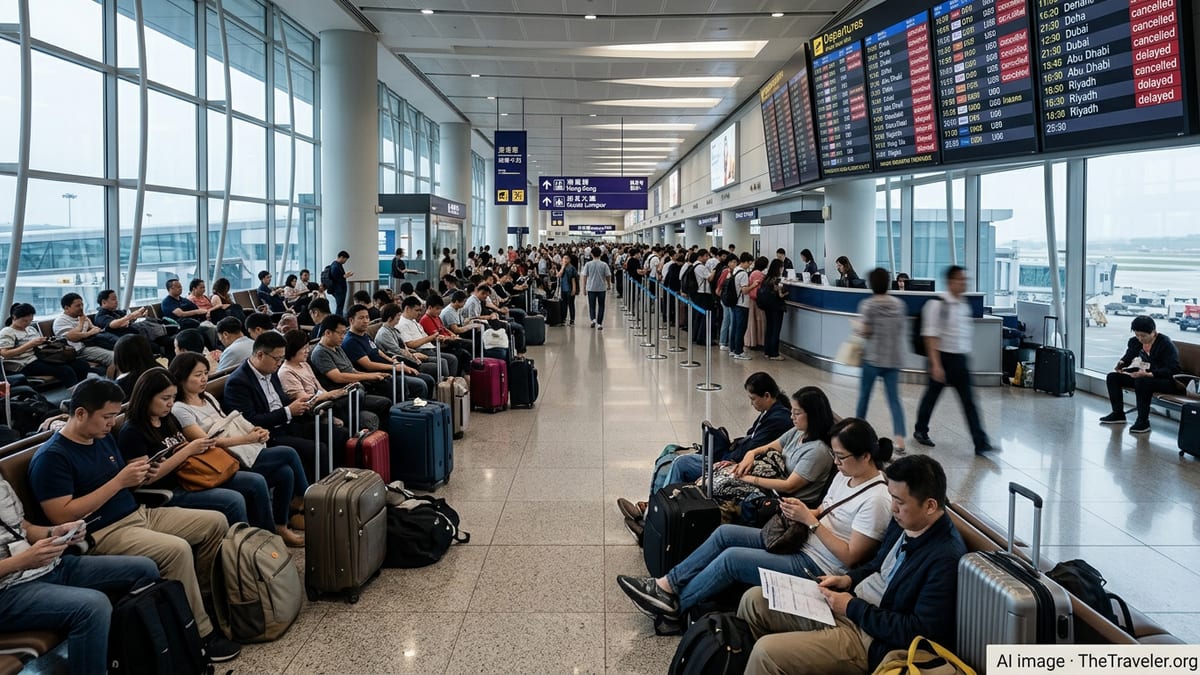
Middle East Conflict Ripples Across Asian Skies
The latest wave of cancellations comes amid a rapidly evolving security crisis in the Middle East that has prompted multiple states to partially or fully close their airspace, forcing airlines to reroute or suspend services through the region’s busiest hubs. Major carriers including Qatar Airways, Emirates, Saudia, AirAsia and United Airlines have all reported disruptions on routes linking Asian cities with Doha, Abu Dhabi, Riyadh, Dubai and beyond.
Industry data compiled in early March shows more than 700 flights cancelled and over 2,000 delayed across key airports in Singapore, Thailand, Japan, India, China, Indonesia, Qatar and the United Arab Emirates, as carriers struggle to navigate around restricted skies and displaced aircraft and crew. While some airlines have begun operating limited repatriation and relief services, normal commercial schedules remain far from restored.
Travel specialists say the disruption is unprecedented in recent years for Asia–Middle East connectivity, rivaling the early pandemic period for sheer operational complexity. With many routes between Europe and Asia traditionally funneled through Gulf super-hubs, the closure of portions of Middle Eastern airspace has created a domino effect that is being felt from Bali to Hong Kong and Kuala Lumpur.
Scenes of Frustration in Bali, Jakarta and Kuala Lumpur
In Indonesia, long lines of weary travelers have been forming at Bali’s I Gusti Ngurah Rai International Airport, where images last week showed crowds clustered around the desks of Gulf carriers after flights bound for Doha, Dubai and Abu Dhabi were abruptly cancelled following regional strikes. Many passengers were holidaymakers due to connect onwards to Europe or North America, only to find themselves suddenly stuck on the island with limited rebooking options.
Jakarta’s Soekarno–Hatta International Airport has reported similar scenes, with airport authorities warning that onward travel via the Middle East could remain uncertain for days. Local travel agents say they have been inundated with calls from Indonesians working in the Gulf states who were due to return to their jobs after home visits, only to discover that their flights through Doha or Dubai have vanished from departure boards.
In neighboring Malaysia, Kuala Lumpur International Airport has seen a spate of cancellations and long delays affecting services operated or codeshared by Gulf and Asian partners. Passengers connecting from secondary Malaysian cities via Kuala Lumpur onto long-haul flights have been particularly affected, as missing one disrupted leg can unravel an entire multi-stop itinerary.
Hong Kong and Taiwan Feel the Shockwaves
Farther north, Hong Kong and Taiwan have not been spared. Carriers that typically rely on Gulf hubs for one-stop links between East Asia, Europe and parts of Africa have had to slash frequencies, upend timetables or switch to complex detours that stretch crew and aircraft utilization to the limit. In Hong Kong, some passengers reported spending hours in customer service queues as they tried to understand whether upcoming flights to Dubai or Riyadh would operate.
Travel agencies in Taipei say they have fielded a surge of inquiries from customers booked on itineraries involving Doha or Abu Dhabi connections, many of whom are now weighing whether to cancel trips outright or attempt rebookings via alternative hubs in East Asia or Europe. With capacity tight and fares rising on unaffected routes, last-minute changes can be costly and hard to secure.
Airlines have introduced flexible rebooking and refund policies for affected passengers, but consumer advocates warn that the sheer volume of cases, spanning multiple jurisdictions and ticketing channels, is creating a backlog that may take weeks to unwind. For now, travelers in Hong Kong and Taiwan are being urged to double-check flight status frequently and avoid arriving at the airport unless their service is clearly confirmed.
Qatar Airways, Emirates and Saudia Shift to Relief Schedules
Qatar Airways, one of the carriers most exposed to Middle Eastern airspace restrictions, has been operating a sharply reduced schedule in and out of Doha, focusing on a rolling list of destinations and relief flights designed to bring home stranded travelers. Official notices for the coming days prioritize services to major cities such as Hong Kong, Kuala Lumpur, Delhi and key European capitals, but the airline stresses that these do not represent a full restoration of its global network.
Emirates and Saudia have likewise pivoted to a mix of reduced commercial operations and targeted repatriation flights. Emirates has gradually increased the number of services to and from Dubai since the start of March, yet remains below normal capacity as it works through a tangle of displaced aircraft, crew duty limits and ongoing airspace constraints. Saudia has extended suspensions on several routes involving Doha, Abu Dhabi, Kuwait and Bahrain into mid-March while maintaining limited connectivity to Dubai and select regional destinations.
United Airlines and other non-Gulf carriers have been impacted mainly through the need to reroute or suspend services that overfly the affected region or rely on Middle Eastern partners for onward connections. Some North America to Asia journeys that once involved convenient transits in Doha or Dubai are now being rebooked via Europe or Northeast Asia, lengthening travel times and straining available seats at short notice.
Stranded Travelers Navigate Rebooking, Refunds and Rights
For passengers left in limbo at Asian airports, the practical challenge is securing a way home or onward without incurring excessive extra costs. Airlines are generally offering fee-free date changes, rerouting where seats exist, or refunds for unused portions of tickets, but the options vary significantly by carrier, ticket type and point of origin. Travelers whose journeys began in the European Union or United Kingdom may have additional protections under local air passenger rights rules, though these can be complex to interpret when non-European airlines and multi-stop itineraries are involved.
Consumer advisers recommend that stranded passengers keep meticulous records of all communications, boarding passes and receipts for unexpected expenses such as hotels, meals and alternative transport. These documents can be vital later when claiming compensation or reimbursement. Many travel insurance policies also include disruption coverage, but policyholders are being urged to check exclusions related to conflict or airspace closures.
On the ground, airport staff and airline agents are juggling full departure halls with limited information, often receiving schedule changes only minutes before passengers do. In some terminals, authorities have imposed tighter controls on access, allowing only travelers with confirmed departing flights to enter check-in areas in an effort to reduce overcrowding and keep operations manageable.
What Travelers Should Expect in the Coming Days
While there are early signs of gradual normalization as certain airspace corridors reopen and carriers refine workarounds, executives and analysts caution that the recovery will be uneven. Even if security conditions improve rapidly, it will take time to reposition aircraft and crews, clear the backlog of stranded passengers and reestablish predictable schedules across networks that stretch from Honolulu and North America to Asia, Europe and Africa.
Travelers with upcoming itineraries through Doha, Dubai, Abu Dhabi, Riyadh or other Middle Eastern hubs in the next two weeks are being strongly advised to monitor airline alerts, confirm their flights before leaving for the airport and remain flexible about routing. Where possible, experts suggest booking through carriers and hubs that currently show more stable operations, even if that means longer journeys or higher fares in the short term.
For now, the ripple effects of the Middle East crisis have underlined just how central the region has become to global air travel, and how quickly a disruption there can strand passengers thousands of miles away. From Bali’s beaches to Hong Kong’s terminals and Kuala Lumpur’s transit halls, travelers are waiting anxiously for the day when departure boards once again show more green lights than red.