


Hyogo Prefecture has quietly stepped into the spotlight. Expedia’s latest Unpack ’27 travel trend report highlights Hyogo as one of the world’s fastest rising destinations, with search interest climbing about 95 percent year on year. For travelers who have already seen Tokyo and Kyoto, or simply want a less crowded, more varied route through Kansai, a compact loop taking in Himeji Castle, Kobe, and Arima Onsen offers a practical, rewarding alternative.
Get the latest updates straight to your inbox!
Why Hyogo Is Suddenly on the Global Map
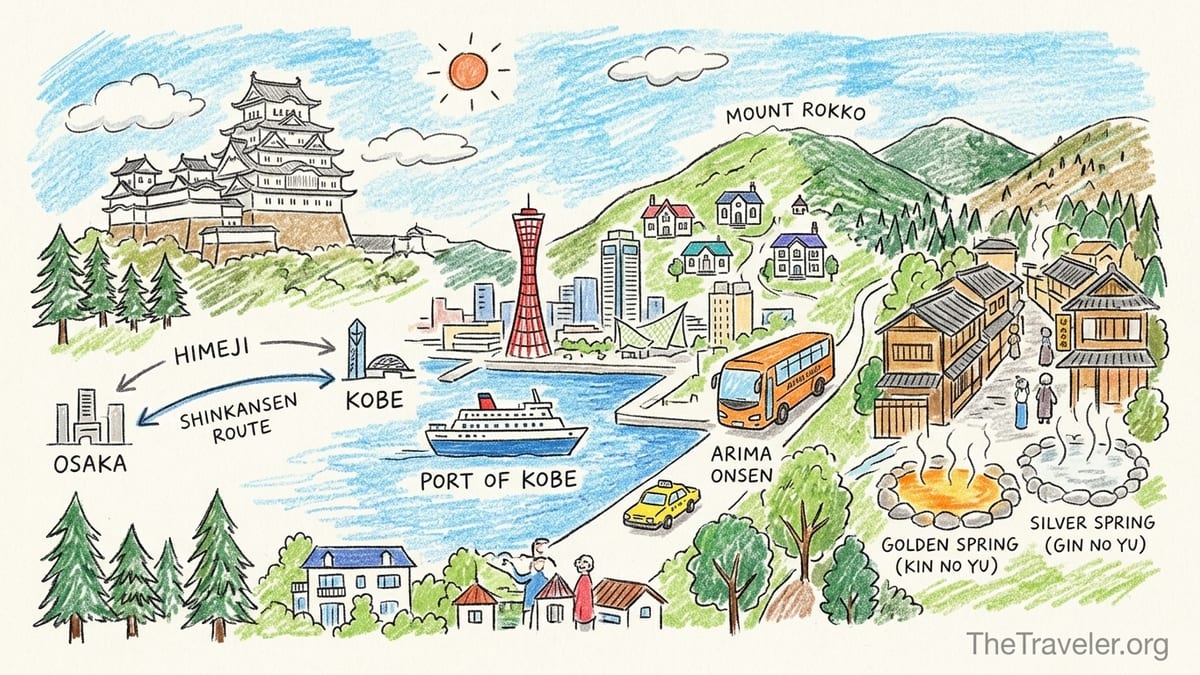
Expedia’s Unpack ’27 report names Hyogo alongside places like South Lake Tahoe and Sedona as a “next wave” destination, backed by a roughly 95 percent jump in searches compared with the previous year. Rather than a single city, Hyogo is being noticed for its combination of experiences within a relatively small radius: a World Heritage castle in Himeji, a cosmopolitan port city in Kobe, and one of Japan’s oldest hot spring resorts at Arima.
For international visitors, the appeal is practical as much as aspirational. Hyogo sits in the middle of the Kansai region, on the same shinkansen line that links Osaka, Kyoto, Hiroshima, and Fukuoka. Himeji Station is about 30 minutes from Shin-Osaka by Nozomi or Hikari services, while Shin-Kobe, the gateway to Kobe city and Arima Onsen, is roughly 15 minutes from Shin-Osaka. That means Hyogo can be woven into existing Tokyo–Kyoto–Hiroshima itineraries with little extra travel time.
On the ground, the distances are short. From Kobe’s main Sannomiya district, local JR or private railway trains reach Himeji in roughly 40 to 60 minutes, depending on service, while direct highway buses link Sannomiya or Shin-Kobe to Arima Onsen in around 30 to 50 minutes. That allows visitors to base themselves in one hotel in Kobe and make day trips, or to move gradually westward, for example Tokyo to Kyoto to Kobe, then Himeji, before carrying on to Hiroshima.
Crucially, Hyogo does not feel like a “secondary Tokyo” or “mini Kyoto.” Himeji’s white castle tower stands over a compact city that is easy to navigate on foot. Kobe’s low-rise streets run between mountains and harbor, with European-style villas in Kitano and a Chinatown near the waterfront. Arima Onsen, tucked in wooded hills behind Kobe, has narrow lanes, steaming bathhouses, and ryokan that feel a world away from Shinjuku or Shibuya.
Himeji Castle: How to Visit Efficiently and Avoid Crowds
Himeji Castle is one of Japan’s best preserved original castles and a UNESCO World Heritage Site. According to official information, standard opening hours are generally 9:00 to 17:00, with last entry at 16:00, and the main keep and corridors start closing down from about 16:30. Admission for most adult visitors from outside Himeji is currently 2,500 yen, reflecting a recent shift to different pricing for residents and non-residents, so it is worth checking the latest fee before you travel on the city’s official channels.
Arriving early is the single most effective way to avoid queues. JR Himeji Station sits on the Tokaido and Sanyo shinkansen lines, so you can catch a morning bullet train from Osaka or Kyoto and arrive soon after opening. From the station, it is about a 15 to 20 minute walk straight up the broad Otemae-dori avenue to the castle gate, or roughly 5 minutes on a Shinki Bus from the north exit to the Otemon-mae stop followed by a short walk through the park. Many visitors who arrive around 10:00 find that climbing up the steep wooden stairs inside the keep can already feel congested.
Plan on at least 90 minutes inside the main castle grounds, and closer to two hours if you stop to read displays and photograph viewpoints. Information boards outline the castle’s defensive tricks, from hidden windows to complex bends in the approach path. Those with mobility considerations should be aware that shoes must be removed in the main keep and stairs are narrow and steep, with no elevator. Families often break up the visit by using the open lawns in front of the keep as a rest area for children who are not keen on climbing every level.
Next door, Kokoen Garden is a worthwhile add-on for travelers who enjoy quieter spaces. Combined tickets that once cost just over 1,000 yen for adults have risen along with the castle’s separate fees, but the package still tends to be cheaper than buying each admission individually. The stroll garden, teahouse, and various smaller garden styles make a calm contrast to the crowded corridors of the main keep, and many visitors plan their timing so that they tour the castle first, then relax over matcha and sweets in Kokoen before returning to the station.
Designing a Practical Hyogo Loop: Three Days in Detail
A realistic Hyogo-focused itinerary that fits neatly between Tokyo and Hiroshima often runs to three days and two nights. One workable pattern is: Day 1 in Himeji, Day 2 and an overnight in Kobe, and Day 3 in Arima Onsen. Travelers coming from Tokyo can take a morning shinkansen to Himeji, store luggage in coin lockers at the station for a few hundred yen per day, visit the castle and garden, then move on to Kobe in the late afternoon.
On Day 1, aim to arrive at Himeji Castle near opening time, tour the grounds, and have an early lunch in the station area before boarding a JR Special Rapid Service or shinkansen east to Kobe. The Special Rapid usually takes about 40 minutes to Sannomiya and is covered by standard nationwide rail passes, while shinkansen services can cut that to roughly 15 minutes between Himeji and Shin-Kobe at an additional cost. Once in Kobe, checking into a hotel near Sannomiya or the Harborland district keeps most sights within a short subway or foot journey.
Day 2 can focus fully on Kobe: morning in the Kitano Ijinkan district at the foot of Mount Rokko, where former consular and merchant houses such as the Weathercock House open to visitors for small entry fees, followed by lunch around Sannomiya or Motomachi. Afternoon hours lend themselves to Kobe Harborland and Meriken Park, where travelers can ride the Kobe Port Tower’s renewed observation floors when open, or simply stroll the waterfront and watch ferries and coastal freighters in the Port of Kobe.
On Day 3, travelers head into the hills to Arima Onsen. From central Kobe, JR highway buses leave from Sannomiya Bus Terminal and Shin-Kobe Station, with journeys to Arima taking roughly 30 to 50 minutes depending on route and traffic. Fares on recent timetables are often in the range of 1,300 to 1,600 yen one way, and advance reservations made through ticket counters or automated machines help ensure a seat at busy weekends. For those who prefer rail, the combination of Kobe’s municipal subway to Tanigami and the Kobe Electric Railway to Arima Onsen Station provides a scenic approach in around 40 minutes from Sannomiya.
Kobe: Food, Neighborhoods, and Evening Atmosphere
Kobe’s charm lies as much in its everyday streets as in individual sights. The city stretches in a ribbon between Mount Rokko and the Seto Inland Sea, and visitors quickly notice that mountains are always to the north and the harbor to the south, making orientation simple. Many travelers choose hotels near Sannomiya Station, which is served by JR, Hankyu, Hanshin, and subway lines, allowing easy access to Osaka, Kyoto, and the airport while keeping Kobe’s bars, cafes, and shopping streets within walking distance.
Food is one of Kobe’s strongest draws. Top end steakhouses near Sannomiya and Motomachi serve branded Kobe beef in courses that can easily exceed 15,000 yen per person, especially at dinner, but lunchtime sets starting around 5,000 to 7,000 yen offer a more accessible way to sample the marbled meat cooked in front of you on a teppan grill. For travelers on tighter budgets, standing steak bars, yakiniku restaurants using domestic but non-branded wagyu, and bustling Chinatown eateries in Nankinmachi all provide substantial meals for 1,000 to 2,500 yen.
Beyond food, Kobe’s Kitano district showcases the city’s international history. Located on a slope about 15 minutes uphill from Sannomiya, Kitano’s Western style houses, once home to foreign merchants and diplomats, now operate as museums and cafes. Entry to each is usually a few hundred yen, or visitors can buy combination tickets covering multiple properties. From here, ropeways and cable cars on the Rokko range carry visitors to herb gardens and night view spots where Kobe’s lights spill out across the artificial islands built for port expansion.
In the evening, Meriken Park and Harborland become pleasant places to walk. Illuminated warehouses, the outline of Kobe Port Tower, and ferries gliding across the bay give the area something of a small scale Hong Kong flavor. Families might opt for a harbor cruise lasting about 40 to 60 minutes, with fares typically in the low thousands of yen depending on operator and time of day. Couples and solo travelers often gravitate to the bars tucked under the elevated tracks near Sannomiya or to cafes overlooking the harbor for dessert and coffee.
Arima Onsen: Hot Spring Traditions Within Easy Reach
Arima Onsen sits on the northern side of Mount Rokko, but door to door it feels remarkably close to Kobe and Osaka. Official tourism information from Kobe and Japan’s national tourism authorities describes Arima as one of Japan’s three classic hot spring resorts, alongside Dogo Onsen in Ehime and Shirahama Onsen in Wakayama. Its compact streets, wooden ryokan, and mix of brown “gold” springs and clear “silver” springs make it a popular weekend escape for Kansai residents, yet it remains under the radar for many first time overseas visitors.
Access from Kobe is flexible. Highway buses run between Sannomiya or Shin-Kobe and Arima Onsen in around 30 to 50 minutes depending on route. Recent bus package tickets sold by regional operators have bundled a round trip from Kobe with entry to public bathhouses such as Kin no Yu and Gin no Yu, though prices and conditions change regularly and should be confirmed close to travel time. The rail route, using the Kobe municipal subway north to Tanigami then transferring to the Kobe Electric Railway’s Arima Line, generally takes 30 to 40 minutes from central Kobe to Arima Onsen Station, which stands a short walk from the main streets.
Within Arima, two public bathhouses anchor the experience. Kin no Yu uses iron rich brown water that colors the tiles and has a distinctly mineral smell, while Gin no Yu, a short uphill walk away, offers clear carbonated water drawn from different springs. Admission fees at each are usually well under 1,000 yen per adult, and visitors can rent towels for a few hundred yen more if they have not brought their own. Many ryokan also include private or communal baths sourced from the same springs, with overnight stays including dinner and breakfast often starting from around 20,000 yen per person on weekends at midrange properties, and more modest business hotel style stays available along the edges of town.
For day trippers, a simple pattern works well: arrive by late morning, stroll the central streets, sample rice crackers or carbonated spring water based sweets sold by local shops, bathe at Kin no Yu or a hotel day spa, and head back to Kobe or onward to Osaka in the late afternoon. Travelers wanting more scenery can combine Arima with Mount Rokko by using the Rokko–Arima Ropeway, which links the mountaintop area and Arima in about 12 minutes, subject to weather and seasonal schedules. Combi tickets sold on site or at city information counters sometimes include ropeway rides and mountain bus loops at discounted prices compared with buying segments separately.
Comparing Hyogo’s Loop to the Classic Tokyo–Kyoto Route
The standard first trip to Japan often revolves around Tokyo, Kyoto, and perhaps Osaka. That route delivers famous sights and convenient transport, but it can also mean time lost in queues at major temples or in crowded city trains. By shifting west into Hyogo while still using the same shinkansen spine, travelers can trade some of that time for experiences that feel more varied and less rushed.
Himeji Castle offers a contrast to Kyoto’s reconstructed castles and temple compounds. Unlike Osaka Castle’s modern concrete interior, Himeji’s main keep remains largely wooden, with narrow staircases, low ceilings, and simple displays that highlight its defensive design rather than interactive exhibits. Kobe stands in for some of Tokyo’s urban energy yet remains easier to cross on foot, and its food scene allows visitors to experience everything from high end wagyu to neighborhood ramen without traversing a metropolis of 14 million people.
Arima Onsen, meanwhile, gives access to the classic ryokan and hot spring experience without the travel times associated with more remote resorts. For someone already coming from Tokyo, a sample route might look like this: Tokyo to Kyoto, two or three nights in Kyoto and Nara, then Kyoto to Kobe for one or two nights, a day trip to Himeji, and a final night in Arima before returning to Osaka for a flight. That pattern connects several of the same cultural icons as the classic circuit while reducing backtracking and adding mountain and onsen time.
Costs are broadly comparable. Shinkansen fares between Kyoto, Shin-Osaka, Shin-Kobe, and Himeji fall in the same general band as those between Tokyo and Kyoto, and reserved seat surcharges are similar. Local JR and private line fares around Kobe, Himeji, and Arima tend to be in the hundreds of yen per ride rather than thousands. Where Hyogo can differ is in accommodation: Kobe often undercuts central Kyoto on nightly rates for international chain hotels, especially midweek, while Arima’s ryokan can be more expensive than standard business hotels but deliver two full meals, onsen access, and a distinctly Japanese experience.
Practical Tips for Making the Most of Your Hyogo Stay
To keep logistics simple, many visitors use a regional rail pass or prepaid IC card for local travel within Hyogo. Nationwide passes issued by JR generally cover shinkansen and JR lines to Himeji and Kobe but not the private Kobe Electric Railway to Arima or non JR buses. For the final legs, cash or IC payment on local operators is common. Travelers who prefer to plan everything in advance can buy highway bus tickets to Arima a few days early at JR bus counters in Sannomiya or Shin-Kobe, especially in busy foliage and cherry blossom seasons.
Luggage can shape how comfortable your itinerary feels. Coin lockers at Himeji, Sannomiya, and Shin-Kobe Stations are widely used for daytime storage and usually cost from 300 to 800 yen per day depending on size. For those heading to Arima for a night or two, hotels in Kyoto or Osaka often help arrange luggage forwarding by courier for a few thousand yen per suitcase, saving you from hauling large bags onto hillside streets and narrow ryokan staircases.
Seasonal timing matters as well. Spring brings cherry blossoms to Himeji’s castle park and pleasant walking conditions in Kobe, while autumn colors around Mount Rokko and Arima Onsen make the ropeway ride and hillside baths especially scenic. Summer can be hot and humid, and queues inside the castle keep feel longer in the heat, so early morning starts and midday breaks in shaded gardens or air conditioned museums become more important. Winter is quieter at the castle and in Kobe’s streets, and many travelers find outdoor rotenburo baths in Arima particularly appealing when the surrounding hills are frosty or dusted with snow.
Above all, allow room for Hyogo to be more than a quick detour. Rather than treating Himeji simply as a stop between big cities, linking it thoughtfully with Kobe and Arima Onsen turns the prefecture into a compact journey in its own right, balancing history, modern city life, and restorative hot springs without adding long detours or complicated transfers to your time in Japan.