

I almost did what so many travelers are doing this year: quietly closing the laptop, convincing myself that "now" was not the right time, and letting another trip die in the bookmarks folder. Flights felt expensive, headlines were full of uncertainty, and every new survey seemed to confirm what my bank account already knew: people were hesitating to travel. I was one click away from abandoning a flight to Lisbon. If I had, I would have missed one of the most important trips of my life.
The Night I Almost Closed the Booking Window
The decision not to travel rarely looks dramatic from the outside. It is usually a quiet no: a tab closed, a calendar cleared, a dream resized to fit a budget spreadsheet. On a gray Tuesday night in March, that was almost my story. I had a round-trip flight from New York to Lisbon on my screen for just under 600 dollars, leaving in late April and returning ten days later. It was not the impossible 300 dollar unicorn deal you sometimes hear about, but for shoulder season to Europe it was solid, in line with recent low-season averages out of New York.
I stared at the total while scrolling through a different kind of travel content: survey after survey showing how Americans were pulling back on trips, trimming budgets, or canceling vacations outright as costs rose. One report suggested that roughly one in five travelers had already cut back on travel plans because of the economy, and another found that more than half felt they could not travel as much as they wanted because of cost pressure. It was exactly the narrative my anxious brain wanted to hear.
On paper my hesitation made sense. Rent had gone up the previous winter. Groceries quietly cost more each month. News about airlines trimming schedules and travelers becoming more price sensitive convinced me that travel was a luxury for someone in a more stable season. Closing the browser felt responsible, almost virtuous. What I did not realize then was how expensive that kind of caution can become when it hardens into habit.
What changed that night was not the price on the screen but the question I asked myself. Instead of "Can I justify this right now?" I tried "What will I remember a year from now: the exact number in my savings account this month, or the trip I took (or did not take)?" It was not a perfect financial equation. It was a values equation. Ten minutes later, with my heart pounding harder than it should for a routine online purchase, I clicked the button to book Lisbon.
Why So Many Of Us Nearly Talk Ourselves Out Of Travel
My hesitation was not unique. In the past couple of years, research from travel and consumer organizations has repeatedly shown a split personality in how people think about trips. On one hand, demand and desire remain high. Surveys have found that more than 9 in 10 Americans still expect to take at least one trip in a given year. On the other hand, a meaningful slice, often around 20 percent or more, say they are traveling less than they had hoped because of the economy, while a majority wish they could travel more but feel blocked by costs and uncertainty.
When you zoom in on individual decisions, those statistics look like late-night text threads about “maybe we should wait until next year,” or families quietly shortening a two-week road trip to five days, or solo travelers deleting half their saved itineraries. A financial study in 2025 highlighted that everyday costs, from rent to groceries, now feel like a bigger barrier to vacation than the trip expenses themselves. In other words, people are not just anxious about a 600 dollar flight. They are anxious about the entire context of their lives.
Travel advisors are seeing the same hesitation play out in real time. A recent industry survey found that well over half of advisors believed economic jitters and lower consumer confidence were making their clients slower to book and more likely to cut back. Middle-class families in particular, one advisor noted, were expressing anxiety not only about money, but about what might go wrong on the road: delays, cancellations, or feeling unwelcome in certain destinations. It is a potent mix of financial and emotional doubt.
Against that backdrop, it is easy to see how a potential trip becomes a soft target. It feels flexible and optional. No one calls if you do not show up in Lisbon. There is no late fee attached to not watching the sunset over the Tagus River. So you tell yourself you are being prudent. The danger is that the habit of postponing travel can quietly become the habit of postponing anything that is not strictly necessary, even when that “unnecessary” experience might be exactly what keeps you grounded and motivated in rougher seasons.
Landing In Lisbon And Meeting The Version Of Myself I Almost Skipped
When my overnight flight touched down at Humberto Delgado Airport just after sunrise, Lisbon was still shaking off a spring chill. Light spilled over terracotta rooftops and the line of taxis outside the terminal. I had booked a simple studio in the Cais do Sodré area, a neighborhood that guidebooks often recommend for its central location by the river and its easy access to trams, ferries, and the Time Out Market food hall. It was not a designer coliving space with a rooftop pool, but it had a balcony and a tiny desk where I could open my laptop and pretend to be a local for ten days.
Lisbon has been talked about for years as one of Europe’s digital nomad capitals, thanks to its mix of historic charm, relatively lower cost of living compared with cities like London or Paris, and a web of coworking spaces and cafes. In 2025, travel reports still put it near the top of lists for remote workers, even as some long-term residents worried about overtourism and rising rents. Neighborhoods like Graça, Alfama, and Campo de Ourique were being singled out for their blend of authenticity and connectivity: leafy streets, good coffee, and enough locals around that you never felt you were in a theme park version of Portugal.
That first morning I wandered down to the waterfront, passing commuters at Cais do Sodré station and a handful of runners tracing the curve of the Tagus River. The city was quieter than I expected. In photos, Lisbon is all saturated colors and dramatic miradouros, but in person the light is softer, almost washed in pastel. The famous hills are as steep as advertised. By the time I reached a small overlook near the Santa Catarina neighborhood, my thighs were burning and I was questioning my choice of carry-on-only packing and one pair of sneakers.
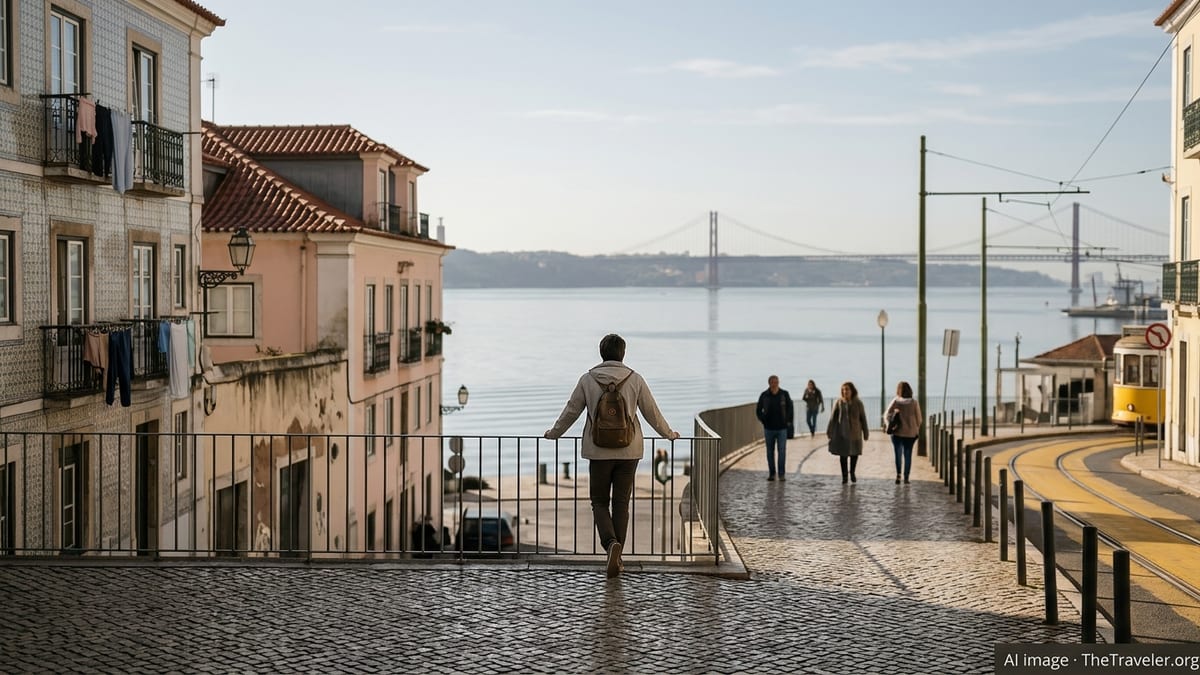
Then the reward appeared: a view across the river, the 25 de Abril Bridge stretching out like a distant cousin of San Francisco’s Golden Gate, and a freighter slowly sliding toward the Atlantic. I bought an espresso from a kiosk for a couple of euros, leaned on the railing, and felt my shoulders drop. The spreadsheets and survey data from home felt a world away. I had almost traded this moment for a slightly higher savings balance.
Real Numbers, Real Tradeoffs: What The Trip Actually Cost
It is easy to romanticize an almost-canceled trip after the fact, but the money still matters. My Lisbon flight, booked about six weeks in advance, landed just below the 600 dollar mark from New York, a price that lined up with what many fare trackers considered reasonable for low- to shoulder-season Europe that year. Had I insisted on peak summer dates, I would have been closer to 900 dollars or more round-trip. Timing was my first quiet savings tool.
On the ground, my ten-night stay in Cais do Sodré came to about 95 euros per night for a small but bright studio with decent Wi-Fi. For comparison, coliving spaces with built-in community events and coworking access in central Lisbon that season were advertising rates around 800 to 1,200 euros per month for a private room, which would have been more cost effective for a longer stay but did not make sense for my short getaway. A basic coworking membership at a popular space near the river ran about 150 euros per month, but I chose to work mostly from my accommodation and the occasional cafe to keep my budget in check.
Food turned out to be where Lisbon saved me. Lunch menus in neighborhood restaurants offered hearty plates of grilled fish, rice, and salad for under 12 euros, including a coffee. A pastel de nata from a local bakery like Manteigaria was around one euro, and I made liberal use of that fact. Compared with metropolitan areas in the United States where a casual lunch can easily hit 20 dollars, Lisbon’s everyday dining scene felt like a gentle correction.
Transport costs stayed modest as well. A 24-hour public transport card covering trams, buses, and the metro was about the price of a couple of coffees, and I walked most places anyway. My biggest incidental expenses were the spontaneous ones: a Fado show ticket in the Alfama district, a last-minute decision to join a small-group day trip to Sintra and Cascais, and a few too many visits to wine bars with river views. All told, the trip including flights, accommodation, food, and activities came in under the cost of what some surveys cited as an average American vacation budget for the year, which hovered in the several-thousand-dollar range. Mine felt far from cheap, but it was not the financial cliff I had imagined on that Tuesday-night booking screen.
The Moments That Would Have Been Lost To Hesitation
No one ever says, “I am glad I passed on that pastel de nata ten mornings in a row,” but we often speak that way about experiences. In Lisbon, it was the accumulation of small, unspectacular moments that convinced me how costly my original nearly-no would have been. Standing in a light rain outside a miradouro in the Graca neighborhood, listening to a busker fold English lyrics into a Portuguese ballad. Learning to time my steps on the slick calçada portuguesa sidewalks so I would not slide downhill in front of a tram. Finding a cafe where the barista wrote my name correctly without asking where I was from.
One afternoon I took the train twenty-five minutes west to the beach town of Carcavelos. I had packed my laptop, intending to answer emails between walks along the sand. Instead, I found myself sitting on the seawall watching local teenagers practice surfing in small, messy waves under a silver sky. A pair of older women in thick coats shared a thermos of coffee on a bench behind me, occasionally cheering when someone managed to stand for more than a few seconds. Everything about the scene felt perfectly ordinary. That ordinariness was what I had been missing.
Later that week, I joined a remote-worker meetup in a coworking space housed in a former warehouse near the river. People had flown in from Berlin, São Paulo, Toronto, and smaller Portuguese towns. A developer from the Netherlands talked about how many trips she had postponed in the last two years, telling herself she would travel “after things settled down,” only to realize that the news was unlikely to be calm anytime soon. A designer from Brazil mentioned that he had booked Lisbon only after his friend reminded him that regret compounds faster than savings interest when it comes to lost experiences.
Hearing their stories, I realized my almost-canceled trip was part of a larger pattern: a global community of people trying to navigate an era where travel still matters deeply but feels somehow less simple and more fraught. The conversations did not erase the realities of budgets or family responsibilities. They just reframed travel not as a frivolous extra, but as one of the ways we stay connected, creative, and resilient in difficult years.
How To Decide When A Trip Is Worth Booking In Uncertain Times
By the time I flew home, my question had shifted from “Should I have spent that money?” to “How can I tell, in the future, which trips are worth pushing past my hesitation for?” I started to notice a few practical filters that might help others who are hovering over the book button in a browser full of conflicting advice and anxious headlines.
The first filter is timing. Booking during shoulder seasons, like late April in Lisbon instead of July or August, can mean the difference between an affordable escape and a trip that feels punishingly expensive. Airfare data for routes between North America and Europe consistently shows that high season can add several hundred dollars to a round-trip ticket compared with quieter months. If your dates are flexible by even a week or two, using fare calendars and alerts to target low-demand windows can make a previously off-limits destination achievable.
The second filter is clarity on your non-negotiables. For Lisbon, I decided I did not need a rooftop pool or daily guided excursions. What I did need was walkability, reliable Wi-Fi for remote work, and at least one or two splurge experiences like that Fado show. Listing those priorities before searching helped me resist “just twenty dollars more per night” creep. It also made it easier to say yes to the trip overall, because I knew what I was actually buying.
The third filter is an honest look at what you will regret more: staying or going. Travel research in 2025 found that while many people were cutting back on trips, almost half of respondents still named “seeing new places” as one of their top life priorities. When your stated values and your choices diverge for too long, it creates a quiet, nagging dissatisfaction. Asking, “If things feel just as uncertain next year, will I be glad I waited?” can be clarifying. Sometimes the answer will be yes. In my case, for Lisbon, the answer was a clear no.
The Takeaway
I did not come home from Lisbon with a life completely transformed. My inbox did not disappear. Rent did not lower itself in gratitude for my brave decision to live fully. The economy did not magically stabilize. What changed was more subtle and more durable. I had a fresh memory of what it feels like to be slightly lost on cobblestone streets in a city where you know almost no one, and to realize that you are more capable, curious, and resilient than your late-night worries suggested.
In the months after the trip, when new surveys came out about consumers trimming travel budgets or airlines warning of softer leisure demand, I read them with more nuance. The numbers are real. So is the fatigue. But I also knew that if I had waited for a year with perfect headlines, perfect prices, and perfect timing, I might wait forever. Travel has always been a conversation between risk and reward. In this era, that conversation is simply louder.
If you are staring at a flight, a train ticket, or a simple three-night escape that feels both irresponsible and essential, consider this: the regret of a well-planned, slightly imperfect trip tends to fade quickly. The regret of a life where you talked yourself out of the journeys that mattered has a way of lingering. My almost-missed Lisbon trip reminded me that sometimes the most responsible choice is the one that keeps you in touch with your own capacity for wonder.
FAQ
Q1. How did you decide Lisbon was worth the cost compared with other destinations?
Lisbon offered a balance of relative affordability, strong public transport, walkable neighborhoods, and a thriving remote work scene, which meant I could stretch my budget further than in pricier European capitals while still feeling connected and inspired.
Q2. How much should a traveler realistically budget for a 7 to 10 day trip to Lisbon from North America?
Exact costs vary, but many travelers can plan for a mid-range budget that includes several hundred to around one thousand dollars for flights, plus daily spending on accommodation, food, and activities that is often lower than in major U.S. cities.
Q3. Is Lisbon still a good choice for digital nomads and remote workers?
Lisbon remains popular with remote workers thanks to its coworking spaces, relatively mild climate, and social scene, though some long-term visitors now look to less crowded neighborhoods or nearby towns for a quieter and more affordable base.
Q4. How did you manage work responsibilities while taking this trip?
I chose a studio with reliable Wi-Fi, kept core working hours in my home time zone, and used early mornings and evenings for exploration, which allowed me to stay responsive without turning the trip into a full work marathon.
Q5. What practical steps can someone take if they are worried about travel costs but still want to go?
Flexible dates, shoulder-season travel, clear priorities for where to splurge or save, and choosing destinations where everyday expenses like food and public transport are moderate can all significantly reduce overall trip costs.
Q6. How do you deal with guilt about spending on travel when the economy feels uncertain?
I set a clear trip budget in advance, made sure essential bills and savings were covered, and reframed travel as an investment in well-being and perspective rather than an impulsive purchase, which helped reduce guilt.
Q7. Did safety or political headlines affect your decision to travel?
Yes, I paid attention to official advisories and reputable news coverage, but I also looked specifically for on-the-ground updates from recent visitors and local sources to get a nuanced view rather than reacting only to dramatic headlines.
Q8. How can solo travelers find community in a city like Lisbon?
Joining coworking spaces, attending meetups for remote workers, visiting popular cafes in neighborhoods like Cais do Sodré or Graça, and signing up for small-group tours are all reliable ways to meet people without forced socializing.
Q9. What would you do differently if you were booking the same trip today?
I would still target shoulder season, but I might add a few nights in a quieter nearby town or along the coast to experience a slower side of Portugal beyond Lisbon’s busiest streets.
Q10. How can someone tell if they will regret not booking a trip?
If you have a destination that keeps resurfacing in your thoughts, aligns with your values, fits within a carefully considered budget, and feels like it would expand your perspective, that persistent pull is often a sign you will regret endlessly postponing it.