


It started, like so many modern trips, with a photo. A turquoise infinity pool spilling into a brighter turquoise sea, a bamboo swing hanging over rice terraces, a caption about “healing” and “finally taking time for me.” After seeing some version of that image for the hundredth time on Instagram, I finally caved. I booked a ticket to Bali, the poster child of viral travel, determined to find out what really happens when you follow the hype to a place the internet has turned into a dream.
When a Destination Becomes a Backdrop
By the time my flight landed at Denpasar, I already knew this was not the sleepy island escape it had been a decade ago. Surveys and travel pieces in the last two years have consistently put Bali, along with places like Santorini and the Maldives, at the top of “overrated” and “Instagram vs reality” lists, usually with the same complaints: traffic, crowds, and an economy increasingly tilted toward photo ops instead of real experiences.
Driving north toward Ubud, the billboards told their own story. “Most Instagrammable Brunch.” “Iconic Swing Experience.” “Bali’s Number One Floating Breakfast.” Almost every cafe and villa seemed to offer some kind of curated shot for social media. The famous Tegallalang Rice Terraces, which I had seen online as a serene, emerald amphitheater, appeared first through a tangle of tour buses, scooters, and hand-painted signs pointing to pay-to-enter “photo points.”
This is what happens when a destination stops being a place and starts being a backdrop. Travel media has documented similar shifts in other hotspots: Hallstatt in Austria now charging to access its lakeside selfie pier, Barcelona tightening taxes on short-stay visitors, even small Swiss villages like Iseltwald putting a fee on a single jetty made famous by a streaming show. The basic story is the same: a few viral images pull in far more people than the infrastructure or community can comfortably handle.
But I did not fully understand it until the moment I joined the back of a line just to sit on a swing.
The Swing, the Queue, and the Quiet Disappointment
The famous jungle swing I chose was one of dozens that now ring the rice terraces. The price board was unapologetically clear: about 450,000 Indonesian rupiah for a “swing package” with harness, dress rental, photographer, and “unlimited shots” in three angles. That works out to roughly 30 US dollars for a few minutes of being pushed back and forth over a valley that local farmers once worked in relative peace.
In line ahead of me, a couple from Europe negotiated for a particular red dress that matched the shade of sunset they hoped for. Behind me, an American group traded tips on which angles performed best on TikTok. Nobody talked much about the actual landscape below us, or the fact that the terraces, while beautiful, were no more spectacular than a dozen lesser-known valleys elsewhere in Bali.
By the time my harness was clipped and the photographer counted down, I already knew how the photos would look. The operator told me to arch my back, point my toes, and look left where the camera was waiting on a tripod. “More happy, please,” he shouted over the Bluetooth speaker blasting pop music into the valley. I tried to focus on the feel of humid air rushing past and the faint smell of wood smoke from a village kitchen somewhere down below, but the entire setup was built around the lens, not the moment.
The pictures, when I saw them on the photographer’s phone, were objectively gorgeous. Edited on the spot with boosted saturation and a teal-and-orange filter, they looked almost identical to the posts that had inspired me to come. Yet I felt an unexpected hollowness walking back up the path. The experience had been fun in the same way a theme park ride is fun, but it had very little to do with the Bali I thought I wanted to meet.
Overhyped Spots, Underwhelming Moments
Once I started looking for it, I saw the pattern everywhere. In New York, where I live, Times Square is often cited in recent surveys as one of the world’s most disappointing attractions, with travelers describing it as stressful, overcrowded, and underwhelming compared with expectations. You stand in a glowing canyon of screens, pay premium prices for chain-restaurant meals, and go home with photos that look identical to millions of others.
In Dubrovnik, travelers now warn each other about cruise-ship days when the walled Old Town becomes so packed that walking its main street feels like shuffling through a stadium concourse. In Santorini’s Oia, the blue-domed churches that launched a thousand honeymoon posts are now surrounded by crowds staking out spots hours before sunset, phones raised, elbows out. Even at smaller scales, in places like Sedona’s most famous red-rock viewpoints or a particular waterfall in Iceland, locals report the same change: once-quiet trails turned into queues, pullouts overflowing with rental cars, and moments that feel more like waiting your turn at a photo booth than finding yourself in nature.
None of these places are inherently bad. They are beautiful, historic, or dramatic for real reasons. What makes them feel overhyped is the gap between what the internet promises and what reality can reasonably deliver when thousands of other people are trying to live out the same dream in the same 15-minute window of sunset light.
The Morning Bali Finally Felt Like Bali
My turning point came on a day when nothing went according to the plan Instagram had silently written for me. I had set an alarm to get sunrise photos at the Gates of Heaven at Lempuyang Temple, another fixture of Bali’s viral image. The famous shot shows a perfect reflection of the gate in a pool of water, with Mount Agung towering in the distance. What most captions do not mention is that the “pool” is actually a trick of a handheld mirror used by local photographers, and that waits of two to three hours are now common in peak season.
A thunderstorm canceled my carefully arranged scooter hire, and by the time the rain let up, it was too late to make the long ride to Lempuyang. My guesthouse owner, a soft-spoken man who had grown up in the area, suggested an alternative. “Why not just walk into the rice fields behind the village?” he said. “There’s a little shrine and no one goes there early.” It sounded almost offensively simple after all the planning I had put into chasing the big-name sites, but with my Plan A washed out, I shrugged and followed his directions.
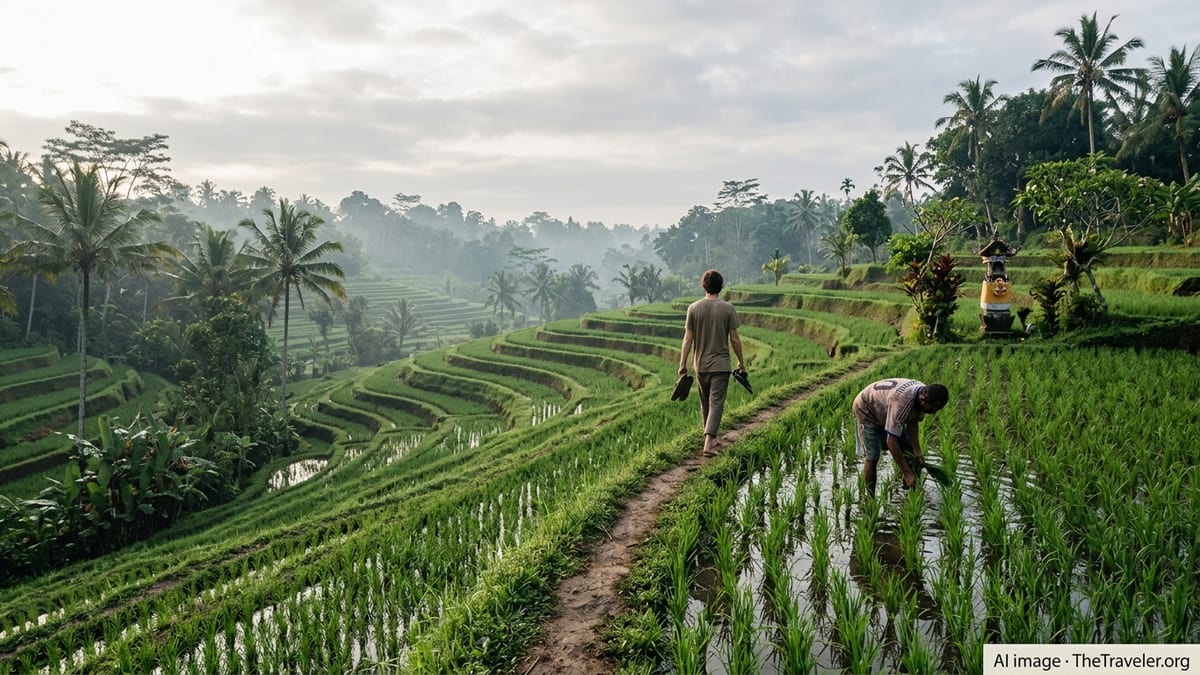
Ten minutes later, I was on a narrow dirt path between paddies, sandals sinking slightly with each step, frogs still chattering from the storm. The air smelled of wet earth and young rice. A farmer in a faded football jersey lifted his hand in greeting, more curious than weary at the sight of a visitor without a tripod. I reached the tiny family shrine just as the clouds began to thin, revealing a soft, diffused sunrise that turned the water in the terraces into sheets of dull silver.
I did not take many photos. The light was flat, and there was no dramatic volcano silhouette. But it was the first morning on the island when I felt fully present. I watched a woman in a conical hat place offerings of flowers and rice at the shrine. I listened to the low, rhythmic thud of someone pounding spices in a mortar in a nearby kitchen. When I did pull out my phone, it was mostly to jot down sensory details that I did not want to forget rather than to frame the perfect shot.
Money, Value, and the Cost of Chasing the Feed
Following the hype is not just an emotional gamble; it is a financial one. In hyper-famous destinations, prices often reflect what people will pay for a coveted image rather than the real value of what is on offer. In Bali, that meant cafes in Canggu charging nearly Western prices for smoothie bowls and lattes in exchange for a seat under neon signs and wings painted on walls. In the Maldives, recent reports note that taxes and fees on visitors have climbed sharply, making those iconic overwater bungalows an even pricier proposition than before, especially when you factor in mandatory transfer costs and resort markups on basics like meals and excursions.
On the ground, you feel it when a simple experience acquires a “content premium.” At a beach club near Canggu, a daybed that included pool access and a “curated photo spot” facing the sunset cost more than my guesthouse room for a night. Meanwhile, a local warung a few streets inland served a plate of nasi campur for a fraction of the price, with no sand-colored beanbags or drone platforms in sight. The food at the warung was better, the conversation with the owner more genuine, and yet one establishment would trend on social media while the other quietly fed its neighbors.
It is not that splurging is wrong. A rooftop bar in New York’s Midtown or a glass of wine on Santorini’s caldera can feel worth every dollar when the view and the company align. The trouble comes when we stack too many of these high-priced, low-substance experiences into a single trip, banking on the promise that our photos will somehow justify the cost. Often, the meals and moments that stay with us are the ones without a price tag attached to a view.
How to Travel in a World Built for the Camera
By the end of my Bali trip, I had not sworn off famous places. I still visited Tegallalang, Uluwatu Temple, and even a couple of those much-maligned beach clubs. What changed was how I approached them. I stopped expecting iconic sites to deliver solitude, stopped measuring days in “must see” boxes ticked off, and started treating social media images as mood boards rather than blueprints.
In practice, that meant skewing my schedule. Instead of joining the pre-dawn convoy to Lempuyang, I visited less-publicized temples in the late afternoon, when group tours had thinned out and the air cooled. When a cafe marketed itself as “most Instagrammable,” I checked its menu and prices the same way I would at home, asking whether I would still come if nobody ever saw the latte art. I used the comment sections below viral posts for practical intel: which days felt unbearable, whether a hike required real fitness or just patience in a queue, and if there were nearby alternatives that locals loved but did not label as content.
Most importantly, I began building time into my itineraries for wandering with no clear outcome. In Bali, that looked like renting a scooter and turning off the main road when I saw a village ceremony in progress, staying respectfully on the edge but watching long enough to feel the rhythm of everyday life. In Prague, it meant crossing the Charles Bridge once for the view, then spending the rest of the day in neighborhoods like Vinohrady and Holešovice, where bakeries, parks, and corner pubs outnumbered souvenir shops.
You cannot completely escape the gravitational pull of hype in 2026. Algorithms will continue to reward the same sunsets from the same rooftops. But you can decide that the value of your trip lies less in how it looks in a grid and more in how it feels while you are there.
The Takeaway
Following the hype to an Instagram-famous spot taught me less about Bali than it did about myself. I learned how easily expectation can sour an objectively good experience, how a beautiful place can feel strangely empty when it has been engineered too carefully for the camera, and how quickly costs creep up when every view comes packaged as a product.
Yet I also learned that the solution is not to reject popular destinations outright. The rice terraces are still beautiful. Santorini’s cliffs are still dramatic. Times Square, on a cold December night when snow starts to fall between the billboards, can still feel like the glowing heart of a city. The key is to arrive with realistic expectations, to diversify what you see and where you spend your money, and to leave room for unscripted encounters that no viral post could have planned for you.
In the end, the photo that means the most to me from that trip is not the one on the swing. It is a slightly crooked shot of a farmer walking home at dusk along a narrow dike, sky the color of cooling embers, sandals dangling from his hand. It is not perfect. It has no geotag. But every time I see it, I remember the soft squelch of the path under my feet and the faint ringing of a gamelan carried up from the village. That, more than anything I chased, feels like the real thing.
FAQ
Q1. Are famous Instagram spots like Bali’s swings still worth visiting?
They can be fun if you treat them like lighthearted attractions rather than spiritual experiences, and if you accept the crowds, queues, and staged nature of the photos.
Q2. How can I avoid feeling disappointed by overhyped destinations?
Lower your expectations, plan visits for off-peak times, mix big-name sights with low-key local places, and focus on experiences rather than recreating specific photos.
Q3. What are some red flags that a place is more about photos than substance?
Multiple “photo packages,” dress rentals, high fees for short visits, and marketing that emphasizes how a place looks rather than what you can actually do or learn there.
Q4. Is it better to skip famous attractions entirely?
Not necessarily. Iconic sites are iconic for a reason, but you might enjoy them more as a brief stop in a wider day that also includes quieter streets, markets, or neighborhoods.
Q5. How do I find less-hyped alternatives near crowded hotspots?
Ask locals, read recent traveler comments, and look just beyond the most geotagged area on a map for similar landscapes, viewpoints, or villages with fewer tour buses.
Q6. Do social media photos usually exaggerate how beautiful a place is?
Often they do. Heavy editing, selective angles, and cropping out crowds can create an idealized version of reality that no real-time visit can fully match.
Q7. Are prices higher at viral locations than elsewhere nearby?
Very often. Businesses know visitors will pay more for a “bucket list” shot, so compare costs with nearby cafes, guesthouses, or tours that are not marketed as iconic.
Q8. What mindset helps most when visiting a hyped spot?
Curiosity instead of entitlement. Go to observe how the place really functions now, not to demand the exact scene you saw online, and be open to mixed feelings.
Q9. How can I still use Instagram or TikTok without letting them dictate my trip?
Use them as inspiration, then build your own plan from guidebooks, local blogs, and conversations. Let apps suggest ideas, not itineraries written hour by hour.
Q10. What should I prioritize if I have limited time in a famous destination?
Choose one or two iconic sights you truly care about, then spend the rest of your time walking, eating where locals eat, and noticing everyday life beyond the camera zones.