

More news on this day
Travelers flying between India and Europe are facing some of the highest ticket prices on record as IndiGo joins Air India and major US carriers in sharply increasing fuel-related charges in response to surging jet fuel costs and disrupted flight routes.
Get the latest news straight to your inbox!
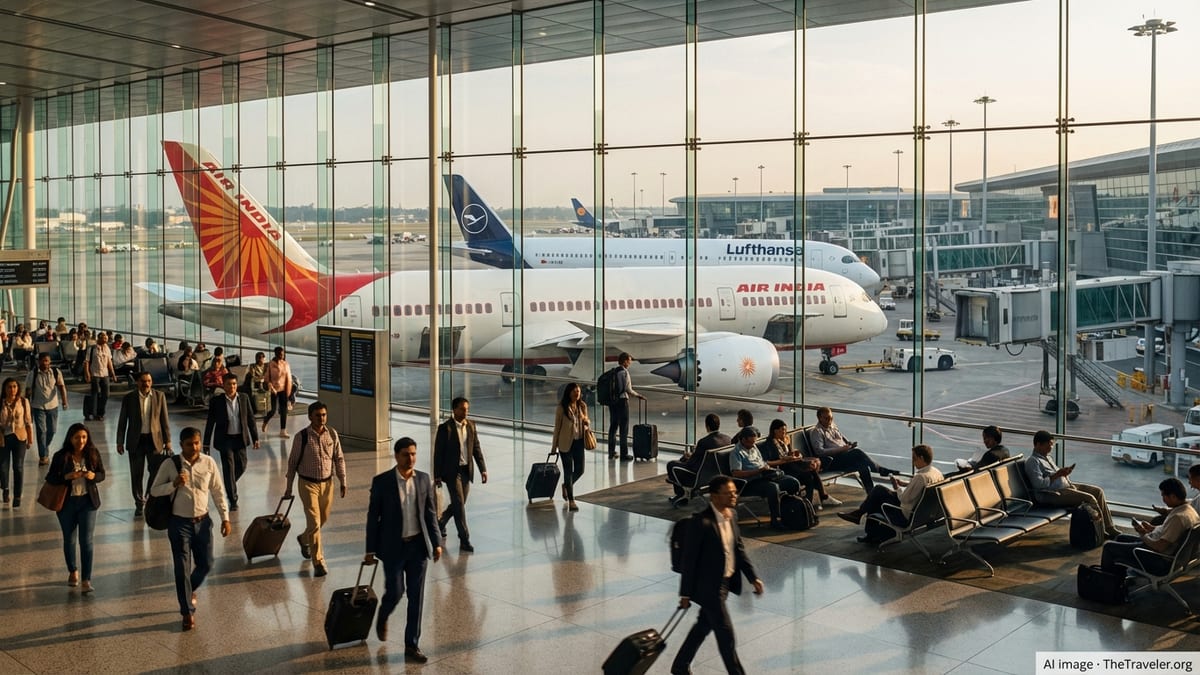
IndiGo Adds Sector-Based Fuel Charge On Europe Routes
India’s largest carrier by market share, IndiGo, has rolled out a dedicated fuel charge across its network that significantly increases the cost of long-haul international travel, particularly to Europe. Publicly available fare information shows that from mid-March 2026 the airline began applying a separate fee on all new bookings, citing a sharp rise in aviation turbine fuel prices linked to geopolitical tensions in West Asia.
On international routes, IndiGo has adopted a distance-based slab structure. Reports indicate that passengers flying to the United Kingdom and mainland Europe now pay an additional fuel charge of up to ₹10,000 per sector on some itineraries after a subsequent revision at the start of April, compared with an initial surcharge of about ₹2,300 when the fee was first introduced. The highest band now applies to long-haul flights such as Delhi or Mumbai to London, Paris, Frankfurt and other major European hubs.
For travelers, the practical effect is that headline base fares may appear unchanged or only modestly higher, while the all-in ticket price at checkout jumps sharply once the fuel line item is included. Travel industry trackers note that IndiGo’s move brings its pricing mechanics closer to legacy carriers that have long relied on separate fuel or carrier-imposed surcharges to manage volatility in operating costs.
Air India Escalates Long-Haul Surcharges To Europe
Air India has already begun a phased rollout of higher fuel surcharges on both domestic and international services, a change that is now feeding into fare searches for summer departures to Europe. According to information published in the airline’s recent surcharge matrix and summarized by Indian business media, new distance-based fees for long-haul flights come into effect from early to mid-April 2026.
On routes from India to Europe, including the United Kingdom, current schedules and pricing tables indicate a surcharge of roughly 200 US dollars per passenger per sector, translating into nearly ₹19,000 at prevailing exchange rates. The increases are layered on top of existing base fares and airport taxes, pushing up the total cost of a return ticket to key destinations such as London, Paris, Amsterdam and Milan by several tens of thousands of rupees.
Air India has framed the change as a response to fuel’s outsized role in airline economics, estimating that aviation turbine fuel can account for close to 40 percent of its operating costs. Analysts note that the airline is also contending with elevated taxes on jet fuel within India, which compound the impact of global oil price spikes and make it harder for full-service carriers to absorb cost shocks without passing at least some of the burden on to passengers.
US Giants United And Delta Add Cost Pressure At The Other End
While IndiGo and Air India are adjusting surcharges in India, large US carriers that connect Europe and North America are also raising fuel-related charges and ancillary fees as jet fuel prices climb. Recent coverage of United Airlines and Delta Air Lines shows both carriers increasing checked baggage fees and other add-ons in early April 2026, explicitly linking the changes to higher fuel bills caused by the conflict in the Middle East and resulting oil market disruption.
For travelers originating in India and connecting onward to the United States via Europe, these developments stack together. A passenger might pay a substantial fuel surcharge on the India to Europe leg with Air India or IndiGo, and then encounter higher baggage fees or carrier-imposed surcharges on a transatlantic segment operated by United or Delta. Although these US carriers have not introduced India-specific fuel surcharges, their broader fee hikes contribute to record end-to-end journey costs when itineraries are priced as through tickets.
Global travel analysts point out that long-haul passengers are particularly exposed because they cross multiple pricing zones and regulatory regimes. As each airline on a multi-stop itinerary recalibrates its own fees to reflect fuel prices, the compounded effect at checkout can be far greater than any single increase might suggest.
Fuel Prices, War And Airspace Restrictions Drive Costs Higher
The latest surcharge wave is unfolding at a time when global jet fuel prices have surged by well over 80 percent since the outbreak of the current conflict involving Iran and other Middle East actors, according to international energy market reporting. Disruptions to crude supply and refiners’ higher input costs have quickly filtered into aviation turbine fuel pricing, leaving airlines across regions scrambling to protect margins.
Carriers flying between India and Europe also face additional structural headwinds. Extended routings around restricted Pakistani airspace and other security-related no-fly zones have increased block times on many westbound flights from northern India, pushing up fuel burn and crew costs. Airlines are effectively paying more to operate the same routes, with few options to offset the impact other than raising surcharges or cutting capacity.
Industry commentary in travel and business publications highlights that these pressures are arriving just as fare caps imposed during India’s 2025 operational crisis have been lifted, giving airlines more latitude to pass through cost spikes. The combination of decontrolled pricing, elevated fuel, and longer routes has created a perfect storm for India–Europe ticket prices.
What Travelers From India To Europe Are Paying Now
For outbound travelers planning trips from India to Europe for the upcoming peak travel season, the immediate impact is visible in booking engines. Comparisons compiled by consumer finance and travel outlets show that the new fuel surcharges alone can add between ₹4,000 and more than ₹20,000 to the price of a return ticket, depending on the carrier, routing and date of purchase.
A typical economy-class return fare from Delhi or Mumbai to major European cities that might have been available in the ₹55,000 to ₹65,000 range before the current fuel spike is now often pricing closer to or above ₹80,000 on popular dates, particularly on non-stop or one-stop itineraries. In some cases, travelers report that the fuel surcharge component on a long-haul ticket is approaching, or even exceeding, the advertised base fare.
Travel experts advise that passengers scrutinize the fare breakdown when shopping for tickets, paying close attention to carrier-imposed charges in addition to government taxes and airport fees. With IndiGo, Air India, United and Delta all adjusting their structures in response to the same underlying cost shock, opportunities to avoid higher charges by switching airlines are limited, and the India–Europe corridor is emerging as one of the clearest examples of how quickly surcharges can reshape the real cost of flying.