

More news on this day
Indonesia’s second and final Airbus A400M military transport aircraft has reached the country after a delivery flight that was rerouted around parts of the Middle East, highlighting how regional airspace tensions are reshaping long-haul ferry routes even for state-owned aircraft.
Get the latest news straight to your inbox!
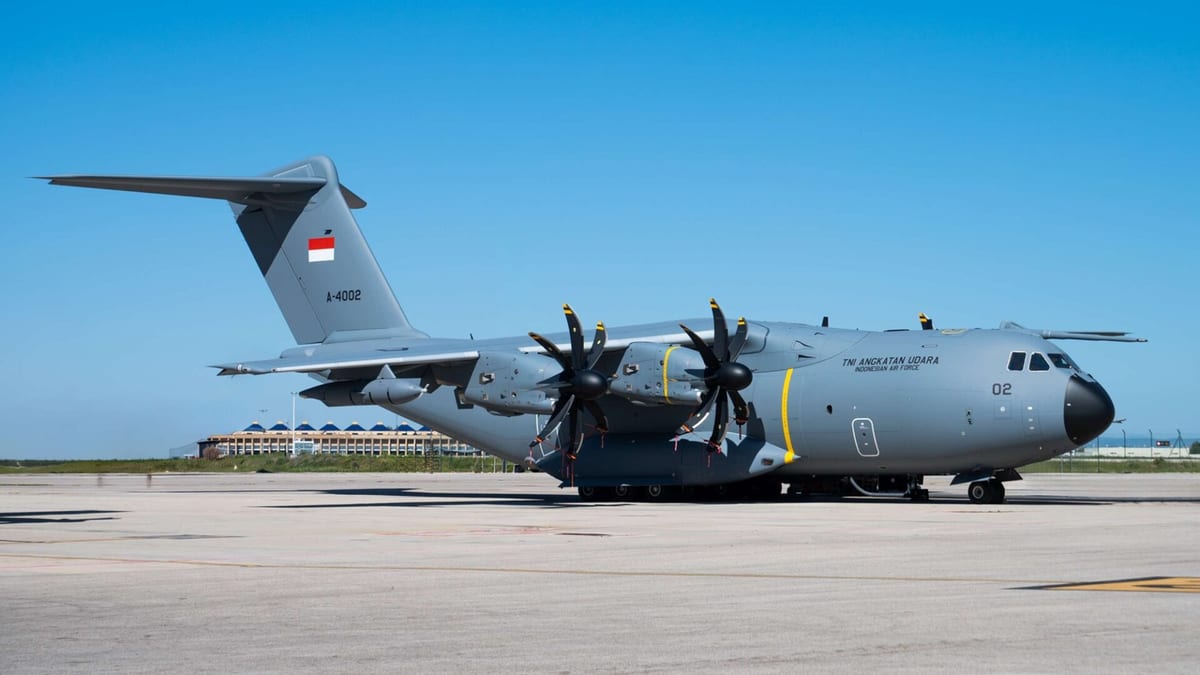
Image by AeroTime
Final A400M Touches Down in Indonesia
Publicly available delivery data and recent aviation tracking suggest the latest A400M for the Indonesian Air Force completed its ferry flight from Airbus’s final assembly site in Seville to Indonesia in late March 2026, closing a small but symbolically important order for two aircraft. The first A400M arrived in November 2025, and Airbus had signaled at the time that the second unit was scheduled for delivery in 2026, a timeline that has now been met despite increasingly complex routing across Eurasia.
The A400M is entering service with the Indonesian Air Force as a strategic airlifter and potential aerial refueling platform, sitting above the country’s existing C-130 Hercules fleet in payload and range. The aircraft is expected to support missions ranging from humanitarian relief and medical evacuation to heavy equipment transport across the sprawling Indonesian archipelago and beyond.
The handover of the second aircraft means Indonesia becomes one of the few Asia Pacific states to operate the European-built airlifter, joining established A400M users in Europe and neighboring Malaysia. The completed pair gives Jakarta a modest but flexible heavy-lift capability as it modernizes its air force with new transports and fighter jets.
Rerouted Ferry Flight Around Middle East Airspace
The delivery flight that brought the final A400M to Indonesia did not take the most direct great-circle route across the Middle East, according to flight-tracking snapshots and route reconstructions shared by aviation enthusiasts. Instead, the aircraft followed a more southerly and westerly path, skirting areas affected by recent military escalation and widespread civil aviation disruption.
Over recent weeks, thousands of commercial flights have been canceled or diverted as conflicts and heightened security concerns temporarily reshaped the airspace map across Iran, Iraq, Israel, and parts of the Gulf region. Airlines have increasingly funneled long-haul services either over Egypt and the Red Sea or along more northerly corridors, trading flight time and operating cost for perceived safety margins.
In that context, the A400M’s ferry flight appears to have mirrored the broader industry trend, threading a path that avoided several of the most volatile flight information regions. While military transports are not bound by the same commercial route economics, planners typically weigh similar risk assessments, and the chosen track for Indonesia’s new aircraft reflects those calculations.
Global Flight Disruptions Ripple Into Military Deliveries
The need to reroute Indonesia’s A400M highlights how geopolitical shocks in the Middle East are no longer only a problem for commercial airlines and tourists but also for government and military operators moving high-value assets across continents. Military deliveries, training deployments, and logistics runs now face the same patchwork of temporary restrictions, rerouting advisories, and insurance considerations that have defined commercial operations since early March 2026.
Aviation analytics firms have reported tens of thousands of flight cancellations and diversions across the region as carriers reconfigured schedules or avoided affected airspace entirely. Detours have added hours to some long-haul journeys between Europe and Asia, increasing fuel burn and complicating crew rostering. For specialized flights like an A400M delivery, the impact is counted less in passenger inconvenience and more in planning complexity, tanker support, and the sequencing of training and induction once the aircraft arrives.
For Indonesia, the successful completion of the delivery despite those constraints suggests a degree of resilience in the global ferry network for large aircraft. The episode also illustrates how even one-off strategic movements now depend on a rapidly shifting map of safe corridors, diplomatic clearances, and risk tolerances.
What the A400M Brings to Indonesia’s Airlift Network
With both A400Ms now on home soil, Indonesia gains a powerful new tool for regional and domestic mobility just as climate-related disasters and humanitarian emergencies place growing pressure on airlift capacity. The type is designed to operate from relatively short or semi-prepared runways, which is important for reaching remote islands and airfields that might be inaccessible to larger, more conventional strategic transports.
In practical terms, the aircraft can carry outsized cargo such as armored vehicles, engineering equipment, or bulk relief supplies, potentially reducing the number of sorties needed during major disaster responses. Its range also enables nonstop flights from Indonesia to key partners in Asia and the Pacific without refueling stops, which can be valuable when infrastructure is damaged or access is constrained.
Indonesia has signaled interest in using the A400M for aerial refueling and medical evacuation, roles that would further extend the country’s reach across its maritime domain. As doctrine, crews, and maintenance infrastructure mature, the combination of heavy lift, tactical flexibility, and interoperability with partners operating similar platforms could reshape how Jakarta plans regional deployments and humanitarian missions.
Regional Aviation Corridors in Flux
The timing of Indonesia’s final A400M arrival coincides with wider reconfigurations of aviation corridors linking Europe, the Middle East, and the Asia Pacific. Egypt’s airspace has emerged as a particularly important bridge between continents as airlines and operators route around parts of the Gulf and Iran, while other flows have shifted northward across Central Asia when conditions permit.
These evolving patterns have implications for travel and tourism to and from Southeast Asia. Longer routings can raise ticket prices, increase schedule volatility, and narrow the set of viable connection hubs for travelers heading to Indonesia’s main gateways such as Jakarta and Bali. They also create new opportunities for airports that sit on the safest and most efficient alternative corridors, which may benefit from increased transit traffic and investment.
For Indonesia, the rerouted A400M delivery underscores how its own connectivity and security are tied to developments far beyond its borders. As the country continues to invest in new aircraft and airport infrastructure, planners must factor in not only domestic demand and regional tourism, but also the shifting geopolitical landscape that shapes the skies those aircraft will fly through.