


Innsbruck has quietly shifted from stopover city to full-scale winter base, helped by new air routes and value-focused platforms such as Priceline highlighting it as a trending European destination. With cable cars leaving almost from the old town, more than a dozen ski areas in easy reach, and city sights that fill non-ski days, it offers an unusual combination: serious alpine terrain without giving up urban comforts or budget control.
Get the latest updates straight to your inbox!
Why Innsbruck Is Trending Now
Travel trend reports from major booking platforms, including Priceline’s recent focus on secondary European cities, have pushed Innsbruck into the spotlight as a winter base where lodging costs are often lower than in big-name resorts for comparable access to snow. Rather than committing to a single ski area, visitors can sleep in the city, use regional ski buses, and choose among local mountains like Nordkette, Patscherkofel, Axamer Lizum, Kühtai, or the Stubai Valley according to weather and skill level.
Innsbruck’s setting is its biggest selling point. The compact medieval core sits in a valley at around 575 meters, ringed by peaks that rise to more than 2,200 meters directly above the rooftops. A modern funicular and cable car route climbs from the edge of the old town to Hafelekar on the Nordkette ridge at about 2,256 meters in roughly 20 minutes, which means it is entirely realistic to be strolling past the Golden Roof one hour and standing in snow with a full city panorama the next.
For winter travelers weighing up where their money goes further, Innsbruck often compares well with purpose-built resorts. A standard city hotel or apartment can cost noticeably less per night than slopeside options in nearby Tyrol hotspots, and because the airport, main station, and city center sit close together, transfers are short and inexpensive. The ability to mix city sightseeing, après options that are not limited to a handful of mountain bars, and flexible ski plans makes the city particularly attractive for mixed groups and long weekends.
Another reason Innsbruck is trending is predictability of access. The airport hosts seasonal flights from several European hubs in winter, and the city anchors international rail routes from Munich, Zurich, and Italy. Once in town, the public transport system and guest cards take over much of the hassle, which is important for travelers looking to keep added “resort fees” and transfer costs in check.
Understanding Ski Access From the City
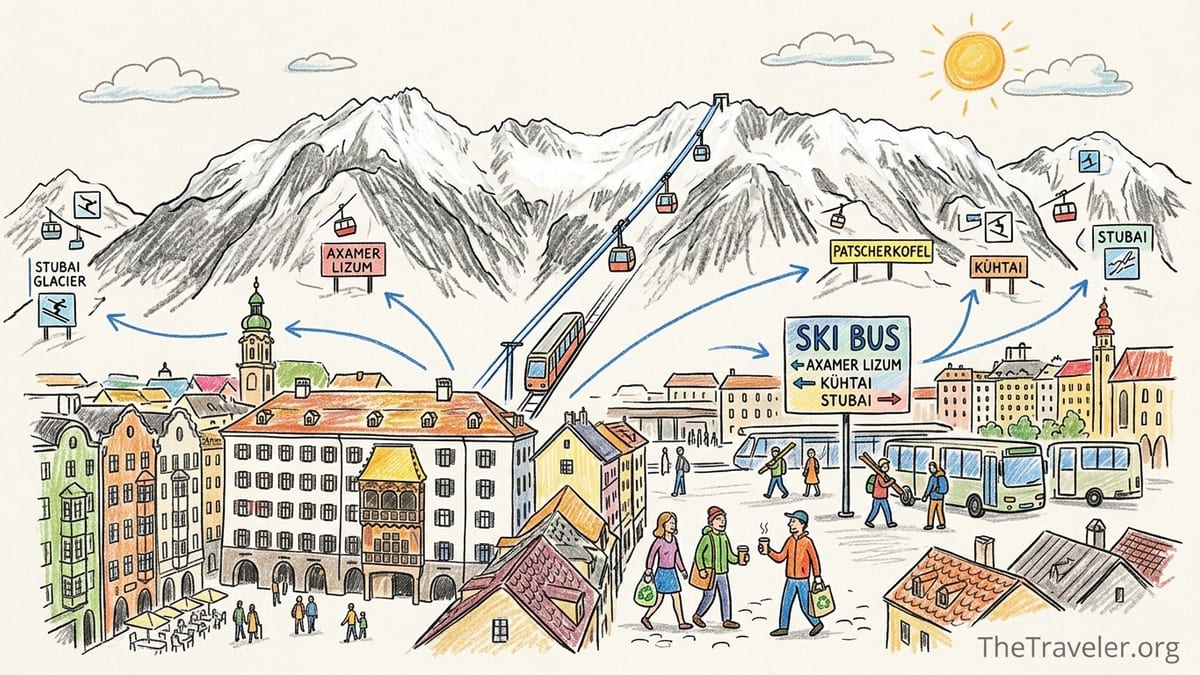
Unlike a traditional single-resort village, Innsbruck acts as a hub for multiple ski areas spread across the region. From town, you can reach steep north-facing freeride runs on Nordkette, Olympic history on Patscherkofel, broad intermediate pistes in Axamer Lizum, or high-altitude snow on Stubai Glacier, all using a combination of trams, regional buses, and dedicated ski buses. This hub model is part of what allows travelers to chase the best snow or visibility each day rather than being tied to one mountain.
The signature example of this easy access is the Nordkette chain above the city. A designer funicular, the Hungerburgbahn, climbs from near the river to the Hungerburg district, where gondolas continue via Seegrube up to Hafelekar on the ridge. Official tourism information notes that the full journey from downtown station to the high alpine terrain takes around 20 minutes, which is unusually short for a 1,700-meter vertical gain. For experienced skiers and snowboarders, this produces some of the steepest lift-accessed terrain directly above a European city; for non-skiers, it is a straightforward sightseeing ride.
Other ski areas involve simple bus journeys. Patscherkofel, on the opposite side of the valley, is connected by a city tram route and local buses that leave from the center. Axamer Lizum, popular with intermediates and known from the 1964 and 1976 Winter Olympics, sits about 20 kilometers outside town and is linked by regional ski buses that run in winter according to a published timetable. Travelers usually board at or near the main station and arrive at the base area in around 40 minutes, depending on traffic and stops.
Even the glacier options work within a day-trip framework. The Stubai Glacier, one of Austria’s largest glacial ski areas, is typically reached by a regional bus line from Innsbruck that climbs through the Stubai Valley to the cable car base. The ride often takes about 75 to 90 minutes. Skiers wanting flexibility sometimes rent a car to reach Stubai or Kühtai on their own schedule, but for visitors trying to keep total winter costs down, using the integrated bus network and guest card benefits tends to be more economical.
Cable Cars, Lift Passes and Realistic Winter Costs
The cable cars and lift passes that underpin an Innsbruck ski trip are a significant part of any winter budget, and official tariffs show meaningful cost differences between sightseeing and full ski days. For the headline Nordkette ride, current information from ticket platforms and local guides in late 2026 indicates that a return “Top of Innsbruck” ticket from the city to Hafelekar is around 56 euros per adult, with child tickets priced a little over half that amount. This fare is aimed at sightseers and day visitors and does not include a broader region pass.
On the skiing side, independent snow and lift-pass aggregators that collect resort data report that recent daily adult ski pass prices in the Innsbruck region vary across mountains. For example, published tables for the 2026–2027 season indicate that an adult day ticket at Axamer Lizum is listed in the low 60-euro range, while Nordkette and Patscherkofel day passes are commonly priced slightly lower or higher depending on the period. Multi-day passes trend upwards from there, with six-day adult tickets in larger Tyrolean areas often approaching or exceeding the high 300 to low 400-euro range. These figures can change by year, and travelers should always check the current season’s tariff before committing.
For visitors interested in combining multiple ski areas with city attractions, the region promotes bundled products such as the SKI plus CITY pass for Innsbruck and Stubai. Official descriptions note that this pass includes several ski resorts around the city along with entry to selected attractions in town. Prices for such combination passes are usually set by season and age category, and while they often look expensive at first glance, they can reduce the per-day cost significantly if you plan a week with several ski days plus visits to sites like the Bergisel ski jump or Ambras Castle. Travelers who only intend to ski one or two days, however, may find individual resort tickets better value.
Cable cars and mountain lifts also play a role outside full ski days. Many winter visitors buy cheaper point-to-point tickets for shorter sections, for example just taking the Hungerburg funicular to reach the Alpine Zoo or viewpoints above the city. Recent local ticket guides list under-20-euro prices for some urban attractions and funicular-only rides, which can make a half-day on the mountain plus an afternoon museum visit affordable even for non-skiers. Budget-conscious travelers often mix one or two premium ascent days to Hafelekar with several lower-cost outings that still deliver strong views.
Guest Cards, Public Transport and How to Keep Costs Down
One of the most powerful tools for managing winter expenses in Innsbruck is the regional guest card system. The free Welcome Card is issued to travelers who stay a minimum number of nights at participating accommodations in the Innsbruck region; current tourism information states that from two nights you typically qualify for the standard Welcome Card, while extended stays or selected hotels may offer an upgraded version. The card functions as a public transport ticket for buses, trams, and regional trains within the Innsbruck area for the length of your stay.
Official tourism sources highlight that the Welcome Card covers not only urban routes but also designated ski buses in winter. This means that a family staying in a Welcome Card partner hotel can often travel at no extra cost from the city center to ski areas such as Axamer Lizum, Kühtai, Muttereralm, or Rangger Köpfl using scheduled ski bus lines. Published ski bus posters for the 2024–2025 and 2025–2026 winters detail specific routes and validity periods, for example noting lines from Innsbruck to Kühtai and Axamer Lizum that operate until late April, with Welcome Card holders riding without buying a separate ticket during the winter season.
Beyond the Welcome Card, two paid products deserve attention for city and mountain combinations. The Innsbruck Card offers a set period of validity that includes entry to major sights plus public transport and selected mountain lifts. Recent summaries describe it as including over twenty attractions, at least two mountain lift rides, city transport, the hop-on hop-off sightseeing bus, and a limited number of hours of city bike rental, all bundled in one price. For travelers planning an intensive 24 to 72 hours of sightseeing with perhaps a single Nordkette ascent, this card can be more economical than paying each entry individually.
To keep winter costs predictable, it helps to sketch out a rough plan before choosing between the free Welcome Card and paid bundles. A couple visiting primarily to ski might prioritize a SKI plus CITY pass plus the free Welcome Card transport benefits. A group of friends interested in nightlife, museums, and perhaps one high-alpine excursion may do better with regular city accommodation that includes the Welcome Card plus a 24- or 48-hour Innsbruck Card to cover major entries. Because official card descriptions and inclusion lists are updated yearly, checking the current benefits and calculating the value based on your exact plans is more reliable than assuming last season’s structure still applies.
Choosing the Right Ski Areas Around Innsbruck
Innsbruck’s satellite ski areas each have a distinct character, which matters for matching terrain, crowds, and budget. Nordkette, towering above the city, is famous for its advanced and freeride terrain. Its steep north-facing slopes and off-piste routes are impressive but can be challenging and avalanche-prone, which makes it more suitable for experienced skiers than for beginners. For many visitors, Nordkette is as much about the view from Seegrube and Hafelekar as it is about the skiing itself.
Patscherkofel, south of the city, offers gentler slopes and a strong Olympic heritage as the venue for downhills in 1964 and 1976. Modern upgrades to the lift system have improved access, and its long, tree-lined pistes appeal to intermediates and cautious skiers. Because it is close to town and reachable by tram and local buses, Patscherkofel can be a cost-effective option for half-day outings, especially for families or those learning to ski who do not necessarily need a full big-mountain experience.
Axamer Lizum sits slightly farther out but is a favorite for many visiting skiers because of its variety of red and black runs, snow reliability due to altitude, and a compact base area. Independent ski industry sources list around 40 kilometers of pistes there, served by a mix of chairlifts and a cable car, which is enough for a satisfying full day without feeling repetitive. Day ticket prices, as noted in regional pass tables, place Axamer Lizum in the mid-range for Tyrol, making it a strong choice for those balancing cost with terrain variety.
Higher and more snow-sure still are options like Kühtai, Austria’s highest altitude resort village at over 2,000 meters, and especially the Stubai Glacier, which reaches up toward 3,000 meters. These areas command somewhat higher pass prices and longer travel times from Innsbruck but reward committed skiers and snowboarders with long seasons and broad glacier pistes. Many Innsbruck visitors choose a mixed strategy: a couple of lower-cost days close to town at Patscherkofel or Muttereralm, then a splurge day on the glacier when the weather is clear, using the Welcome Card or regional buses to minimize extra transport costs.
Balancing Ski Days With a City Break
One of Innsbruck’s strongest advantages over standalone resorts is the ability to switch easily between mountain and city days. In poor weather or whiteout conditions that close higher lifts, travelers can spend time exploring the medieval alleyways around the Golden Roof, visiting the Imperial Palace, or touring the Hofkirche with its striking Renaissance monuments. Recent price lists compiled by local guide services put indoor attractions such as the City Tower at under 5 euros, the Court Church under 10 euros, and major museums and castles between about 12 and 16 euros per adult, which is considerably less than the cost of a wasted ski pass on a stormy day.
Even within a single day, it is practical to blend both worlds. A skier might take an early tram to Patscherkofel, ski until mid-afternoon, then return to stroll along Maria-Theresien-Strasse, stopping for a coffee at one of the many cafés or sampling Tyrolean dishes such as Kaspressknödel soup or Schlutzkrapfen at a traditional inn. Because lifts on nearby mountains are close enough to the city that you are typically back at your hotel by late afternoon, there is time for spa visits, shopping, or simply walking along the Inn river after skiing.
For couples or groups where not everyone wants to ski, the city break element becomes even more important. Non-skiers can ride the Hungerburg funicular for valley views, visit the Alpine Zoo, or take a guided walking tour of the old town while others head to the slopes. In the evening, everyone can regroup for dinner in the city center without the feeling that some members of the party have paid for ski infrastructure they are not using. This flexibility is a major reason why multi-generational families often find Innsbruck easier than committing to an isolated resort.
Nightlife in Innsbruck leans more towards bars, student pubs, and a handful of late-night venues rather than large-scale clubbing, reflective of its size as a university town. Prices in central bars are broadly in line with other mid-sized Austrian cities; a draft beer or a glass of house wine usually costs considerably less than equivalent drinks in major Alpine resorts with strong foreign demand. For budget-conscious travelers, stocking up at supermarkets or grabbing street food such as kebabs or pizza slices can keep evening costs manageable while still leaving room for a few nights out in more atmospheric spots.
Practical Planning Tips for a Value-Focused Innsbruck Stay
To get the most from an Innsbruck-based ski and city break, planning around a few practical points pays off. First, choose your accommodation with the Welcome Card in mind. Official lists from the Innsbruck tourism board show that hotels, guesthouses, and apartments in the region that participate in the scheme issue the card automatically for qualifying stays, which then unlocks free public transport and ski buses. Selecting one of these properties may mean a slightly higher nightly rate compared to a non-partner option, but it often saves money overall once you factor in daily bus tickets, especially for groups or families.
Second, clarify which lift pass strategy suits your itinerary. If you intend to ski almost every day for a week and visit several different mountains, it can be worth investigating regional passes such as the SKI plus CITY product covering multiple Innsbruck-area resorts and the Stubai Glacier, then comparing its price to buying day tickets. On the other hand, if you are planning only two or three ski days in between city sightseeing, buying individual mountain passes and perhaps a short-duration Innsbruck Card for museum and cable car access often comes out cheaper.
Third, pay attention to seasonal timing. Ski bus timetables, Welcome Card inclusions, and lift operating hours are all tied to specific winter periods, often running from early December to late March or April. Official ski bus posters, for example, explicitly state end dates for each route in April. Before booking non-refundable flights or accommodation, verify that the mountains you want to visit and the transport lines you intend to use will be running during your stay. Shoulder periods can be rewarding in terms of price and crowds but carry more risk of limited lifts or patchy snow at lower elevations.
Finally, remember that Innsbruck sits at a lower altitude than many neighboring resorts, so conditions on the valley floor can be mild even when the mountains are in full winter. Pack with layered clothing in mind, including waterproof outerwear and warm mid-layers for the slopes alongside lighter items for walking around town. For travelers arriving by air and looking to reduce baggage costs, renting equipment and even helmets in Innsbruck or at the ski areas is straightforward, with several rental shops operating close to the main station and in resort base areas. Checking online rental price ranges in advance can help you weigh the savings of bringing your own gear against airline sports baggage fees.
Conclusion: Who Innsbruck Works Best For
Innsbruck is not a traditional all-inclusive resort, and that is precisely its appeal. It works best for travelers who enjoy assembling their own mix of city and mountain experiences rather than staying inside a single large ski area. Those comfortable navigating buses, trams, and cable cars will find that the Welcome Card and regional passes can deliver a lot of skiing and sightseeing for a reasonable outlay, especially compared with marquee Alpine resorts.
For intermediate and advanced skiers who like variety, the region’s network of nearby ski areas offers enough terrain for a week or more, from steep freeride zones on Nordkette to rolling pistes on Patscherkofel and higher, more snow-sure days on glacier or high-altitude slopes. For couples and families, the ability to balance ski days with museum visits, café-hopping, and walks along the Inn makes it easier to keep everyone happy and the budget under control.
As Priceline and other travel platforms spotlight Innsbruck as a smart-value European winter city, demand is likely to increase for key dates such as Christmas, New Year, and school holidays. Booking early, choosing accommodation that includes the Welcome Card, and making a rough plan around which mountains and attractions you want to prioritize will help you lock in better rates and avoid surprises. In return, Innsbruck offers something rare: a genuine alpine city where world-class views, solid skiing, and manageable costs can still align in a single trip.