

More news on this day
As Boeing’s 777X inches toward a 2027 debut after years of delays, the world’s largest twin-engine jet is drawing fresh attention for what may matter most to travelers: a new cabin architecture designed to make long hours in the air feel less confining and more efficient for airlines to operate.
A Wider Fuselage and a Reworked Sense of Space
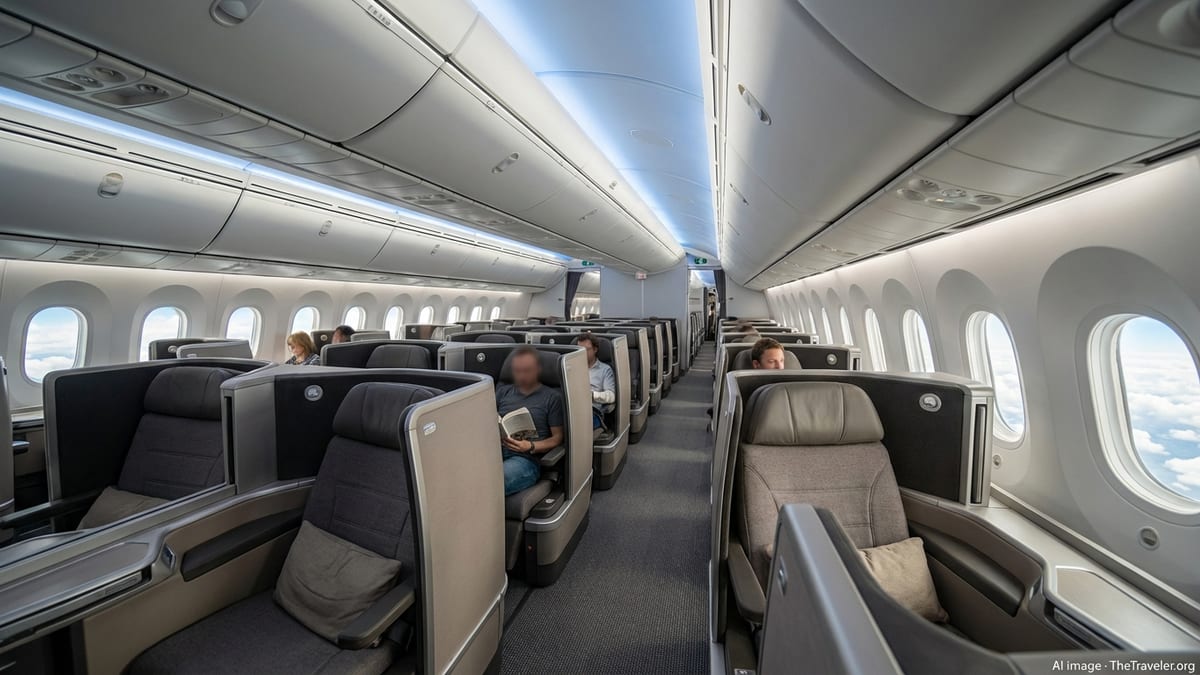
Central to the 777X story is an interior cross-section that has been subtly re-engineered rather than completely redesigned. By reshaping internal structural ribs and sidewalls, Boeing has created a cabin roughly 10 centimeters wider than today’s 777 without altering the jet’s external footprint. That modest-sounding gain translates into precious millimeters at shoulder level for every passenger, and more flexible layouts for airlines.
The additional width is being marketed as an enabler of more comfortable seating rather than simply more seats. In business class, that can support wider suites with higher doors and additional personal storage. In economy, the extra space gives carriers the option to specify slightly broader seats or marginally wider aisles that make boarding, service and movement through the cabin feel less congested on full long-haul flights.
Designers have also focused on the psychological perception of space. Cleaner sidewalls, slimmer ceiling contours and carefully hidden structural elements are intended to make the cabin feel less like a tube and more like a contemporary living space, continuing a design language first seen on the 787 and now scaled up for the larger 777X fuselage.
Larger Windows, Better Views and a Calmer Environment
The 777X continues Boeing’s shift toward larger, higher-mounted windows, with apertures around 20 percent bigger than those on the current 777. Positioned slightly higher on the fuselage, they are aligned so that a greater proportion of passengers have a direct line of sight to the horizon, which can reduce feelings of confinement on ultra-long flights. The larger panes also bring more natural light deep into the cabin, which airlines increasingly use as part of their mood-lighting strategies.
Borrowing from the 787’s environmental systems, the 777X cabin is designed to operate at a lower effective cabin altitude and higher relative humidity than previous generations. While exact figures will ultimately depend on airline settings and certification, the architecture supports pressure and humidity levels closer to those experienced on the Dreamliner. For travelers, that can translate into less dryness, reduced fatigue and a smaller perception of jet lag on flights stretching beyond 10 or 12 hours.
Noise reduction has been another priority. The combination of the GE9X engines, redesigned nacelles and updated insulation is expected to yield a quieter cabin than the current 777, particularly in the forward and mid-cabin zones where premium cabins are typically located. Along with multi-zone LED lighting and improved air distribution, Boeing is positioning the 777X interior as a calmer, more residential-feeling space compared with earlier widebodies.
New Doors, Entryways and Premium Cabin Possibilities
The 777X door and entry architecture has been revised to support more dramatic welcome areas and flexible premium layouts. Airlines are being offered concepts that turn the forward entry into a lounge-like zone, with sculpted sidewalls, arches and integrated display features that frame the transition from jet bridge to cabin. This is aimed squarely at carriers like Emirates, Qatar Airways and Lufthansa, which view the first impression on board as a key part of their long-haul brand.
Because of the jet’s immense floor area, airlines will have greater freedom to experiment with staggered seating, enclosed business suites and small social spaces without sacrificing density. Early design studies highlight the potential for spacious first-class suites with separate seating and sleeping zones, as well as business cabins that feel more like mini private offices than traditional recliners.
The door configuration and wider fuselage also support more generous galleys and preparation areas. That can improve the flow of service in premium cabins and, at the rear of the aircraft, help economy-class crews manage multiple meal waves on full flights. For travelers, the changes may manifest as faster service, fewer trolley bottlenecks in aisles and more discreet food preparation away from the main cabin sightlines.
Economy and High-Density Layouts in a Changing Market
Even as Boeing emphasizes comfort, the 777X is being developed in a market that still rewards seat efficiency. The new cabin architecture is optimized around a 10-abreast economy layout that airlines have widely adopted on the current 777, but the slightly wider cross-section gives operators more leeway in how that density is implemented. Some may choose marginally wider seats and narrower aisles, while others may prioritize faster boarding and wheelchair access with broader aisles.
Cabin monuments, such as lavatories and crew rest areas, have been repositioned and reshaped to reclaim space that was previously difficult to use. This can enable extra exit-row or bulkhead seats with more legroom, which airlines often monetize as a separate “preferred” category without major structural changes. For passengers, that could mean a greater variety of comfort tiers between standard economy and premium economy.
As ultra-long-haul routes proliferate, particularly between Europe, the Gulf and Asia-Pacific, carriers are expected to deploy the 777X on flights regularly exceeding 12 hours. The balance Boeing is trying to strike is an interior that allows airlines to maintain competitive seat counts while still selling a narrative of enhanced comfort. How carriers configure their cabins will ultimately determine whether travelers experience the 777X as roomier or simply more efficiently packed.
Efficiency, Certification Headwinds and What Travelers Can Expect Next
Behind the cabin story lies a wing and engine combination that is central to the 777X’s efficiency claims. The composite wing with folding wingtips, paired with GE9X engines, is expected to deliver around 20 percent better fuel burn per seat compared with earlier 777 variants, depending on configuration. That efficiency is what makes very long routes viable for airlines, and it underpins the investment in a more sophisticated interior product.
Progress toward service entry has been bumpy. After test-flight pauses in 2024 related to cracks in thrust link components and a series of certification challenges, Boeing resumed flights in January 2025 and later cleared key regulatory hurdles. The company and regulators now target first deliveries in 2027, seven years later than the original 2020 goal, as airlines adjust fleet plans and retrofit existing 777s and 787s to bridge the gap.
For travelers, the practical takeaway is that the 777X is moving closer to reality, but it remains a medium-term prospect. Boeing has recently signaled plans for the first flight of a production-standard 777X in 2026 for launch customer Lufthansa, a milestone that will bring real-world cabin photos and airline-specific layouts into view. Until then, the jet’s revolutionary cabin architecture exists mainly in detailed mock-ups and design studios, promising a new blend of comfort and efficiency that will be tested once the aircraft finally joins scheduled long-haul networks.