


Holiday Inn has quietly become one of the most familiar backdrops to modern travel. The green-and-white sign shows up on interstate exits, beside suburban business parks, and near theme parks and city centers around the world. For many families and business travelers, it promises a particular kind of trip: reliable midscale comfort, on-site dining, and a price that usually falls below full-service upscale brands but above bare-bones motels. Yet the reality on the ground can vary from resort-style pools and kids’ clubs to straightforward highway properties designed for one-night stopovers. Understanding the Holiday Inn experience, from family stays to business trips, can help you decide whether it fits your next journey and how to get the most value out of your booking.
Get the latest updates straight to your inbox!
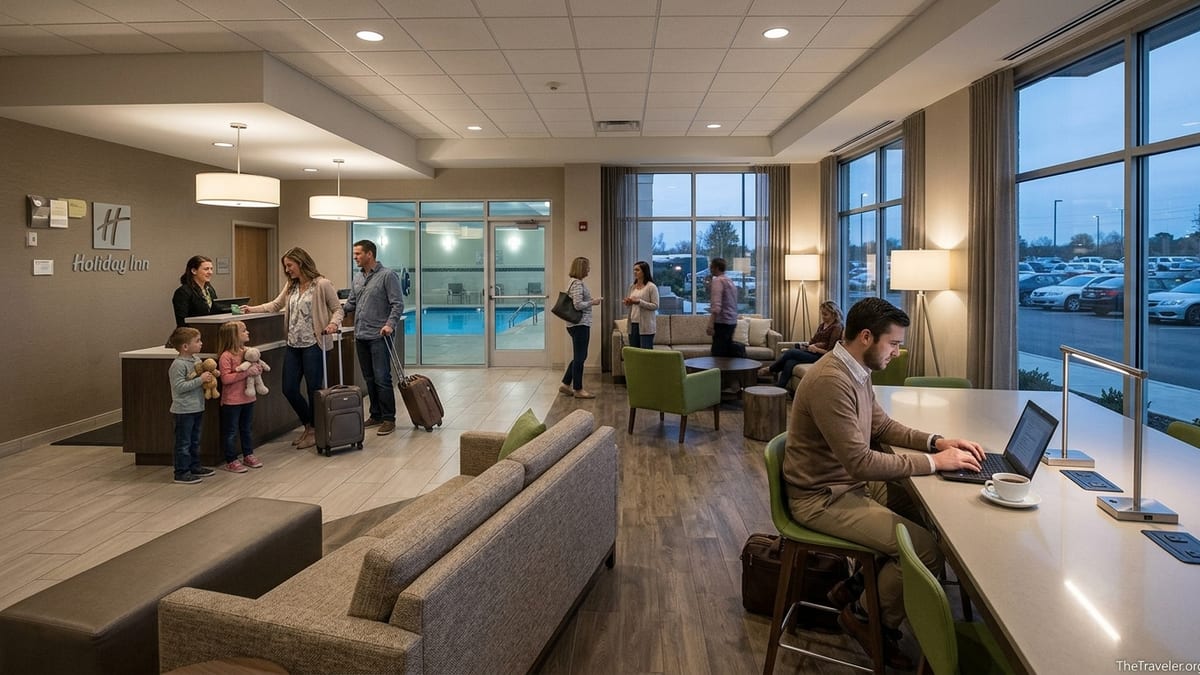
The Holiday Inn Brand in 2026
Holiday Inn is part of IHG Hotels & Resorts, the global group that also owns InterContinental, Kimpton, Holiday Inn Express, and other brands. Within that portfolio, Holiday Inn occupies the midscale, full-service segment aimed squarely at mainstream families and business travelers who want more than a bed and a grab-and-go breakfast, but do not need luxury touches. Many properties include a full-service restaurant and bar, meeting rooms, and a pool, which differentiates them from limited-service brands.
IHG’s own reporting indicates that the Holiday Inn brand family remains a core growth engine, accounting for a large share of new hotel openings and signings worldwide in 2024. That expansion shows up in practical ways for travelers: new-build Holiday Inns appearing in secondary US cities, expanding into European markets like Germany, and filling gaps in suburban office corridors where older independent hotels once stood. What you meet on the road today may be a decades-old convention property that has been renovated multiple times, or a crisp, contemporary building opened within the last few years.
For US travelers in 2026, Holiday Inn typically competes with brands like Hilton Garden Inn, Courtyard by Marriott, and Four Points. Nightly rates often track slightly below or roughly in line with these peers, depending on location and demand. On an average midweek night, a Holiday Inn near a major US airport might be priced around the high 100s to low 200s in dollars, while a suburban Holiday Inn an hour away could come in closer to the low 100s. Those numbers fluctuate with city, season, and major events, but they give a sense of where the brand sits against the wider market.
What Families Can Expect: Rooms, Pools, and Kids’ Perks
Holiday Inn’s reputation with families rests partly on its room layouts and partly on the extras that smooth multi-person stays. Standard guest rooms at a typical US Holiday Inn will usually feature either two queen beds or one king bed with a sleeper sofa. For example, at the Holiday Inn Winter Haven in Florida, near the LEGOLAND Florida Resort, families can book a room with two queen beds and a rollaway or portable crib if needed. Many similar properties in resort-adjacent areas follow this template, allowing parents and two children to sleep comfortably in one room without upgrading to a suite.
One of the biggest draws for parents is the brand’s “Kids Stay Free” and “Kids Eat Free” policies. In the Americas region, many Holiday Inns allow up to two children under a specified age threshold to stay free when sharing a room with two adults, subject to maximum room occupancy rules. At the restaurant, children 11 or under often eat free from a dedicated kids’ menu when dining with an adult who orders a main course. In real terms, that can mean breakfast and dinner for two kids at no added food cost during a long weekend, provided you eat in the hotel restaurant instead of heading out.
The details, however, vary by property, and they matter. At some hotels, the policy applies only in the main restaurant and not via room service or the lobby bar. Other properties cap the benefit at four children per dining family or require that kids order from a specific printed kids’ menu. A family staying at a Holiday Inn near a regional airport, for instance, may find a laminated kids’ menu with simple choices like pasta, grilled chicken, or burgers, and a clear notation that the meal is free with a paying adult. Another family at a downtown Holiday Inn might encounter a voucher system at check-in, where breakfast or kids’ meals are only complimentary if you receive and present a coupon. Checking the hotel’s specific fine print and asking at check-in helps avoid awkward surprises at the table.
Beyond beds and meals, pools and recreation can make or break the stay for children. Many Holiday Inns in warm-weather or vacation markets feature outdoor pools, sometimes with small splash areas or shaded lounging. At more business-oriented suburban sites, the pool may be an indoor rectangle primarily used by families unwinding after long drives. While you will not usually find water slides or extensive kids’ clubs outside of branded resorts and timeshare properties, it is common for front desk staff to provide board games, coloring kits, or local family activity recommendations, especially on weekends and school holidays.
Inside a Typical Family Stay: Real-World Scenarios
Consider a family of four driving from Atlanta to Orlando in early spring. Night one, they break their journey at a highway-side Holiday Inn in southern Georgia. The parents book a room with two queen beds for a single night at a rate around the low to mid 100s. Check-in takes a few minutes, the kids make a beeline for the indoor pool, and dinner happens in the hotel restaurant so that the adults do not have to get back in the car. Two kids order from the “Kids Eat Free” menu, the adults choose from a basic grill-style menu, and the entire meal feels familiar and low-stress after a day on the road.
Two nights later, the same family stays at a Holiday Inn near a major Orlando-area attraction. Here, the rate might be closer to the high 100s or more, especially during school breaks, but the trade-off is a larger outdoor pool, shuttle service to nearby parks, and a lobby full of other families. Breakfast could be a buffet with a mix of hot and cold items, sometimes included in a package rate and sometimes paid separately. For parents who want to avoid driving after long days in the parks, the presence of an on-site restaurant and bar becomes more important than in the highway stopover scenario.
Extended family trips illustrate another side of the brand. Holiday Inn Club Vacations, a related timeshare-style offering under the broader Holiday Inn umbrella, operates resort properties with villa-style accommodations that include kitchens, multiple bedrooms, and extensive amenities like lazy rivers and activity centers. A multi-generational group traveling to a beach resort might combine a villa at one of these properties with a traditional room or two at a nearby standard Holiday Inn, allowing grandparents and parents to enjoy kitchen and living room space while cousins rotate through shared pools and game rooms. While the booking model for Club Vacations differs from standard nightly stays, the overall atmosphere is intentionally family-focused.
In all of these scenarios, what families tend to value most is predictability. They know roughly what room types, amenities, and food options to expect when they see the Holiday Inn sign, even though decor and age of the building can vary. When comparing with independent motels or budget brands, the brand’s consistency, kids’ policies, and access to IHG One Rewards points often tip the scales in its favor for travelers who take family trips once or twice a year.
The Business Traveler’s Lens: Convenience, Connectivity, and Quiet
For business travelers, Holiday Inn fills a particular niche between budget-friendly roadside properties and higher-end full-service hotels. Many of the brand’s newer or renovated locations flank office parks, airports, and regional conference centers. Walk into a suburban Holiday Inn outside Phoenix or Dallas on a Tuesday night, and you are likely to see a lobby filled with laptop-toting guests in business casual attire, many of them on solo stays booked by corporate travel departments.
Room design in these locations reflects that audience. Standard king rooms often feature a decent-sized desk with accessible power outlets, an ergonomic-style chair, and good task lighting. Free Wi-Fi is standard. While speeds vary, many business travelers find them adequate for video calls and cloud-based work during normal evening hours. Some properties have co-working style lobby spaces with communal tables and individual booths, allowing guests to work outside their rooms between meetings.
On the food and beverage side, business-oriented Holiday Inns typically provide a full breakfast offering, either buffet or cooked-to-order, that can be added to the room rate or expensed separately. Dinner menus in the on-site restaurant may include familiar items like steaks, salads, and flatbreads, plus a small selection of local specialties. For someone flying into a city for a single client meeting, being able to land at the airport, check into a Holiday Inn within a short shuttle ride, and eat both dinner and breakfast on property can significantly cut logistical friction.
Meeting and event facilities are another key feature. A Holiday Inn near a highway interchange might host small corporate training sessions in a pair of divisible meeting rooms, while a city-fringe property could offer a ballroom that handles regional sales conferences or association events. In practice, that could look like a technology company booking 40 rooms for a two-day training, using a main meeting room for sessions, a breakout room for smaller groups, and in-house catering for coffee breaks and buffet lunches. For frequent planners, IHG Business Rewards, tied into the IHG One Rewards framework, allows them to earn points for those room blocks and events in addition to the individual traveler’s own points.
Maximizing Value with IHG One Rewards
Whether you travel with family or for work, understanding the IHG One Rewards program can unlock extra value from Holiday Inn stays. Members earn points on eligible room charges at Holiday Inn properties, with earning rates that increase at higher elite tiers. Frequent business travelers who spend much of their year in midscale hotels often find that they can reach mid- to upper-tier status, which brings benefits such as room upgrades when available, bonus points, late checkout requests, and in some cases a welcome amenity like points or a food and beverage credit.
For a concrete example, imagine a consultant who spends 40 nights per year at various Holiday Inns across the United States. By booking directly with IHG channels and attaching their IHG One Rewards number each time, they accumulate a significant balance of points over the course of a year. Those points might then be used to book a long weekend at a Holiday Inn near a national park, effectively turning work stays into a partially or fully covered family getaway. Exact point requirements fluctuate by property and date, but shorter weekend stays at midscale hotels are often within reach after a busy business travel season.
Families can benefit from the same ecosystem. A parent who travels several times a year for conferences could direct their stays to Holiday Inn and other IHG brands, then redeem those points for a summer vacation at a resort-focused Holiday Inn or for multiple shorter weekend trips. Occasional leisure travelers who do not chase elite status can still earn enough points for meaningful redemptions by combining paid stays with IHG promotions, partner credit cards, or bonus offers that periodically boost earnings.
It is important to factor in the trade-offs. Not all corporate or third-party bookings earn full points or elite night credit, and individual properties may have different approaches to recognizing elite benefits. Traveler reports suggest that some Holiday Inns are very proactive with upgrades and late checkouts for elites, while others stick strictly to availability and published minimums. If elite benefits are central to your plans, contacting the hotel ahead of arrival to confirm what they usually extend can help set realistic expectations.
Choosing the Right Holiday Inn for Your Trip
Because Holiday Inns span urban, suburban, airport, and resort settings, the specific property you pick matters more than the logo on the sign. Before booking, it helps to match the hotel’s profile to your trip’s purpose. Families heading to a theme park or beach town might prioritize properties labeled as resorts or those clearly advertising large pools, game rooms, or shuttle services. Business travelers, on the other hand, often focus on distance to offices or convention centers, airport shuttle options, and the presence of quiet floors or executive-style rooms.
Real-world pricing varies widely. A Holiday Inn in a major US city’s downtown core can easily sit above 250 dollars per night on busy evenings, similar to competing brands, especially around major events or festivals. By contrast, a Holiday Inn in a smaller Midwestern city near a highway junction might be available around 120 to 150 dollars on typical nights, occasionally dropping lower on weekends. In international markets, the same brand name may sit at different price points relative to local competitors, reflecting regional demand and currency effects.
Within individual markets, room categories are also worth a close look. Many Holiday Inns offer standard rooms plus a small number of junior suites or one-bedroom suites. For a family on a road trip, paying a moderate supplement for a suite that provides a separate living area can create space for children’s early bedtimes or remote work requirements for parents. For business travelers with longer stays, a room with a larger refrigerator, microwave, and extra storage can make a week on the road feel less transient.
Guest reviews, while subjective, provide practical insight into how each hotel operates day to day. Parents may focus on comments about noise levels, pool cleanliness, and how consistently the kids’ meal policies are honored. Business travelers often key in on Wi-Fi reliability, breakfast quality, and the responsiveness of front desk staff when handling early check-ins or late checkouts. Reading a cross-section of recent reviews can help distinguish between a newly renovated property humming along smoothly and one that is overdue for an update despite carrying the same brand name.
The Takeaway
Holiday Inn occupies a useful middle ground in today’s hotel landscape. For families, it offers a combination of familiar room layouts, on-site dining, and kid-friendly policies that can take some of the stress and cost out of travel, especially on multi-stop road trips or theme park vacations. For business travelers, it provides reliable workspaces, meeting facilities, and food and beverage options that support tight schedules without requiring a splurge on upscale hotels.
The key is to approach the brand with clear expectations and a bit of homework. Identify whether your chosen Holiday Inn leans more toward family resort, conference hub, or simple roadside stopover. Confirm how kids’ stay and eat policies work at that particular property. Consider the value of IHG One Rewards, especially if you spend significant time on the road. When you match the right Holiday Inn to the right trip, the experience tends to fade into the background in the best possible way: everything functions as expected, leaving you free to focus on family time, client meetings, or simply getting where you need to go.
FAQ
Q1. Are Holiday Inn hotels generally good for families with young children? Holiday Inn is often a strong choice for families because many properties offer rooms with two queen beds, pools, and kids’ policies that allow young children to stay and often eat free when sharing a room and dining with adults. The atmosphere is usually casual and tolerant of noise, which can be reassuring for parents traveling with toddlers or school-age kids.
Q2. How can I confirm if kids stay and eat free at a specific Holiday Inn? While many Holiday Inns follow brand-wide guidelines for kids staying and eating free, individual properties can set specific rules, such as age limits or voucher systems. The most reliable approach is to check the “offers” or “dining” section of the hotel’s own information page and then email or call the front desk before arrival to confirm exactly how the policy works for your dates.
Q3. What price range should I expect for a Holiday Inn room in the United States? In many US markets, typical nightly rates for a standard room at a Holiday Inn fall somewhere between about 120 and 220 dollars, depending on location, season, and demand. Downtown and airport properties in large cities tend to sit at the higher end of that range, while smaller-city and highway locations often fall near the lower or middle portion.
Q4. How does Holiday Inn compare to Holiday Inn Express for business travel? Holiday Inn is usually a full-service brand with a restaurant, bar, and meeting space, while Holiday Inn Express focuses on limited service with complimentary breakfast but no full restaurant. Business travelers who need on-site dining and larger meeting rooms often prefer Holiday Inn, whereas those who mainly want a clean room, breakfast, and Wi-Fi may gravitate toward Holiday Inn Express for simplicity.
Q5. Can I earn and use IHG One Rewards points when staying at Holiday Inn? Yes. Holiday Inn participates fully in the IHG One Rewards program, so eligible stays booked through IHG channels earn points and count toward elite status. You can later redeem points for reward nights at Holiday Inn and other IHG brands, subject to availability and dynamic pricing in points.
Q6. Are Holiday Inn hotels suitable for remote work during longer stays? Many Holiday Inns are workable bases for remote work, thanks to in-room desks, free Wi-Fi, and often additional seating in the lobby or restaurant during off-peak hours. For a week-long stay, it is wise to check photos or reviews to make sure rooms have a comfortable workspace and to ask about quieter floors if you plan on frequent calls or video meetings.
Q7. Do Holiday Inn properties offer airport shuttles for business travelers? Many Holiday Inns located near major airports do run regular shuttles, but it is not universal. Some charge a fee, restrict hours in the late night or early morning, or rely on shared third-party shuttles. When booking an early flight or late arrival, confirm shuttle availability, schedule, and cost directly with the hotel so you can plan ground transportation confidently.
Q8. What should I look for when booking a Holiday Inn for a conference or event? For meetings or events, focus on the size and layout of the hotel’s function rooms, available audiovisual support, and catering options. A property that regularly hosts local conferences will usually offer sample menus, room block rates, and an on-site coordinator. If attendees are flying in, proximity to the airport or rail station and the availability of group transportation can be decisive factors.
Q9. How far in advance should I book a Holiday Inn for peak family travel periods? During peak family travel periods such as summer holidays or major school breaks, booking a Holiday Inn near popular attractions several months in advance is prudent, especially for weekends. Early booking improves your chances of securing connecting rooms, suites, or specific bedding setups and often locks in more favorable rates before demand drives prices up.
Q10. Is Holiday Inn a good option for international travel outside the United States? Holiday Inn has a substantial international footprint, and in many countries it occupies a similar midscale position with familiar room standards. However, pricing and amenities can shift relative to local market norms. When traveling abroad, it is wise to review photos and recent guest feedback for that specific hotel so you understand how the property compares to regional competitors and local expectations.