

Staying connected in Greece in 2026 is easier than ever, but the quality of your experience will depend on how you choose to get online and where in the country you travel. From fast 5G in Athens to patchy coverage on tiny Aegean islands, visitors have a growing mix of WiFi, prepaid SIM, eSIM, and EU roaming options. This guide explains what to expect, how to choose the right data plan, and practical tips for working, streaming, or simply messaging your way around Greece.
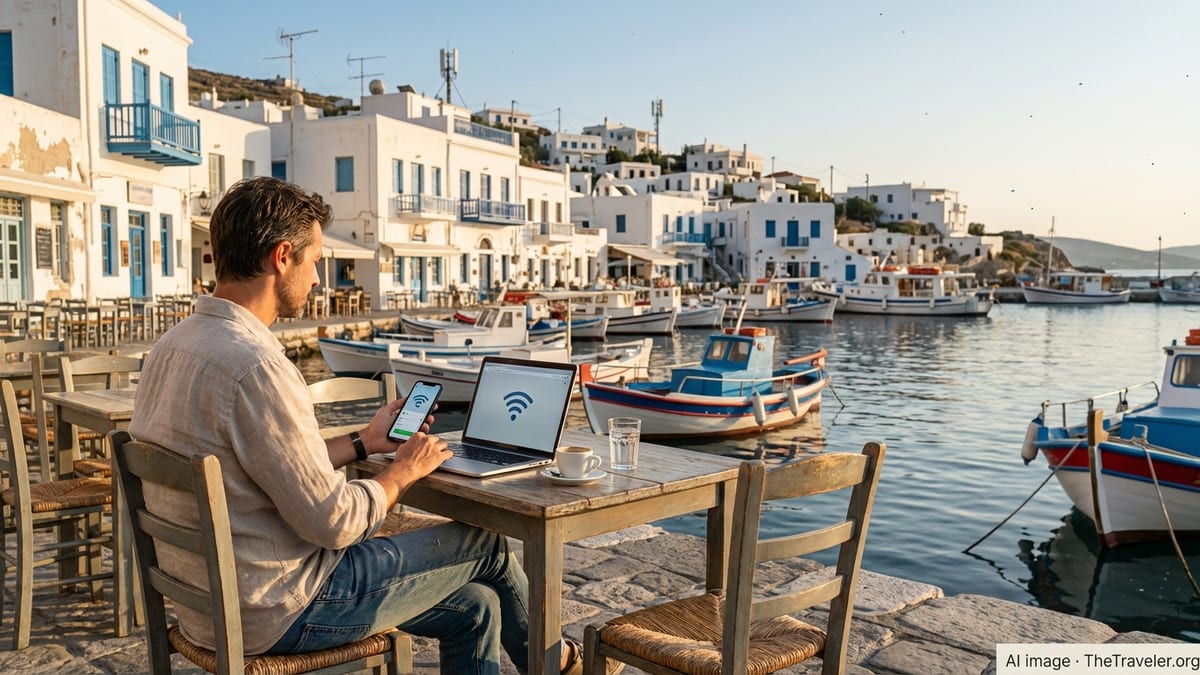
Connectivity in Greece in 2026: The Big Picture
Greece has made significant progress in mobile connectivity over the last few years. 5G networks now reach most of the population, and average mobile speeds are comparable to or better than many other European Union countries. For everyday travel needs like navigation, messaging, social media, and online bookings, coverage in mainland cities and major tourist islands is generally reliable and fast.
Three main mobile network operators underpin the system: Cosmote, Vodafone Greece, and Nova (which absorbed the former Wind network). Cosmote typically offers the widest coverage, especially in rural regions and across the islands, while Vodafone and Nova also provide solid service in cities and popular destinations. Alongside these, several virtual operators and international eSIM brands resell access to the same networks, which means you can often buy data without ever visiting a Greek phone shop.
For visitors, the most important trend in 2026 is choice. You can rely on your existing EU plan under Roam Like At Home rules, pick up a local prepaid SIM at the airport, activate an eSIM before you land, or combine hotel WiFi with a modest mobile bundle. Each option has different strengths depending on how long you stay, how intensively you use data, and how far you travel off the beaten path.
At the same time, connectivity is not uniform. While central Athens, Thessaloniki, and the main islands feel almost as connected as Western European capitals, some remote villages, mountain roads, and small islands still see slow speeds or occasional signal drops. Planning ahead, especially if you need to work remotely or join video calls, is essential.
WiFi in Cities, Hotels and Cafes
In Greek cities and resort hubs, public and semi-public WiFi has become a standard amenity. Most hotels, guesthouses, and short-term rentals now include WiFi in the room rate, and many promote high-speed or fiber-backed internet as a selling point. In practice, speeds and reliability vary: newer business hotels and upscale properties tend to deliver strong, stable connections, while small family-run pensions or older buildings may suffer from patchy coverage in rooms or slower bandwidth during peak evening hours.
Restaurants, cafes, and bars in tourist neighborhoods almost always offer WiFi, typically protected by a password printed on the menu or supplied on request. In Athens and Thessaloniki, co-working spaces and modern cafes with strong WiFi cater to digital nomads and remote workers, offering faster and more stable connections than many hotel networks. For video calls or large uploads, these dedicated spaces are often a better choice than relying on shared hotel WiFi in the evening when everyone is streaming.
Free municipal WiFi exists in some city squares, ports, and promenades, but quality can be inconsistent. It may be adequate for quick messaging or checking maps, yet unreliable for banking, work, or streaming. As with public networks anywhere, using a VPN and avoiding sensitive transactions is sensible, since security settings on these systems are often minimal.
On the islands, WiFi is widely advertised but can be more fragile. Many properties connect to the internet via shared local infrastructure that strains under peak summer demand. Even if your hotel promises free WiFi, expect occasional slowdowns at night or during storms, and consider mobile data as your primary connection if you need consistent speeds.
Mobile Networks, Coverage and 5G Across Greece
Mobile coverage in Greece is strongest on the mainland, in larger cities, and along primary highways. In Athens, Thessaloniki, Patras, and other regional centers, 4G and 5G coverage is dense, and speed tests often show high download rates suitable for streaming and remote work. Urban areas typically offer full signal for all three major operators, with 5G available in many neighborhoods rather than just central business districts.
On popular islands such as Santorini, Mykonos, Paros, Naxos, Rhodes, Corfu, and Crete, network infrastructure has been upgraded to meet seasonal tourism demand. Recent surveys indicate excellent 4G coverage and rapidly expanding 5G footprints in town centers, ports, and main beach areas. In these locations, using mobile data for everything from video calls to cloud backups is usually straightforward, though performance may dip during busy evening periods when thousands of simultaneous users are online.
Coverage becomes more variable on smaller or more remote islands, and in mountainous inland regions. Places like Kastellorizo, Anafi, or sparsely populated villages in the Peloponnese and northern Greece may have only basic 4G or even fallback 3G in certain spots. Signal can drop entirely in gorges, on isolated hiking trails, or along secondary roads. For travelers who plan road trips into the mountains or island hopping to less-developed destinations, choosing an operator known for the broadest national coverage, usually Cosmote, can make a practical difference.
5G is no longer a premium novelty. It is increasingly bundled into standard plans, and if your phone supports it, you will often see 5G indicators in major cities and tourist zones. While speeds vary, the main advantage for visitors is extra capacity during peak times. Where everyone else is sharing a crowded 4G cell, a 5G connection can remain smoother for streaming and video conferencing, though real-world performance will always depend on local load and signal strength.
SIM Cards, eSIMs and Tourist Data Options
Travelers arriving in Greece without an EU plan generally face a straightforward choice between purchasing a local physical SIM card or activating a digital eSIM from either a Greek or international provider. Physical prepaid SIMs are available at major airports, city kiosks, and mobile operator stores. You will usually need your passport for registration, in line with EU regulations, and staff can help with activation if needed. Starter packs often include a bundle of domestic minutes, texts, and a data allowance valid for 2 to 4 weeks.
Typical prepaid offers from the main operators cluster around moderate data packages at mid-range prices. Many tourist-friendly bundles include several gigabytes of data plus unlimited domestic calls and basic EU roaming. Promotions change frequently and vary by brand and season, so it is worth checking current offers when you arrive rather than relying on older information. For short trips focused on one country, a Greek-specific SIM is usually simpler than a multi-country European package, although heavy travelers may prefer broader regional eSIMs that also work in neighboring states.
eSIMs have become a popular choice for visitors who prefer to avoid physical cards. You can purchase plans from international providers in advance, receive a QR code by email, and activate the eSIM on your phone moments before landing. Many of these eSIM products ride on Greek networks like Cosmote or Vodafone, offering fixed data bundles for defined periods, while some advertise unlimited data with fair-use criteria. For those hopping between islands or moving constantly, eSIMs remove the need to track a tiny plastic SIM or visit a local shop between ferries.
Some specialists now focus specifically on Greece, while wide-coverage European eSIMs include the country as part of an EU or pan-European zone. For stays of several weeks or for travelers who expect heavy data consumption, high-capacity or 30-day plans represent good value. Always verify whether tethering is allowed, what speeds are realistically achievable, and how support is handled if you experience coverage or activation issues.
EU Roaming Rules for Visitors With European Plans
For travelers who already hold a mobile contract from another European Union or European Economic Area country, Greece is covered by Roam Like At Home regulations, currently extended to at least 2032. This framework generally allows you to use your domestic voice, text, and data allowances while in Greece without paying daily roaming surcharges, subject to fair-use limits. In practical terms, many Europeans can land in Athens and start using their phones exactly as they would at home.
Fair-use policies are designed to prevent long-term, permanent roaming and to keep roaming services financially sustainable for operators. If your plan is very cheap or includes unlimited data, your provider may set a roaming data cap calculated using an EU formula. Above that threshold, modest per-gigabyte surcharges can apply, but these are regulated and have been falling over time. Operators are required to alert you when you approach or exceed your roaming allowance and to give you the option to continue at the regulated surcharge if you choose.
From 2025 onward, wholesale price caps for roaming data within the EU have continued to decline, and in 2026 retail out-of-bundle costs remain strictly limited. This means that bill shocks from accidental data roaming within Greece should be rare, provided your home operator has correctly activated EU roaming and you keep an eye on warning messages. A default safety mechanism usually cuts off data around a predefined extra-charge limit unless you explicitly confirm that you want to keep browsing.
Despite these consumer protections, details still vary between providers. Some non-EU operators maintain Greece-like roaming zones but under different terms, while a handful of UK and other carriers have introduced or adjusted roaming fees even after the initial Roam Like At Home era. Before you travel, confirm with your home provider whether Greece is included in your standard roaming zone, what your fair-use data limit is, and whether 5G access is available on partner networks in the country.
Working Remotely and Streaming From Greece
Greece has become increasingly attractive for remote workers, digital nomads, and long-stay visitors, in part due to improved connectivity and the availability of modern workspaces in major cities and resort towns. In Athens, Thessaloniki, and some island capitals, co-working hubs and laptop-friendly cafes with strong WiFi and plenty of power outlets make it relatively straightforward to work a full day online. Many offer fiber-backed connections that can comfortably handle video conferencing, large file transfers, and cloud-based workflows.
For remote work away from major centers, mobile data is often the more reliable option. Using a smartphone hotspot or a dedicated mobile router connected to a strong 4G or 5G signal can provide a stable connection where hotel WiFi struggles. This setup is especially useful on islands where older buildings and thick stone walls limit WiFi coverage inside rooms, even when the main access point in reception or a lobby is fast. Choosing an operator with strong local coverage and a data plan generous enough to cover work usage becomes essential.
Streaming services and video calls generally work well in cities and on large islands, as long as you are not sharing a weak connection with many other users during peak evening hours. Many travelers report that streaming high-definition content is possible on both WiFi and mobile data in central locations, though quality can drop during busy holiday periods when networks are congested. If your work depends on smooth video calls, scheduling them during morning hours, when both WiFi and mobile networks are less loaded, is a practical strategy.
Travelers who rely heavily on cloud backups, large uploads, or real-time collaboration tools should build flexibility into their schedules. Weather-related disruptions, power cuts in older neighborhoods, or ferry delays that keep you between reliable networks can all affect connectivity. Keeping an offline copy of essential documents, identifying a backup cafe or co-working space, and carrying a power bank to keep devices charged are all sensible precautions in Greece just as they are elsewhere.
Practical Tips for Staying Connected Around Greece
Before departure, check that your phone is unlocked and supports the bands and technologies used in Greece, including 4G LTE and 5G where available. An unlocked, recent-generation smartphone will give you the flexibility to switch between your home SIM, a local prepaid SIM, and one or more eSIMs. If you plan to use an eSIM, confirm compatibility and install the profile in advance, so you do not need to rely on unstable airport WiFi to download crucial activation data.
Once in Greece, consider your itinerary when choosing a provider. If you will spend most of your time in Athens or Thessaloniki, or only on the best-known islands, you can be relatively relaxed about which network you use. However, if you are driving through rural mainland regions, hiking in the mountains, or exploring lesser-known islands, prioritize coverage rather than small price differences. In practice, that often means favoring the operator with the most extensive national footprint, even if it costs slightly more.
For many visitors, a hybrid approach works best: use hotel or apartment WiFi for heavy evening streaming, combine it with a modest mobile data plan for navigation and on-the-go messaging, and keep a backup eSIM or second SIM slot ready in case your primary network experiences local outages. Downloading offline maps for your key destinations, storing boarding passes and key documents locally, and enabling two-factor authentication methods that do not depend solely on SMS can all protect you against temporary connectivity issues.
Security and privacy deserve attention as well. Open WiFi networks in public places may not be encrypted, so using a reputable VPN for sensitive tasks such as online banking, email access, or work logins is wise. Set devices to ask before joining new networks, disable auto-connect to unknown hotspots, and be cautious about entering passwords or credit card details on captive portals that redirect you through basic browser splash pages.
FAQ
Q1. Is mobile internet coverage good across Greece for tourists?
Coverage is generally strong in cities, along main highways, and on major islands, while more remote villages, mountain regions, and tiny islands can still experience weaker signals or slower data.
Q2. Should I buy a local SIM card or use an eSIM in Greece?
Both work well. Local SIMs can be cost effective for longer stays, while eSIMs are convenient for quick activation and island hopping, especially if your phone has limited SIM slots.
Q3. Can I rely on hotel WiFi for remote work in Greece?
Sometimes, but not always. Business hotels and modern apartments often have strong WiFi, while smaller guesthouses and busy island properties may be slower or congested, so a mobile data backup is advisable.
Q4. Does EU Roam Like At Home apply when I travel to Greece?
If you have a mobile plan from an EU or EEA country, Greece is generally included under Roam Like At Home, though your provider may apply fair-use data limits and specific terms.
Q5. Is 5G widely available in Greece?
5G is increasingly common in major cities and large tourist islands, and it is gradually spreading to more regions, though rural areas and smaller islands may still rely mainly on 4G or 3G.
Q6. How expensive are data plans for visitors in Greece?
Prices vary by provider and season, but prepaid SIM and eSIM packages for tourists are typically mid-range by European standards, with several competitively priced short-term and monthly options.
Q7. Is public WiFi in Greece safe to use?
Public and municipal WiFi is fine for basic browsing and messaging, but like any open network it may not be fully secure, so use a VPN and avoid sensitive transactions whenever possible.
Q8. Will my navigation apps work reliably on the islands?
Navigation apps usually work well on larger islands and main roads, but signal can drop in remote coves, mountain routes, and smaller islets, so downloading offline maps is a smart precaution.
Q9. Can I use my phone as a hotspot in Greece?
Yes, most Greek and international plans allow tethering, although some eSIM products may restrict it or apply fair-use limits, so always confirm hotspot rules in your chosen plan.
Q10. What is the best way to stay online during island hopping?
A combination of a strong-coverage mobile operator, a suitably sized data bundle, and flexible options like eSIMs or dual-SIM phones works best, with hotel WiFi used as a supplement rather than the only connection.