


More news on this day
Preliminary findings from a major rail investigation in England indicate that the driver killed in last week’s fatal collision near Bedford passed a red signal shortly before his London-bound train struck the rear of another service, deepening questions over how one of Europe’s safest rail networks suffered its worst crash in years.
Get the latest news straight to your inbox!
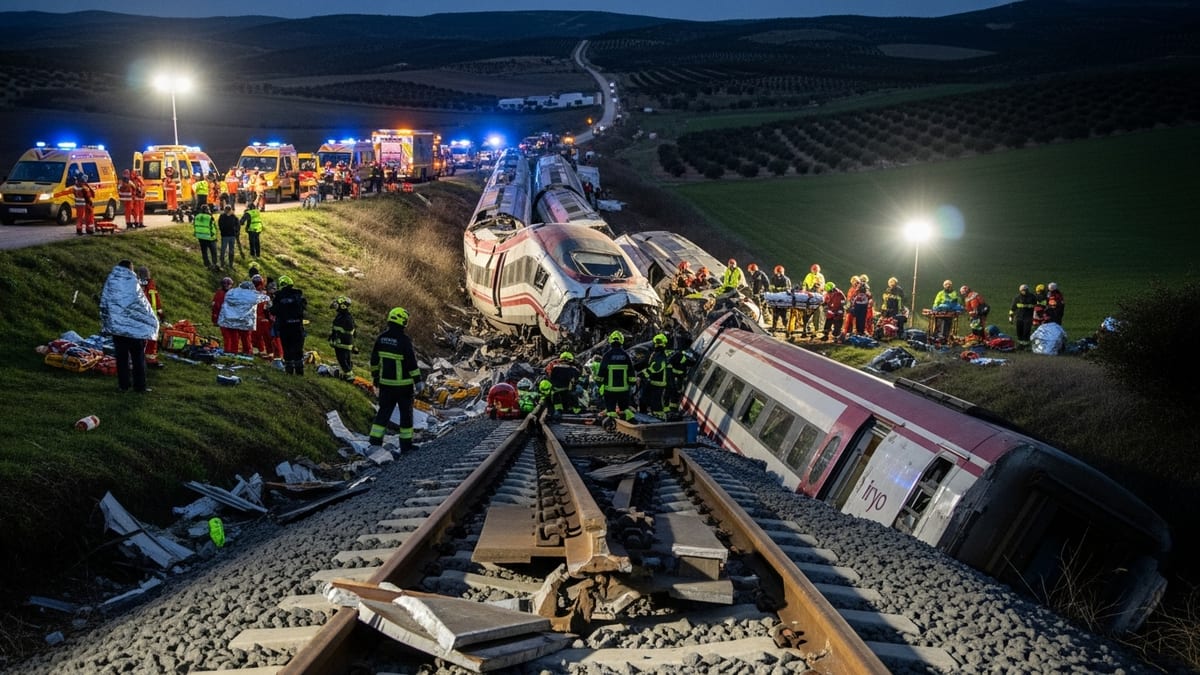
Preliminary report points to signal passed at danger
According to a preliminary update from the Rail Accident Investigation Branch, publicly available on Wednesday, evidence suggests the East Midlands Railway service involved in the Bedford collision travelled through a red signal without authority in the seconds before impact. The collision on June 19 south of Bedford left driver Shaun Burton, 60, dead and around 100 people injured, with several passengers still reported to be in critical condition in hospitals across the region.
Investigators say forward-facing CCTV from the cab and signal data logs indicate the train had earlier passed at least one cautionary yellow aspect and then a signal at danger as it accelerated away from a station stop on the busy Midland Main Line into London St Pancras. The affected signal was designed to protect the slower-moving train ahead, which had been operating on the same southbound route and had reduced speed as it approached congestion.
The early findings do not assign responsibility for the crash but confirm that the sequence leading up to the collision meets the definition of a “signal passed at danger,” a type of incident that has been a major focus of British rail safety policy for decades. The Rail Accident Investigation Branch has stressed that its work remains ongoing and that a fuller interim report with technical analysis will follow in the coming weeks.
British rail networks have recorded very few fatal multi-train collisions in recent years, and commentators in national and specialist transport media note that this early indication of a red signal being passed is likely to drive renewed debate about how signaling technology and driver training are deployed on intensively used commuter corridors into London.
Focus on protection systems and signaling layout
Publicly available information shows that investigators are examining not only the driver’s actions but also the configuration and performance of lineside signals and automatic protection equipment at the crash site near Elstow, just south of Bedford. Industry coverage indicates particular interest in whether the signal that was passed at danger was fitted with Train Protection and Warning System equipment capable of automatically applying the brakes if a train continues towards a red aspect at speed.
On much of Britain’s mainline network, a combination of audible in-cab warnings and automatic interventions is used to reduce the risk of a train moving past a restrictive signal. Technical commentary in rail industry reports suggests that while the driver’s train was equipped to receive warnings, the precise mix of trackside and on-board systems at the specific signal remains a central question for investigators, along with the sequence in which alarms sounded and were acknowledged.
Specialist reports also highlight the role that signal spacing, line speed and the proximity of junctions may have played in how much time the driver had to react to changing aspects. On intensively used routes, signals can be positioned relatively close together to maximise capacity, which can compress the window in which a train must decelerate from line speed to a standstill if the aspect ahead remains red.
Engineering teams from Network Rail and contractors have been working to recover damaged rolling stock and repair track and overhead line equipment, under the direction of safety investigators. Rail operations analysts note that the physical evidence recorded from wheel marks, braking distances and the condition of couplers and buffers between the two trains will form a crucial part of the reconstruction of events.
Human factors and the driver’s final journey
The collision claimed the life of Shaun Burton, a veteran driver whose name and photograph have been widely shared in national and regional news coverage since the crash. His family, colleagues and local representatives have led tributes describing his long career on the railway and his deep ties to the Bedford area, turning the incident into a focal point of public grief in a town that serves as a major commuter hub.
Human factors specialists are expected to examine Burton’s final shift in detail, including workload, timetable pressures, fatigue and any unusual operating conditions on the day. While there is no publicly available evidence at this stage to suggest impairment or deliberate action, analysts say the investigation will typically review recent rostering records, training history and any previous safety incidents to build a complete picture of how an experienced driver came to pass a red signal.
Reports in national media have also drawn attention to the psychological demands placed on drivers working intensely trafficked corridors, where repeated cautionary signals can create a pattern of routine acknowledgement. Safety commentators suggest that understanding how habit, expectation and distraction interact in the seconds before a signal is passed at danger will be central to any recommendations the Rail Accident Investigation Branch eventually makes.
Unions and rail staff associations, while paying tribute to Burton, have called for a careful, evidence-led approach that considers systemic issues alongside individual actions. Comment pieces in transport-focused outlets caution against early blame and argue for a focus on whether technology, operating rules and staffing levels together provide sufficient safeguards when a single human error occurs.
Impact on passengers, services and public confidence
The Bedford collision disrupted one of the principal north–south commuter arteries into London, with services on the Midland Main Line heavily curtailed over the weekend as wreckage was removed and infrastructure repairs undertaken. Travel outlets and rail operators’ public updates have described significant timetable alterations, with reduced services and extended journey times while a limited number of tracks were brought back into use.
Passengers caught up in the crash have recounted scenes of confusion and injury in television and newspaper coverage, describing being thrown from seats, forced to clamber out of tilted or buckled carriages, and waiting on an embankment as emergency crews triaged the most seriously hurt. More than 80 people were treated at hospitals following the crash, according to widely reported figures, and medical staff continue to monitor those who suffered major trauma.
As services gradually resume, travel commentators say the incident poses a test of public confidence in Britain’s railways, which have long been promoted as among the safest in Europe. The rarity of high-casualty collisions is frequently cited in official statistics, but images of crumpled carriages near Bedford are likely to linger in the minds of regular commuters and occasional leisure travellers planning summer journeys.
Rail industry analysts suggest that the clarity and speed with which investigators communicate their findings, along with visible safety improvements where needed, will be crucial to reassuring passengers. Some coverage points to the potential for short-term reductions in demand on the affected route, particularly at peak times, as travellers weigh alternative options or adjust working patterns in response to the shock of the crash.
What the Bedford crash could mean for future rail safety
The emerging picture of a red signal passed at danger has already prompted comparisons with earlier incidents where similar failures triggered major changes in rail safety policy. Commentators in specialist publications have recalled previous collisions that led to the widespread adoption of modern warning and protection systems, suggesting that the Bedford crash may mark another inflection point in how risk is managed on Britain’s busiest lines.
Transport policy watchers say the incident is likely to feed into ongoing debates over investment in digital signaling and in-cab systems that can enforce speed limits and braking independently of the driver. Advocates argue that such technology could further reduce reliance on human reaction times and help prevent a single lapse from escalating into a mass-casualty event, though critics point to cost and complexity on a network with a mix of old and new infrastructure.
Publicly available statements from government and industry figures in the days since the crash have promised full cooperation with the Rail Accident Investigation Branch and a readiness to implement any recommendations that emerge. Some campaigners for rail safety and passenger groups are already urging a broad review that looks beyond the immediate causes to consider wider issues such as maintenance regimes, staffing and the pace of modernisation on key main lines.
For now, the Bedford collision remains the subject of a meticulous technical and human investigation whose early findings have transformed initial uncertainty into a clearer, if still incomplete, narrative about a red signal, a split-second sequence of decisions and a devastating rear-end impact. As the summer travel season gathers pace, many eyes in the UK and beyond will be on how the country’s rail system responds to one of its most serious modern tests.