

More news on this day
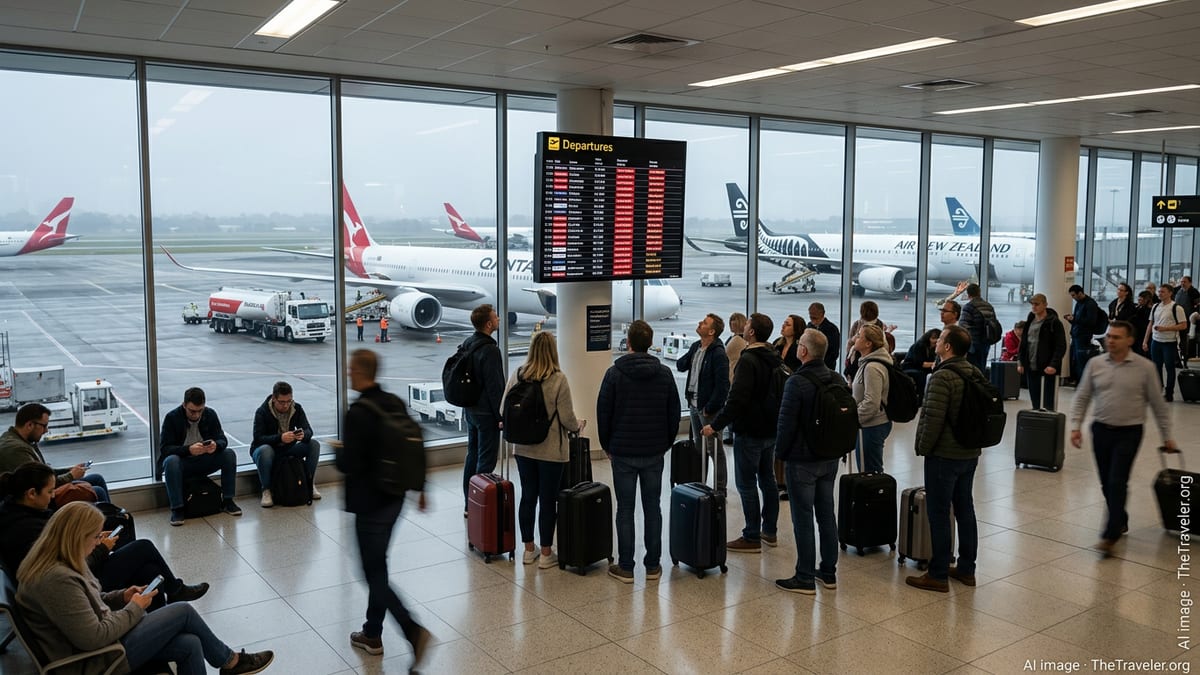
A sudden spike in jet fuel prices triggered by the US-Israeli war on Iran is rippling through global aviation, forcing airlines from Australasia to Europe to slash capacity, raise fares and warn that the recovery in international travel is in jeopardy.
Get the latest news straight to your inbox!
War in Iran Upends Oil Routes and Airline Economics
The latest conflict centered on Iran has disrupted one of the world’s most important oil export corridors, driving crude and refined product prices sharply higher almost overnight. Airlines, whose business models depend on relatively predictable fuel costs and carefully hedged exposure, have been among the first global industries to feel the shock.
Jet fuel, typically the single largest operating expense for most carriers, has surged from pre-conflict levels of about 85 to 90 dollars a barrel to reported spot prices as high as 150 to 200 dollars in recent days, according to figures cited by Air New Zealand and other carriers. The scale and speed of the spike have left airline finance teams scrambling to recalculate budgets, hedge positions and schedules as they confront a cost base that has effectively doubled in less than a fortnight.
The surge follows the late February strikes by the United States and Israel on Iran and subsequent Iranian attacks that have rattled infrastructure and shipping through the Gulf region. Tanker traffic and insurance costs on key routes have been hit, tightening supply and sending the so-called crack spread between crude and jet fuel to extreme levels, a direct blow to airlines even in markets far removed from the Middle East.
With fuel costs suddenly outpacing revenue growth, many carriers now face a stark choice: push through painful fare increases and capacity cuts or risk flying loss-making routes at a time when balance sheets are still healing from the pandemic era.
Air New Zealand Suspends Outlook and Lifts Fares Across Network
Air New Zealand has emerged as one of the first major airlines to announce broad-based fare increases directly linked to the crisis. The flag carrier said this week that unprecedented volatility in global jet fuel markets had forced it to suspend its financial outlook for the 2026 fiscal year, underscoring just how uncertain the operating environment has become.
The airline detailed across-the-board price rises: economy tickets up by about 10 New Zealand dollars on domestic routes, 20 dollars more on short-haul international services and an additional 90 dollars on long-haul flights. Executives warned that further adjustments to pricing, network planning and schedules remain possible if fuel prices stay elevated or climb higher.
Air New Zealand had been counting on steady long-haul demand to and from North America and Asia, as well as robust trans-Tasman traffic, to underpin its recovery. Instead, the carrier now faces a delicate balancing act: protecting yields through higher fares without pricing out price-sensitive leisure travelers or undermining corporate demand that had only recently started to normalise.
The move has alarmed many New Zealand travelers, who were already contending with higher living costs. Travel agents report a rush to lock in trips at current prices and growing concern that more aggressive increases could follow if the conflict drags on into the Southern Hemisphere winter.
Qantas, SAS and Others Cut Capacity and Pass Costs to Passengers
Australia’s Qantas Airways has also announced fare hikes on its international network, explicitly citing the surge in jet fuel costs linked to the conflict. The carrier said higher oil prices, combined with airspace closures and diversions around the Middle East, have pushed up operating costs on already long sectors to Europe and beyond.
Qantas is examining ways to redeploy capacity to Europe on routes that can bypass the most disrupted corridors, but that typically involves longer flight times and higher fuel burn. Even where aircraft remain full, thinner margins and increased risk have compelled the airline to raise ticket prices, particularly on long-haul itineraries that transit or previously skirted Middle Eastern hubs.
Scandinavian carrier SAS and several Asian airlines have also moved to increase fares and adjust schedules. On Asia–Europe routes, where airspace closures and missile and drone activity have forced complex reroutings, fares have spiked as capacity tightens. Hong Kong’s Cathay Pacific is adding extra flights to London and Zurich to capture demand and compensate for disrupted competitors, while other carriers are trimming frequencies or temporarily suspending services to destinations in the wider region.
With key Gulf hubs such as Dubai and Doha affected by missile threats and heightened security measures, some airlines are offloading connecting traffic to secondary routings, adding time and cost. The result is a patchwork of new schedules that can be difficult for passengers to navigate and that often come with a higher price tag than just weeks earlier.
Passengers Face Higher Prices, Fewer Options and Longer Journeys
For travelers, the immediate impact of the Iran conflict is already clear: sharply higher fares on many international routes, fewer non-stop options and a growing risk of last-minute changes. Routes linking Asia and Europe have been particularly hard hit, as airlines avoid conflict-adjacent airspace and grapple with the loss of operational flexibility at major Middle Eastern hubs.
Travel agents across Australasia and Europe report fare increases on popular itineraries to London, Paris and other European gateways, alongside warnings that the lowest fare buckets are selling out faster than usual. Qantas has urged customers to book early to secure the best available deals, an implicit acknowledgment that what counts as a bargain today could look cheap compared with prices later in the year if fuel markets remain tight.
In some cases, the disruption is measured in time as much as money. Longer routings to avoid high-risk skies can add hours to already lengthy flights, complicating connections and increasing the likelihood of missed onward journeys. For business travelers trying to compress multi-city trips into tight windows, and for families connecting through multiple hubs, the cumulative effect can be exhausting.
There is also growing concern about a potential dampening of travel demand if the crisis endures. Analysts note that while pent-up appetite for international travel remains strong after years of pandemic restrictions, sustained high prices and operational uncertainty could persuade many households and companies to postpone or scale back long-haul trips, especially discretionary leisure travel.
Uncertain Outlook as Airlines Revisit Hedging and Capacity Plans
The volatility has prompted a fresh look at fuel hedging strategies across the industry. Some carriers, particularly in Europe and North America, had locked in a significant portion of their 2026 fuel needs at lower prices earlier in the year, cushioning the immediate blow but leaving them exposed when those contracts roll off if today’s prices persist.
Others, including several Asia-Pacific airlines, entered the crisis with lighter hedging or shorter-duration cover, giving them more flexibility to benefit if prices fall back but forcing faster and sharper fare increases while costs remain high. Investors and regulators are watching closely to see whether hedging strategies that worked in a more stable market can withstand the stress of a prolonged geopolitical shock.
Capacity planning is also being rapidly rewritten. Airlines that only months ago were touting ambitious growth on long-haul routes are now talking about targeted reductions, seasonal suspensions and aircraft redeployments to markets less affected by the conflict. Some executives warn privately that if jet fuel remains near current levels and oil supply remains constrained, the industry could see grounded aircraft and postponed fleet renewal plans.
For now, most carriers are betting that travelers will absorb at least part of the higher costs, especially on essential and VFR (visiting friends and relatives) routes. But the longer the war in and around Iran continues to unsettle energy markets and global airspace, the greater the risk that today’s emergency fare hikes and schedule tweaks harden into a new, more expensive normal for international passenger travel.