

More news on this day
Thousands of passengers are stranded at Doha’s Hamad International Airport after Iranian strikes and a cascading series of Middle East airspace closures, including the United Arab Emirates, triggered an abrupt halt to many of the hub’s operations and forced airlines into mass cancellations and diversions.
How the Crisis Unfolded Around Hamad International Airport
The disruption began after United States and Israeli forces launched major strikes on targets inside Iran on February 28, 2026, prompting Tehran to respond with drone and missile attacks across the Gulf. In rapid succession, Iran, Iraq, Israel and several Gulf states either fully or partially closed their airspace, effectively sealing off some of the world’s most important aviation corridors almost overnight.
For Hamad International Airport in Doha, one of the key crossroads between Europe, Asia and Africa, the immediate trigger was the temporary suspension of Qatari airspace. Qatar’s Civil Aviation Authority ordered a halt to air navigation as a precaution while its defense systems intercepted incoming missiles and debris was reported falling in industrial areas around the capital.
Although Hamad itself has not reported the kind of direct physical damage seen at airports in Dubai and Abu Dhabi, the closure of the skies above Qatar meant that aircraft could neither arrive nor depart under normal commercial operations. Qatar Airways, the airport’s dominant carrier, quickly announced a full suspension of flights to and from Doha until authorities declare the airspace safe to reopen.
By March 2, the ripple effects had become global. Long-haul services linking Europe and North America with Asia and Australasia, many of which rely on Doha as a refuelling and transfer point, were either cancelled outright or forced into lengthy diversions that bypassed the Gulf entirely, adding hours to journeys and straining airline schedules worldwide.
UAE Airspace Closure and the Knock-On Effect on Doha
The closure of UAE airspace has amplified the disruption at Hamad International Airport. The United Arab Emirates announced a temporary and partial shutdown of its skies as an “exceptional precautionary measure,” immediately affecting operations at Dubai International and Abu Dhabi’s Zayed International, two of the busiest intercontinental hubs alongside Doha.
With Dubai, Abu Dhabi and Doha all heavily restricted at the same time, airlines lost the three central pillars of the Gulf’s hub-and-spoke network. Routes that would normally be re-accommodated through nearby airports could no longer rely on Emirates or Etihad’s networks, leaving Qatar Airways with sharply reduced options to reroute stranded passengers even once its own flights resume.
The UAE’s move also removed vital alternative routings around closed airspace in Iran and Iraq. Carriers attempting to bridge Europe and Asia have been forced to route south over Saudi Arabia or much further west and north, where capacity is already constrained due to continuing limitations over Russia and parts of Eastern Europe.
For travelers at Hamad International, that means even confirmed rebookings remain subject to last-minute change. Seats on remaining open corridors are scarce, crew duty limits are tightening, and aircraft are often out of position after two days of sudden diversions and turn-backs.
What Passengers at Hamad International Are Experiencing Now
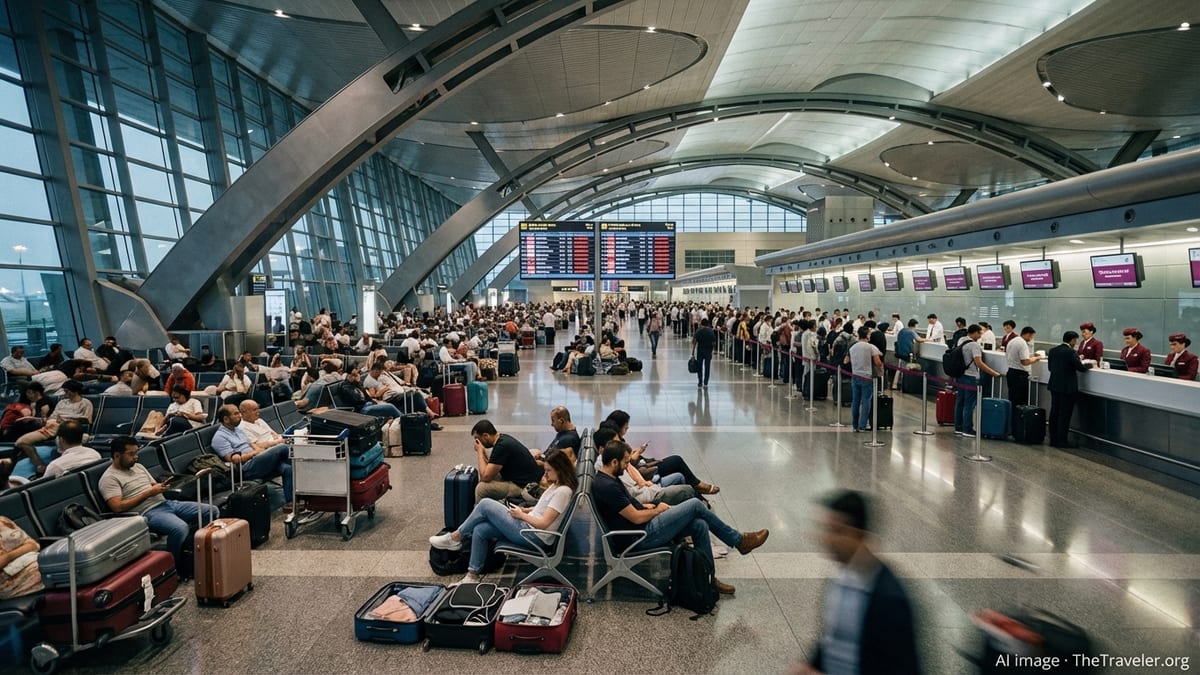
Inside Hamad International Airport, scenes are reminiscent of previous global aviation shocks, with departure boards filled with cancellations, long queues at airline service desks and transit passengers bedding down in seating areas as hotel capacity in Doha tightens. Many travelers arrived in Qatar shortly before the airspace closure and have since been unable to continue to their final destinations.
Qatar Airways has said that operations will remain suspended until the country’s regulators confirm it is safe to reopen the skies, with the next formal update expected on March 2 local time. In the meantime, the airline is prioritizing communication through booking channels and airport announcements, but the volume of affected passengers means individual assistance is slow and options are limited.
Some travelers have managed to leave the region via rare open corridors on other Gulf or regional carriers, or by securing seats on flights that route through Istanbul, Cairo or European gateways. However, with thousands of flights delayed or cancelled across the Middle East since the strikes began, capacity out of the region is severely constrained and fares on remaining services have spiked.
Travelers still en route to Doha have seen aircraft diverted mid-flight back to origin cities or to alternative hubs such as Rome, Athens or Istanbul. In some cases, flights have returned to their departure airports hours into the journey after airspace closures were extended, creating additional backlogs at far-flung airports and compounding the strain at Hamad International once those passengers are rebooked.
Global Airlines Reroute Around a New Aviation Black Hole
The combined closure of airspace over Iran, Iraq, Israel, Qatar and the partial shutdown of UAE skies has created what aviation analysts describe as a temporary “black hole” in the heart of global aviation. Before the crisis, routes crossing the Gulf were among the most heavily trafficked in the world, linking London, Paris and Frankfurt to Mumbai, Bangkok, Singapore, Sydney and beyond via Doha and other Gulf hubs.
Now, many of those flights simply cannot use their traditional routings. Airlines that normally overfly Iran and the Gulf are turning to more southerly or northerly paths that increase fuel burn and flight time, reduce aircraft utilization and create knock-on delays across entire networks. Carriers that had already been navigating around Russian airspace restrictions are now facing a second major no-go zone cutting across their east-west trunk routes.
For Hamad International Airport, this means that even after Qatar reopens its skies, the return to regular schedules will be gradual and complex. Aircraft and crews will be out of position, and some routes may remain suspended or heavily reduced until conflict risk assessments improve and insurance premiums stabilize. Airline planners are warning that the operational shock could echo for weeks, particularly on Europe–Asia and Europe–Australasia sectors that rely on Gulf connections.
Industry bodies are also closely monitoring safety guidance from regional and international regulators. Conflict-zone advisories now cover broad swathes of the Middle East, and many airlines are likely to maintain conservative routings around Iran and its neighbors even if formal airspace closures are lifted, further limiting the immediate recovery of traffic through Doha.
Key Advice for Travelers With Flights via Doha
For passengers booked to travel through Hamad International Airport in the coming days, the overarching message from airlines and travel agents is not to proceed to the airport unless specifically instructed. With flight operations from Doha largely paused and security conditions fluid across the region, travelers turning up unannounced are unlikely to be able to board alternative services and may struggle to secure accommodation.
Instead, passengers are being urged to monitor their airline’s official communications channels, keep contact details up to date in their bookings and watch for rebooking or refund options. Many carriers, including Qatar Airways and major European and Asian airlines, have introduced flexible policies that allow travelers to postpone trips, change routes or accept vouchers without the usual penalties.
Travelers who must transit through the wider region for essential reasons should be prepared for longer journey times, last-minute schedule changes and potentially overnight layovers. Comprehensive travel insurance that includes disruption and war-risk cover is strongly recommended, as standard policies may exclude events linked to armed conflict or government-ordered airspace closures.
With no clear timeline yet for a full normalization of air travel across the Middle East, Hamad International Airport will remain a focal point of the crisis. For now, the best strategy for affected passengers is patience, flexibility and close coordination with airlines and travel providers as the situation evolves day by day.