

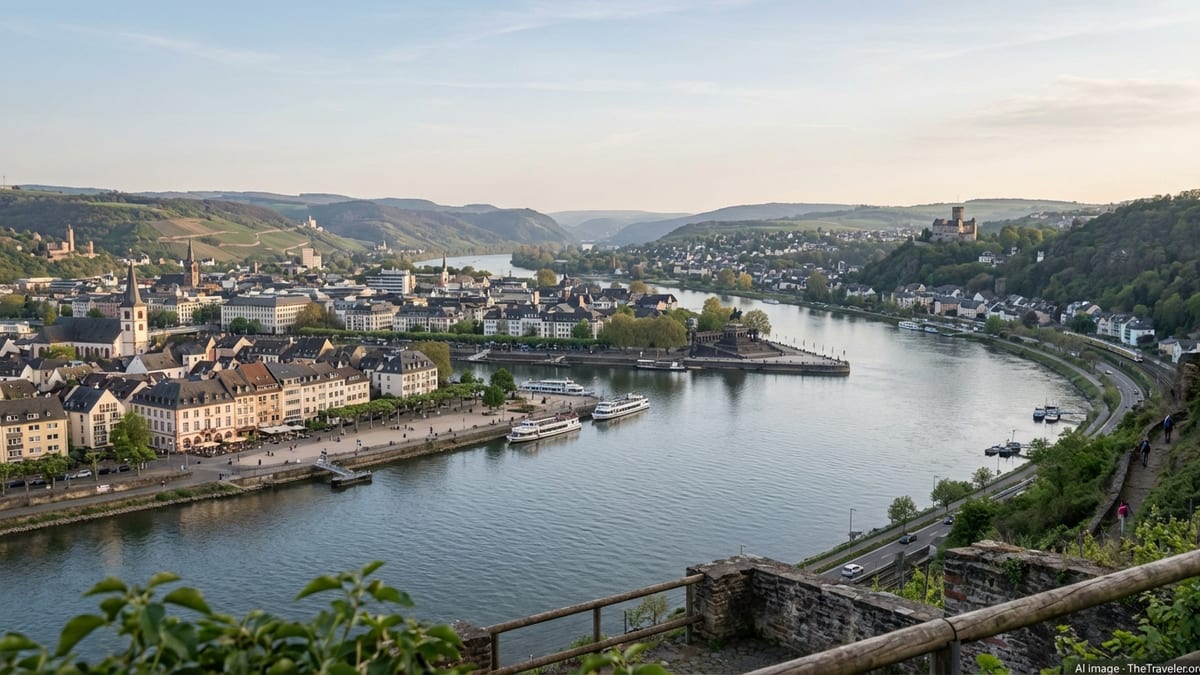
The romantic meeting point of the Rhine and Moselle has long tempted travelers to set up base in Koblenz, the historic city at the confluence of the rivers. Yet just a few kilometers upstream, the quieter town of Lahnstein is increasingly on the radar of visitors who want the same river views and castle access in a more relaxed, village-like setting.
This comparison works best after understanding whether Lahnstein is worth visiting on its own merits. Deciding between the two can significantly shape how you experience the Middle Rhine and lower Moselle, from transport convenience and day-trip logistics to evening atmosphere and budget. This article weighs the strengths of each base to help Rhine and Moselle travelers decide whether Lahnstein or Koblenz is the better fit.
Orientation: Where Koblenz and Lahnstein Sit on the Rivers
Reviewing the main things to do in Lahnstein highlights how it differs from Koblenz. Koblenz occupies one of the most strategic positions in the region, at the exact meeting point of the Rhine and Moselle. The city stretches along both rivers, with its historic old town close to the Deutsches Eck, where the two waterways converge.
From here, the UNESCO-listed Upper Middle Rhine Valley begins, running south toward Boppard, St. Goar, Bacharach and Bingen, while the Moselle curls westward into wine country around Winningen, Cochem and Traben-Trarbach. Koblenz is effectively the hinge between these classic scenic routes, which is why many tour itineraries and river cruises treat it as the central hub.
Lahnstein, by contrast, lies just upriver on the east bank of the Rhine, where the smaller Lahn River flows into the Rhine. It is only about 7–8 kilometers from Koblenz as the crow flies, and regional trains cover the distance in a matter of minutes. Despite the short distance, Lahnstein feels markedly different: less urban, more small-town, with hills, vineyards and wooded slopes closing in quickly around its neighborhoods. The town straddles the mouths of two valleys, the Rhine and the Lahn, making it a natural jumping-off point not just for river cruises but also for inland hikes and scenic drives.
From a map perspective, both bases sit in prime position for exploring castles and wine villages on the Rhine and Moselle. What differs is the immediate environment. Koblenz offers a substantial city center with plazas, museums and nightlife, while Lahnstein delivers a softer landscape and more residential feel. Travelers choosing between the two are deciding as much between city energy and small-town calm as they are between two riverfronts only a few minutes apart.
Because the distance between them is so short, it is entirely feasible to base in one and spend frequent time in the other. That flexibility is useful to keep in mind: the choice is less about what you can reach and more about how you want your days and evenings to feel when you return from your excursions.
Transport & Connectivity: Which Base Makes Getting Around Easier?
For most Rhine and Moselle visitors, efficient transport is a top priority. Koblenz clearly leads on long-distance connectivity. Koblenz Hauptbahnhof is a major regional rail hub, with frequent Intercity and regional services linking the city to Cologne, Frankfurt, Bonn and beyond. Regional express lines such as the Rhein-Express and Rhein-Erft-Express run roughly hourly along the Rhine corridor, while other services fan out along the Moselle and into the Eifel region. For travelers arriving by train from international gateways like Frankfurt Airport or Cologne, reaching Koblenz generally involves a straightforward direct or one-change journey.
Lahnstein, however, holds its own surprisingly well for a town its size. The Niederlahnstein station is a key junction where the East Rhine Railway meets the Lahn Valley Railway, and there are additional stops at Oberlahnstein and Friedrichssegen. Regional trains between Koblenz and Lahnstein are frequent, and travel times are short enough that many locals comfortably commute between them. Arriving from farther afield, though, you typically route through Koblenz first, then transfer to a short regional hop to Lahnstein. For car travelers, Lahnstein sits directly on the B42, with easy links to major north-south motorways, making it convenient for self-drive itineraries that combine river towns with inland stops.
When it comes to day-tripping along the Rhine, Koblenz again has a slight edge in simplicity. Regular trains down the left bank serve the main river villages and towns, while services on the right bank reach Braubach for Marksburg Castle and St. Goarshausen for Lorelei viewpoints. From Koblenz, you can step out of your accommodation and be on a through-train south within minutes, often without needing transfers. Lahnstein, on the right bank, connects well to the same Rhine corridor, but some routes will require a bit more checking of timetables to ensure optimal connections, especially if you are trying to string together Rhine and Moselle stops in a single day.
On the water, Koblenz is one of the principal moorings for scheduled Rhine cruise operators. Passenger ships and day-cruise boats call regularly at the landing stages near the city center, and Koblenz is a common embarkation or disembarkation point for multi-day itineraries. Lahnstein’s docks see far fewer scheduled departures, though some ships do call at Oberlahnstein or Niederlahnstein. For travelers who want maximum choice in departure times and cruise routes without extra transfers, Koblenz is more straightforward. Those comfortable with a short train or bus ride to Koblenz before boarding a ship will find Lahnstein’s slightly lower level of direct service less of a concern.
Atmosphere & Character: Big-Hearted City vs Quiet Riverside Town
The most immediate difference between Koblenz and Lahnstein is felt the moment you step out for an evening stroll. Koblenz is a mid-sized city with a lively old town filled with cafés, wine bars, restaurants and shops. There are promenades along both the Rhine and Moselle, a broad riverside park near the Deutsches Eck, and illuminated views of Ehrenbreitstein Fortress high above the Rhine. In high season and during events, the streets can feel busy and festive well into the night, with outdoor dining and street life continuing after sunset.
Lahnstein, conversely, trades intensity for intimacy. The town’s neighborhoods along the Rhine and Lahn feel more residential, and its old streets are quieter after dark. You will find traditional guesthouses, local pubs and a handful of restaurants, but there are far fewer venues than in Koblenz, and evening options wind down earlier. Many visitors choose Lahnstein precisely for that calm: you can spend the day in bustling river villages and then return to a place where the night is largely defined by church bells, river sounds and a few locals chatting in a corner tavern.
For some travelers, Koblenz’s city energy is a major plus. If you enjoy browsing in shops, catching an evening concert, or hopping between wine bars and gelato stands, the variety can be a highlight of your trip. The presence of cultural institutions, from museums to theaters, lends Koblenz a year-round feel that extends beyond the tourism season. It is also easier in Koblenz to adapt to rainy days by diving into indoor attractions without using regional transport.
Others, especially those seeking a more romantic or meditative experience, find Lahnstein’s scale more appealing. The hills close in quickly, landmarks like Lahneck Castle give the skyline a storybook touch, and the absence of heavy through-traffic in many areas makes even short walks feel peaceful. Families with young children sometimes prefer the lower sensory load, while hikers value the direct access from town to forested slopes and river viewpoints without crossing busy arteries. In short, Koblenz feels like a compact city on the rivers; Lahnstein feels like a riverside town that happens to sit beside world-famous scenery.
Castles, Sights & River Cruises: Who Has the Better Access?
One of the core reasons for visiting this part of Germany is the concentration of castles and fortifications overlooking the Rhine and Moselle. Koblenz offers immediate access to one of the region’s most impressive: Ehrenbreitstein Fortress. Reached most memorably by a modern cable car that glides across the Rhine, the fortress complex includes museums, exhibitions, viewpoints and event spaces. From the ramparts, you look down on the meeting point of the rivers, the city roofs and the green slopes of the valley. For many visitors, this combination of fortifications and city views is the definitive Koblenz experience.
South of Koblenz, Stolzenfels Castle rises above the left bank, widely cited as a quintessential example of 19th-century Rhine romanticism. Easily reached by short bus ride, taxi or even a longer walk and climb from the riverside, it pairs well with a day of strolling along the riverside promenades. Koblenz also offers proximity to the string of Rhine castles that define the UNESCO-listed valley between Koblenz and Bingen. With frequent trains and ships, it is simple to plan visits to Marksburg at Braubach, the castles above Boppard and St. Goar, and farther south to Rheinfels, Schönburg and Pfalzgrafenstein.
Lahnstein’s ace is Lahneck Castle, perched above the confluence of the Lahn and Rhine. Smaller and more intimate than Ehrenbreitstein, Lahneck offers guided tours that highlight its medieval origins and later romantic refashioning. For guests based in Lahnstein, the castle is practically on your doorstep, with hiking paths linking it to river viewpoints and forested ridges. From Lahnstein, Braubach and Marksburg are a short train or boat ride away, and the Lahn Valley itself opens up hiking and cycling routes past smaller fortifications, monasteries and old stone bridges.
When it comes to river cruises, Koblenz is the dominant embarkation point in the area. Major Rhine cruise operators schedule regular departures from moorings near the city center, offering half-day loops through the scenic gorge, one-way trips to Boppard or Bingen, and themed excursions. Moselle day cruises also frequently start or end in Koblenz, heading into wine country past terraced vineyards and riverside villages. While some riverboats do call at Lahnstein, the choice is comparatively limited, and sailings may be more seasonal or tied to specific itineraries rather than daily departures.
Practicalities: Accommodation, Costs & Dining
From a practical standpoint, both Koblenz and Lahnstein offer a range of lodging, but Koblenz unsurprisingly has greater variety. In the city you will find everything from large chain hotels near the train station to mid-range riverside properties, boutique stays in historic buildings, and budget options a short tram or bus ride from the old town. This variety can be helpful if you are traveling at peak times, when tour groups and river cruises fill cores of the region, or if you are balancing different preferences within a larger family or friend group.
Lahnstein’s accommodation scene is smaller, skewing toward guesthouses, traditional hotels and a limited number of apartments and river-view properties. On the one hand, this can mean less competition for centrally located rooms with character. On the other, inventory is finite, and travelers with very specific requirements may need to book earlier or be flexible on exact location. The upside is that many of Lahnstein’s properties offer calm surroundings, with less late-night noise from bars and traffic compared with a central Koblenz address.
In terms of cost, average nightly rates in Koblenz can run higher, particularly for central hotels in high season and during festivals. However, the competition between numerous restaurants and cafés can result in a broad price spectrum for dining. You can opt for simple kebab shops and bakeries, beer halls serving hearty Rhineland classics, mid-range wine taverns, or upscale dining in historic settings. Vegetarians and vegans will find more options in Koblenz than in many smaller river towns, simply because of the city’s scale.
Lahnstein tends to be slightly gentler on the budget, especially for accommodation and informal meals. Local pubs and guesthouse restaurants focus on regional dishes, and while you will not find the same variety or number of venues, everyday costs can feel modest. The trade-off is fewer late-opening places and less international cuisine. For travelers planning to have their main meal at lunchtime while on excursions, then return to a simple dinner near their lodging, Lahnstein’s offerings are likely sufficient. Those who see dining as a primary focus of the trip may lean toward Koblenz to take full advantage of its broader scene.
Best Traveler Profiles for Each Base
Choosing between Lahnstein and Koblenz often comes down to matching the base with your travel style. Koblenz suits visitors who prioritize convenience and urban amenities. If you want to arrive on a direct train from a major airport, check into a centrally located hotel, and spend your days alternating between river excursions and city-based sightseeing, Koblenz keeps everything within easy reach. Travelers who enjoy evenings out, from wine bars along the Moselle to concerts at cultural venues, will appreciate the range of options that a regional city brings.
Lahnstein is better matched to travelers who value a quieter backdrop and do not mind a small extra step in logistics. If your ideal Rhine stay involves morning hikes to castles and viewpoints, afternoons drifting on a riverboat or hopping on regional trains, and evenings spent in a tranquil town where you are more likely to hear church bells than street musicians, Lahnstein delivers that rhythm. It also works well for repeat visitors who have already explored Koblenz’s main sights and now want a slower, more local-feeling base.
Families may find that the decision hinges on the ages and interests of their children. With teenagers or young adults eager for independent exploring, shopping and nightlife, Koblenz’s walkable center and multiple attractions offer more autonomy. For families with younger kids, Lahnstein’s calmer streets, ready access to outdoor play in nature and more limited stimulation can be an advantage, especially on longer stays when downtime becomes as important as active sightseeing. Where you stay can tip the balance, especially when deciding where to stay in Lahnstein.
Couples on romantic trips often end up split between the two options depending on personality. Some relish the atmosphere of Koblenz’s old town squares, riverside promenades and cable car sunsets, framing the city as a compact, scenic base that remains lively after dark. Others prefer Lahnstein’s close connection to nature, the chance to walk quickly from riverside paths to wooded slopes, and the feeling of coming home each evening to a town that feels one step removed from the tourist mainstream.
The Takeaway
So, is Lahnstein better than Koblenz for Rhine and Moselle travelers? The honest answer is that neither is universally better; each excels for different types of trips. Koblenz is the natural choice if you want a strong transport hub, dense concentration of sights, and a lively evening scene. It makes logistics easy, especially for first-time visitors and those with limited days who want to pack in as much as possible with minimal planning.
Lahnstein, by contrast, shines as a base for slower, more reflective travel. Its small-town feel, direct access to hiking, and proximity to Lahneck Castle lend it a different kind of romance. You give up some immediate cruise and cultural options, but you gain quiet mornings, gentle evenings and the sense of living in a place that is not defined solely by tourism.
Because the distance between the two is so short, one sound strategy is to treat the choice as a question of where you want to sleep and relax, not what you can reach. From Koblenz you can always take a quick train to Lahnstein and the Lahn Valley for a day of walks and castle visits. From Lahnstein, you can ride into Koblenz for museums, shopping and a sunset cable-car ride. If your instincts lean toward energy and variety, base in Koblenz. If they lean toward calm and scenery, choose Lahnstein.
In the end, the Rhine and Moselle will impress you from either base. The key is to match the overnight atmosphere with the pace and mood you want your journey to have. Do that, and whether your room overlooks the Moselle quays of Koblenz or the quieter bends of the Lahn in Lahnstein, you will be well placed to experience one of Europe’s classic river landscapes at its best.
FAQ
Q1: Is Lahnstein or Koblenz better for first-time visitors to the Rhine?
For most first-time visitors, Koblenz is the better base because it combines excellent train connections, a wide range of accommodations and restaurants, and immediate access to major sights like Ehrenbreitstein Fortress and the Deutsches Eck. Lahnstein works well for travelers who already know the region or who deliberately want a quieter, small-town setting.
Q2: Which base is more convenient for exploring both the Rhine and the Moselle?
Koblenz is more convenient for covering both rivers efficiently. It sits right at the confluence and functions as a transport hub, with frequent trains and river cruises in both directions. From Lahnstein you can still reach the Moselle easily, but you will often route through Koblenz first.
Q3: Is accommodation generally cheaper in Lahnstein than in Koblenz?
On average, accommodation in Lahnstein can be slightly less expensive, particularly in guesthouses and smaller hotels, but differences are not dramatic. Koblenz has more price tiers, including budget options and premium riverside hotels, while Lahnstein has a smaller but often good-value selection, especially outside peak festival dates.
Q4: I will not have a car. Will I be at a disadvantage if I stay in Lahnstein?
You can comfortably stay in Lahnstein without a car because it has multiple train stations and frequent regional connections to Koblenz and other Rhine towns. However, you will need to pay a bit more attention to timetables, and you may have slightly longer door-to-door journeys for some excursions compared with basing directly in Koblenz.
Q5: Which place is better for nightlife and dining variety?
Koblenz clearly offers more nightlife and dining variety, with numerous wine bars, beer halls, restaurants and cafés in the old town and along the rivers. Lahnstein has a smaller number of pubs and restaurants that are pleasant for low-key evenings, but it does not have a true nightlife scene.
Q6: Is Lahnstein a good choice for hikers and nature lovers?
Yes, Lahnstein is very attractive for hikers and nature-focused travelers. Trails lead directly from town into the hills and forests around the Rhine and Lahn valleys, and Lahneck Castle provides a focal point for scenic walks. While you can also hike from Koblenz, the transition from town to countryside feels more immediate in Lahnstein.
Q7: Can I easily visit Ehrenbreitstein Fortress and take the cable car if I stay in Lahnstein?
Yes. From Lahnstein you can take a short regional train or bus into Koblenz and then walk or take local transport to the cable car station on the Rhine. The extra step adds a bit of time, but it is still straightforward as a half-day or full-day outing from Lahnstein.
Q8: Is parking easier in Lahnstein than in Koblenz?
Generally, parking is simpler and less stressful in Lahnstein, where traffic volumes are lower and accommodation often provides on-site or nearby spaces. Koblenz has multi-story car parks and organized parking near the center, but navigating city traffic and finding street parking can be more demanding during busy periods.
Q9: Which base would you recommend for a short two-night stay?
For a short two-night stay, Koblenz is usually the better choice because you minimize transit time and maximize access to key sights and cruise departures. You can still sample smaller towns on day trips. Lahnstein becomes more attractive when you have additional days and want to balance sightseeing with quieter downtime.
Q10: Is it realistic to split a trip between Lahnstein and Koblenz?
Yes, splitting a trip is realistic and can work well if you have at least five or six nights in the region. You might spend a few nights in Koblenz for city-based exploration, then move to Lahnstein for a slower-paced finale centered on hiking and river views. The short distance between the two keeps moving days low-stress.