

Rising prices in Mexico over the past several years have prompted prospective movers to question whether the country still offers a clear cost advantage compared with higher income economies. While Mexico remains structurally less expensive than the United States, Canada, and much of Western Europe, inflation, localized rent spikes, and service price convergence have narrowed the gap in some urban and coastal markets. Evaluating whether moving to Mexico is still “worth it” now requires a more granular look at cost trends by region, lifestyle, and income source.
How Much Have Living Costs in Mexico Actually Risen?
Mexico experienced a pronounced inflation cycle after 2020, driven by global supply chain shocks, higher food and energy prices, and a strong post‑pandemic rebound in domestic demand. Headline inflation peaked in the mid‑single digits on an annual basis and remained above the central bank’s 3 percent target for several years before gradually easing. Cumulatively, this has translated into a noticeable increase in everyday prices relative to pre‑pandemic levels.
Consumer price index data shows that the national price level in Mexico in 2024 was roughly 20 to 25 percent higher than in 2021, based on the progression of the official CPI. This broad increase has filtered through to food, transport, utilities, and services, meaning long‑term residents feel a sustained erosion of purchasing power in local currency terms even as nominal wages have also risen.
At the same time, inflation has moderated. Recent data indicates headline inflation hovering around the mid‑3 to low‑4 percent range year on year, suggesting that the period of sharp price jumps has given way to more typical, though still elevated, annual increases. For prospective foreign movers who earn in dollars, euros, or other strong currencies, the impact of past inflation is partially offset by wage and exchange rate dynamics, but the absolute price level is clearly higher than it was five years ago.
In practical terms, what used to feel exceptionally inexpensive in 2018 or 2019 now often feels “moderately cheaper” rather than “dramatically cheaper.” Evaluating whether relocation is still attractive requires comparing today’s costs with current conditions in the home country, not with a nostalgic pre‑pandemic Mexico.
Mexico’s Cost Advantage vs Major Western Economies
Despite recent increases, comparative indices still place Mexico as structurally less expensive than the United States and most Western European countries. Composite cost‑of‑living indexes that track prices for groceries, dining out, local transport, and consumer goods typically show Mexico at roughly one‑third to one‑half of the U.S. price level, depending on methodology and city selection. Some recent estimates indicate that overall consumer prices in Mexico are around 40 to 50 percent lower than in the United States, excluding rent, with rent itself often 50 to 70 percent lower outside the most in‑demand districts.
This differential is especially pronounced for domestically produced goods and locally provided services. Fresh food, public transport, and everyday personal services such as haircuts or basic home repairs generally remain significantly cheaper in peso terms than their equivalents in advanced economies. The gap narrows for imported goods and globally priced categories, including electronics, branded clothing, and many packaged foods, which may approach or even exceed U.S. prices once import costs and taxes are factored in.
When adjusted for purchasing power parity, Mexico’s per‑capita income is substantially lower than that of the United States, but the cost structure also remains lower, which is what creates the perceived affordability for foreigners with external income. For retirees receiving fixed pensions in hard currency or remote workers paid to U.S. or European scales, the effective purchasing power in many Mexican cities is still considerably higher than at home, though less extreme than in the early 2010s.
For individuals relocating with locally denominated salaries, however, the comparison looks different. Mexico’s average gross salary remains modest in international terms, and local wages have not always kept pace with the full cost of urban inflation. For these movers, the question is less whether Mexico is cheap compared with the United States and more whether Mexican wages comfortably cover Mexican living costs in the chosen location.
Regional Divergence: Mexico City, Coastal Hubs, and Interior Cities
Rising living costs in Mexico are not uniform. The most pronounced increases have occurred in Mexico City and in several coastal and tourist‑oriented cities that have seen strong post‑pandemic demand from both international visitors and long‑stay foreigners. In these areas, rents and some service prices have risen faster than the national average.
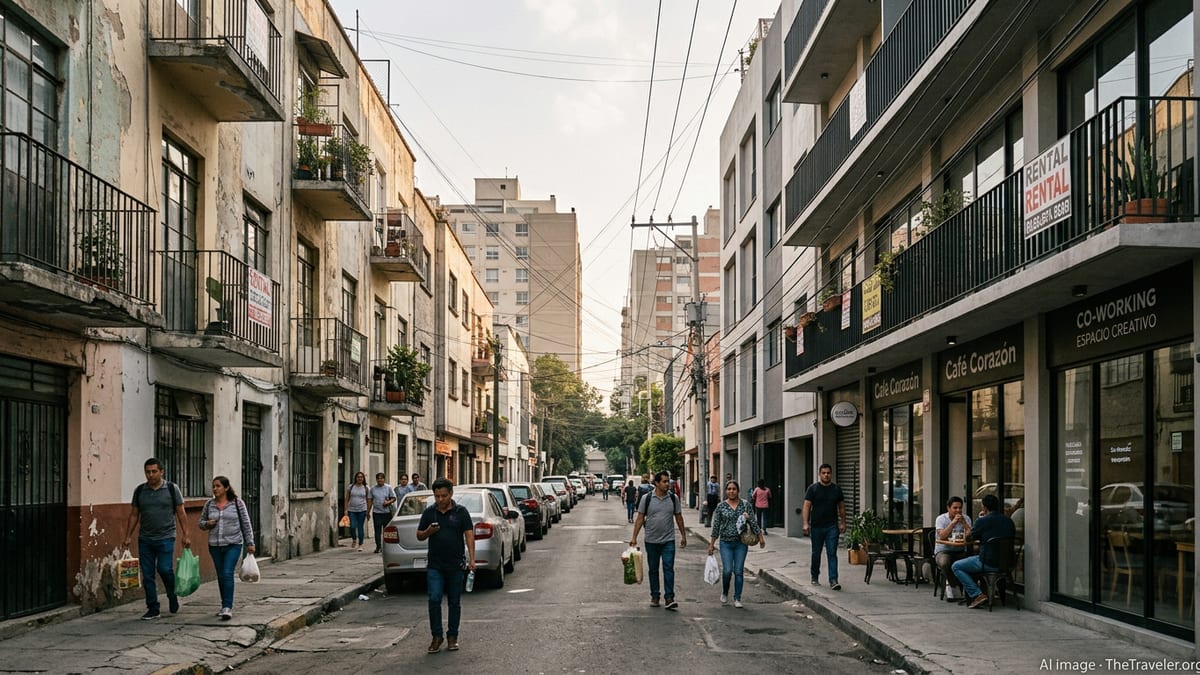
Mexico City illustrates this divergence clearly. Reports since 2020 point to rent increases of around 40 to 50 percent in key central neighborhoods, especially those popular with overseas residents and digital workers. Local accounts and media coverage describe households spending a growing share of income on housing, and political debate has intensified around short‑term rentals and so‑called transnational gentrification in colonias such as Roma, Condesa, Hipódromo, and parts of the Centro area.
Similar dynamics are reported in coastal hubs such as parts of the Riviera Maya, Puerto Vallarta, and other Pacific and Caribbean resort belts. There, seasonal tourism, short‑term rentals, and foreign buyer interest have contributed to higher accommodation and dining prices, particularly in well‑known zones. While national data still shows Mexico as relatively affordable, the lived experience in a beachfront enclave or a fashionable urban district can feel much closer to mid‑tier U.S. city pricing, especially for housing.
By contrast, many secondary and interior cities remain substantially cheaper. Industrial centers and mid‑sized state capitals away from the main tourist corridors often preserve more moderate rent levels and less price pressure on services. For movers focused primarily on maximizing the cost advantage, these interior markets can deliver a significantly lower monthly budget than flagship destinations, without eliminating the structural benefit Mexico offers over high‑income countries.
Key Components of Living Costs: Where Increases Are Most Visible
Not all components of the Mexican cost of living have moved in lockstep. For prospective movers, it is important to distinguish between categories that have seen pronounced increases and those that remain comparatively low. This allows for more realistic budget planning and helps determine whether relocation still aligns with financial objectives.
Housing costs have been the most visible pressure point, particularly in high‑demand neighborhoods. Examples from Mexico City and other large urban areas indicate rent growth since 2020 outpacing both general inflation and local wage growth, especially in areas with heavy short‑term rental activity. While national averages suggest that rent in Mexico remains substantially lower than in the United States, newcomers targeting trend‑leading districts should anticipate far higher housing budgets than earlier online anecdotes might suggest.
Food and basic goods have also become more expensive, reflecting both global commodity shocks and domestic inflation. Staple items and fresh produce still tend to be significantly cheaper than in North America or Western Europe, but shoppers notice that weekly supermarket totals have climbed compared with even a few years ago. Dining out shows a similar pattern: local eateries can still be very affordable, but restaurants catering to international clientele in major cities often charge prices that are only moderately below U.S. levels and, in some cases, approach them.
Transport and many local services remain a relative bright spot. Public transport fares, standard taxis in most regions, and general service labor tend to be low in international terms, though they too have experienced modest nominal increases. Utilities, including electricity and water, vary by region and consumption pattern but are often competitive with or below many U.S. urban markets, particularly for modest‑sized homes without intensive air‑conditioning use.
Remote Earners vs Local Earners: Who Still Gains the Most?
Whether moving to Mexico is still “worth it” after rising living costs depends heavily on the source and level of income. The country’s value proposition remains strongest for individuals with stable external income in hard currency: retirees with foreign pensions, remote employees for overseas firms, and independent professionals billing clients abroad.
For these groups, the key consideration is the ratio between their home‑country cost base and their expected Mexican expenditure. In many scenarios, a mid‑range U.S. or European salary still affords a high standard of living in Mexico, even in relatively expensive neighborhoods, though the cushion is narrower than it was a decade ago. A professional who might have once expected to spend one‑third of a U.S. city budget living in Mexico City may now find that achieving equivalent comfort in popular districts requires perhaps half as much as back home, especially after housing and imported goods are factored in.
For people relocating to take local employment paid in pesos, the calculus is different. Mexico’s average salaries, although gradually rising, remain low compared to costs in premium urban and coastal markets. A local middle‑income household can face housing cost burdens above 30 or even 40 percent of income in hot neighborhoods, which constrains discretionary spending. Foreigners who accept local salaries in these same markets may discover that their margin over basic expenses is thinner than anticipated, particularly if they are comparing expectations to dated accounts of ultra‑low Mexican living costs.
This divergence points to a key conclusion: the narrative of Mexico as a universally “cheap” destination is outdated. Instead, Mexico functions as a tiered cost environment where external earners in strategic locations still enjoy strong purchasing power, while local earners in premium markets face genuine affordability challenges.
How Recent Policy and Market Responses May Shape Future Costs
Local authorities in major Mexican cities have begun responding to public concern about rising living costs, particularly housing. In Mexico City, legislators have approved measures limiting the number of days per year that properties can be rented through short‑term platforms, seeking to moderate price pressures and speculative conversions of long‑term rental stock. Municipal governments have publicly committed to exploring broader frameworks for affordable housing and rent regulation, although concrete, nationwide policy shifts remain limited.
These policy experiments may slow the steepest rent increases in specific neighborhoods, but they are unlikely to reverse broader price convergence in highly internationalized markets. Demand from domestic higher‑income households, international companies, and foreign residents continues to support elevated housing and service prices in attractive districts. Over time, this can entrench a two‑speed cost of living pattern inside single metropolitan areas: premium corridors with near‑global pricing and more affordable outlying or less fashionable zones.
At the national level, the central bank’s tighter monetary policy in recent years has helped bring down inflation from its post‑pandemic peaks, which should gradually stabilize broad consumer price growth. However, structural factors such as rising wages in some industries, infrastructure investment, and continued foreign demand for Mexican goods and services suggest that very low inflation is unlikely in the near term. Prospective movers should plan for ongoing, though more moderate, annual cost increases rather than expecting prices to revert to earlier baselines.
Overall, policy responses may help keep Mexico relatively affordable by international standards, but they do not eliminate the underlying trend toward higher nominal prices in key urban and tourist centers. Long‑term relocation planning must assume a dynamic, not static, cost environment.
Decision Framework: When Is Mexico Still Financially Attractive?
For individuals and families weighing whether Mexico remains financially attractive after rising living costs, a structured decision framework is helpful. The following factors typically matter most in practice: income source and currency, target city and neighborhood, housing expectations, and tolerance for local inflation risk over a multi‑year horizon.
Remote earners and pensioners with stable hard‑currency income are still most likely to find Mexico advantageous, especially if they are open to living outside the priciest districts of Mexico City and coastal resort areas. In many interior cities and less saturated neighborhoods, such households can often cover monthly expenses comfortably while maintaining savings or investment contributions at levels that would be difficult to sustain in high‑cost Western urban markets.
By contrast, individuals depending on local incomes, or those committed to living in the most internationally popular enclaves, should assume a tighter margin. In these cases, careful budgeting around rent, schooling (if relevant), and imported goods becomes essential. For some such movers, the financial advantage relative to their home country may be modest, while for others, especially those coming from extremely high‑cost cities, Mexico can still represent a meaningful reduction in living expenses despite recent price increases.
The key is realistic benchmarking using up‑to‑date data. Prospective movers should compare current price estimates for their specific destination and housing type with detailed budgets from their home city, adjusting for exchange rate expectations and likely inflation over the next several years. Only then can a clear answer emerge as to whether moving to Mexico is still “worth it” from a cost‑of‑living perspective in their particular circumstances.
The Takeaway
Mexico is no longer the uniformly low‑cost environment that older accounts sometimes portray. Inflation since 2020, rent surges in popular urban and coastal markets, and partial convergence in internationally traded goods have all raised the baseline cost of living. For many locals, particularly in flagship neighborhoods of Mexico City and resort zones, affordability pressures are real and growing.
Yet in comparative terms, Mexico generally remains significantly less expensive than the United States, Canada, and much of Western Europe, especially outside the most sought‑after districts. For foreign residents with external income in strong currencies, the country still offers a substantial cost advantage, albeit one that is smaller and more geographically uneven than it used to be.
From a relocation intelligence standpoint, the central conclusion is nuanced. Moving to Mexico is still often financially “worth it,” but not by default. The value proposition now depends on income structure, destination choice, and willingness to adapt housing and lifestyle expectations to current market realities rather than past narratives of extreme cheapness.
Decision‑grade planning therefore requires detailed, location‑specific budgeting and a recognition that Mexico’s living costs are evolving quickly. When those elements are factored in, many movers will still find that Mexico delivers a favorable balance of expenses and quality of life compared with high‑income countries, even in the era of higher prices.
FAQ
Q1. Has Mexico’s cost of living increased enough to erase its advantage over the United States?
The cost of living in Mexico has risen noticeably in recent years, but in most categories it remains substantially lower than in the United States. The advantage has narrowed in specific urban and coastal hotspots, particularly for housing, but on a national average basis Mexico generally still offers significantly lower day‑to‑day expenses.
Q2. Are rent increases in Mexico City representative of the whole country?
No. Mexico City and certain coastal and tourist regions have experienced much sharper rent increases than many interior cities. While national inflation affects all regions, the most significant housing cost pressures are concentrated in high‑demand neighborhoods that attract both domestic higher‑income residents and foreigners.
Q3. Is Mexico still affordable for retirees with foreign pensions?
For many retirees receiving pensions in dollars, euros, or other strong currencies, Mexico remains comparatively affordable, especially outside the priciest districts. However, retirees should now plan for higher housing costs in flagship areas and factor in ongoing inflation when assessing the long‑term sustainability of their budgets.
Q4. How much more expensive is Mexico than it was before the pandemic?
Aggregate consumer prices in Mexico are roughly one‑fifth to one‑quarter higher than in the early 2020s, based on national price indexes, with some local variation. In key urban neighborhoods, rent and some services have increased by considerably more than the headline inflation rate.
Q5. Do remote workers still benefit financially from relocating to Mexico?
Remote workers paid at U.S. or European levels generally still benefit from relocating to Mexico, particularly if they choose moderately priced neighborhoods or secondary cities. The benefit is smaller than in the past in premium districts, but the combination of lower routine expenses and foreign‑currency income typically still results in greater disposable income than in many home markets.
Q6. Are everyday expenses like groceries and transport still cheaper in Mexico?
Yes, everyday expenses such as locally sourced groceries, public transport, and many personal services are still generally cheaper in Mexico than in high‑income countries. However, imported products, international restaurant options, and branded consumer goods can be significantly closer to global price levels.
Q7. How do rising living costs affect foreigners earning local Mexican salaries?
Foreigners earning local salaries in pesos face similar affordability challenges to local residents, particularly in hotspots where housing costs have risen faster than wages. In such markets, the margin between income and essential expenses can be relatively tight, making careful budgeting critical.
Q8. Will new regulations on short‑term rentals significantly reduce living costs?
New regulations on short‑term rentals in some cities are likely to moderate the most extreme rent pressures in specific neighborhoods, but they are unlikely to dramatically reduce overall living costs. Broader demand for centrally located housing and continued economic growth will still support relatively high prices in attractive areas.
Q9. Is it necessary to avoid major cities to benefit from lower living costs in Mexico?
Not necessarily, but cost advantages are larger outside the most expensive districts of major cities and popular resort zones. Many metropolitan areas offer more affordable neighborhoods with good services where living costs remain substantially below those in high‑income countries.
Q10. How should prospective movers evaluate whether Mexico is still “worth it” for them?
Prospective movers should compare detailed, up‑to‑date budgets for their target Mexican location with current costs in their home city, accounting for income source, exchange rate exposure, and likely inflation over several years. This individualized analysis provides a clearer picture of whether the financial benefits of relocating to Mexico remain compelling in their specific case.