

More news on this day
From Venice’s day‑tripper tax to beach rules in Greece and noise crackdowns in Spain and Portugal, a growing number of European destinations are tightening the screws on overtourism ahead of peak travel seasons.
Get the latest news straight to your inbox!
Italy’s New Role at the Front Line of Overtourism
Italy has become a focal point in Europe’s latest wave of overtourism measures, with Venice at the center of a sweeping shift in how destinations manage visitor pressure. The lagoon city introduced a much debated entry charge for day visitors in April 2024, initially on a limited trial basis during the busiest days of spring and early summer. Reports indicate that the scheme, which requires advance booking and payment, was designed to target short‑stay day‑trippers who crowd the historic center without contributing to the overnight tax base.
Local coverage shows that Venice is now expanding and refining the fee in 2025 and 2026, applying it across more peak days and hours to better spread arrivals. The standard charge has been set at 5 euros for most dates, with officials testing higher rates on the highest demand days. Travellers who fail to pre‑book or pay can face on‑the‑spot checks and fines running into the hundreds of euros, part of a broader push to shift the city away from unmanaged mass tourism toward a pre‑planned, pay‑to‑access model.
Beyond Venice, other Italian hotspots are tightening controls in quieter but significant ways. Italian regional governments have backed stricter visitor caps in fragile coastal and alpine areas, higher overnight levies in major cities and expanded “no go” zones for tour buses and large groups in historic centers such as Florence and Rome. Publicly available information points to a clear trend: Italy is moving to price, meter and reroute tourism rather than simply chase ever higher arrival numbers.
These changes are unfolding in the context of record travel demand across Southern Europe. Tourism statistics compiled by international agencies show Italy comfortably among the world’s most visited countries, with visitor volumes surpassing pre‑pandemic levels and driving renewed debate over housing, congestion and environmental impacts in popular cities and resort areas.
Spain and France Target Rentals, Parties and Urban Crowds
Spain has emerged as one of the most visible flashpoints in Europe’s overtourism debate, with large demonstrations in 2024 and 2025 in destinations such as the Balearic Islands, the Canary Islands and Barcelona. Protesters have demanded stricter controls on visitor numbers and short‑term rentals, arguing that mass tourism is hollowing out residential neighborhoods and driving up housing costs. According to published coverage, regional governments have responded by tightening rules on holiday apartments, raising fines for illegal rentals and expanding restrictions on disruptive behavior in resort areas.
In parts of the Balearic Islands, regulations now limit alcohol sales during certain hours and penalize public drunkenness and balconing incidents at party resorts. Local authorities have promoted the measures as a way to reset the archipelago’s image from a party hotspot toward a more sustainable model focused on longer stays and higher‑value tourism. Meanwhile, Barcelona has continued to reduce cruise ship calls on sensitive days, increase its tourist tax and introduce new crowd management plans around landmarks and in historic districts.
France is taking a similarly multifaceted approach, combining national policy discussions with local experimentation. French resort towns on the Mediterranean have brought in seasonal alcohol bans on beaches, daytime dress codes in certain coastal areas and higher fines for littering and noise. Major cities such as Paris and Marseille are refining caps on short‑term rentals and tightening licensing rules aimed at keeping more housing stock available for residents.
Reports on the French Riviera indicate that some municipalities have introduced stricter quiet hours and stepped‑up fines for disorderly conduct in seafront party zones. The overall direction mirrors that of neighboring Spain: a move away from low‑cost, high‑impact mass tourism toward a model that asks visitors to behave more like temporary residents than transient partygoers.
Greece, Croatia and Portugal Protect Coasts and Historic Sites
In Greece, concern about overcrowding on headline islands such as Santorini, Mykonos and Paros has pushed the government toward more explicit limits on visitor numbers. Public information on recent reforms indicates that authorities are restricting the number of cruise calls to certain islands and capping the daily volume of cruise passengers disembarking at sensitive ports. New fees for cruise visitors have also been introduced on some Cycladic islands during peak months, reflecting a drive to offset the strain on local services and landscapes.
Greece has simultaneously strengthened beach rules, including a requirement that a significant share of public beaches remain free of commercial sunbeds and umbrellas. The aim is to guarantee access for residents, preserve natural shorelines and prevent entire stretches of coast from being turned into pay‑to‑enter club spaces. At major archaeological sites, longstanding bans on high heels, drones and food are being more visibly enforced as visitor numbers surge back toward and beyond pre‑pandemic records.
Croatia, whose walled cities and Adriatic islands have experienced rapid growth in arrivals over the past decade, is doubling down on cruise management and behavior rules. Dubrovnik, a poster child for overtourism following the global success of screen productions filmed there, has worked with cruise lines to stagger arrivals and cap the number of ships docking at any one time. Municipal regulations now include fines for walking around in swimwear away from the beach, noise violations in historic centers and other forms of disruptive behavior that residents argue have become intolerable in peak months.
Portugal is also recalibrating. Coverage from Lisbon and Porto highlights stricter limits on noise from bars and clubs, tougher enforcement of public drinking rules and a growing list of fines for antisocial behavior in historic quarters. Algarve beach towns have likewise tightened rules on late‑night partying on the sand and in seafront streets. At the national level, officials have linked these measures to a broader sustainability agenda that seeks to balance tourism revenue with liveability for residents and protection of coastal ecosystems.
Netherlands and Austria Rein In City Breaks and Alpine Hotspots
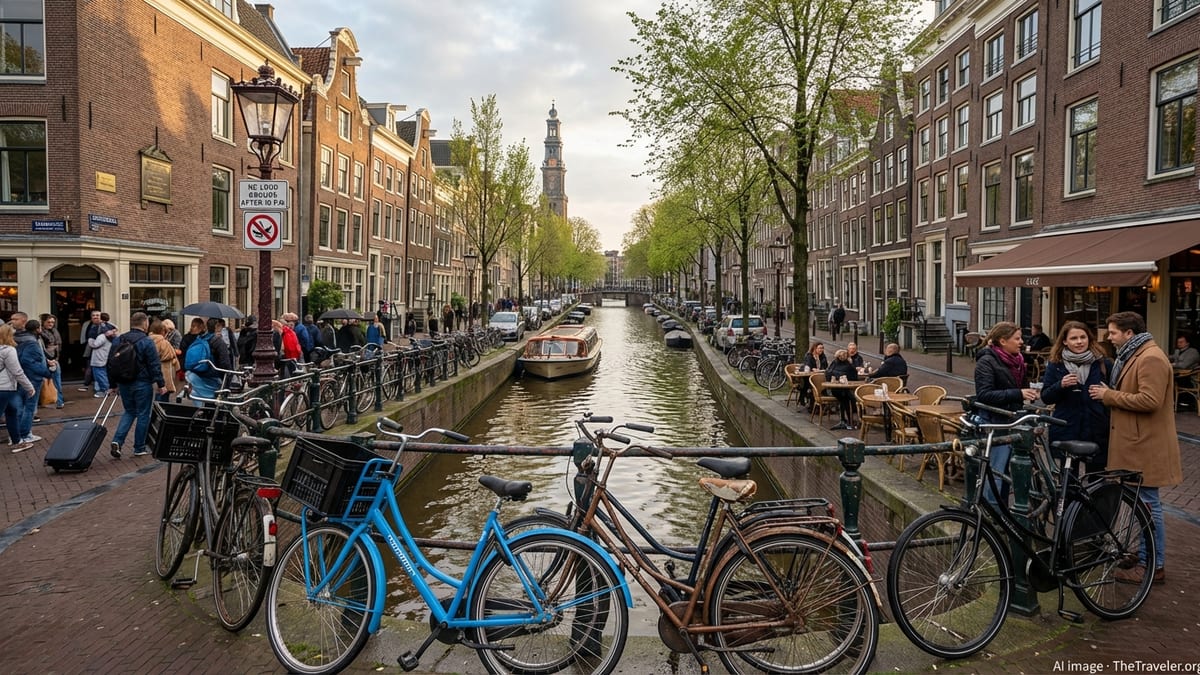
In the Netherlands, Amsterdam has been at the forefront of Europe’s most high‑profile tourism crackdowns. Following years of concern about nuisance tourism in the Red Light District, the city introduced a ban on smoking cannabis in key central streets and squares, backed by fines that local guides describe as substantial. Separate rules restrict alcohol sales at night and curb street drinking, while licensing policies for short‑term rentals have been tightened in residential areas.
Recent updates to municipal policy indicate that Amsterdam is using planning rules to cap or reduce tourism infrastructure in the most saturated areas. No new hotels are being allowed in the historic center, and the city has moved to limit certain types of entertainment venues that target stag and hen parties. There has also been public discussion about relocating some coffeeshops and further restricting large guided groups in narrow streets, part of a wider effort to redefine the city’s image from a party destination to a cultural capital with stricter visitor etiquette.
Austria, meanwhile, is wrestling with overtourism of a different kind. Alpine and lakeside destinations such as Hallstatt have drawn intense interest through social media exposure, leading to daily coachloads of day‑trippers into small communities. In response, local authorities have introduced higher parking fees, limits on bus arrivals and plans for caps on the number of large tour groups allowed in the village at any one time. Reports from the Salzkammergut region describe trial systems where buses must pre‑book arrival slots and pay premium rates at peak times.
Across Austria’s Alpine regions, national park managers and local governments are also tightening rules on hiking, camping and vehicle access. Restrictions on wild camping, reinforced trail etiquette, and seasonal road closures are framed as measures to protect fragile mountain environments from erosion, litter and wildfire risk during increasingly intense summer seasons.
What Travelers Need to Know for 2025 and Beyond
For international travelers planning European trips in 2025 and 2026, the patchwork of new restrictions means more homework and fewer spontaneous, “show up and go” day trips. Many popular cities now require or encourage advance booking windows for major attractions, while some, like Venice, effectively treat entry to historic districts on peak days as a ticketed experience for non‑overnight visitors. Failing to understand local rules can result in unexpected costs, from day‑tripper access fees to on‑the‑spot fines for behavior that might be tolerated elsewhere.
Tourist taxes are also becoming more complex. Overnight levies that once added just a small sum per night are rising in many destinations and may vary by season, location and accommodation type. At the same time, behavior‑linked fines are proliferating: penalties for public drunkenness, noise, inappropriate dress away from beaches, swimming in restricted areas or ignoring smoking bans are now common in coastal resorts and historic centers across the continent.
Industry analysts note that these moves coincide with the rollout of new border management systems at the European level, including enhanced entry and exit checks for non‑European Union nationals. While these initiatives are driven primarily by security and migration policy rather than tourism management, they contribute to an overall tightening of travel rules in and around the Schengen Area. Together with local measures on the ground, the result is a more regulated environment in which visitor flows are more closely monitored and controlled.
Travel organizations and destination marketing bodies are increasingly advising visitors to think in terms of shoulder seasons, lesser‑known regions and longer stays rather than short, high‑impact weekend breaks in already saturated hotspots. The emerging message from Italy, Spain, France, Greece, the Netherlands, Croatia, Portugal, Austria and beyond is clear: Europe still wants tourists, but on terms that prioritize resident wellbeing, cultural preservation and environmental sustainability over raw arrival numbers.