

More news on this day
Rail passengers across Europe face a growing web of delays and cancellations in 2026, as Italy becomes the latest country to confront severe train disruptions alongside Belgium, the United Kingdom, France and Germany.
Get the latest news straight to your inbox!
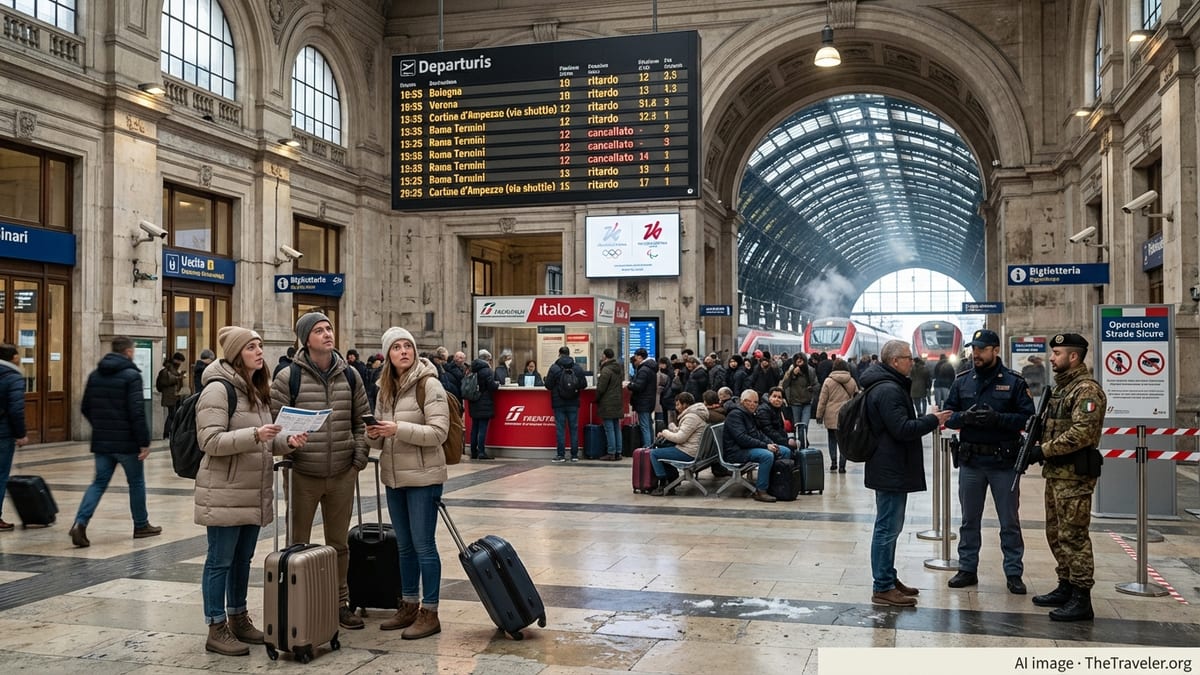
Italy’s Network Hit by Sabotage, Strikes and Planned Closures
Italy has moved to the forefront of Europe’s rail challenges after a series of incidents and planned works converged in early 2026. Publicly available information describes coordinated sabotage against national railway infrastructure in February, affecting key corridors and forcing operators to curtail or reroute services while damage was assessed and repaired. The episode highlighted how vulnerable dense, high‑volume rail networks can be to targeted disruption.
At the same time, Italian travelers are being warned about multiple rounds of industrial action and engineering works affecting both high speed and regional services. Strike notices covering Trenitalia, regional subsidiaries and private operator Italo point to cancellations and altered timetables on selected dates in February and March, adding uncertainty for both domestic passengers and international visitors planning to move between major cities by train.
Planned infrastructure upgrades are compounding that volatility. Work on the crucial Rome to Florence high speed axis, including the roll‑out of the European Rail Traffic Management System, is leading to temporary closures and timetable thinning on some of Italy’s busiest long‑distance routes. Travel advisories show periods where high speed options disappear from booking platforms for specific days, forcing passengers onto slower regional trains or alternative transport.
For tourists, the combined effect is significant. Routes such as Venice to Florence and Rome to Florence, long marketed as seamless high speed hops, are now subject to rolling changes that require close monitoring of schedules and, in some cases, last‑minute rebooking. Industry observers note that Italy’s situation has shifted from occasional strike‑day disruption to a more structural period of instability across parts of the network in 2026.
Belgium’s Repeated Rail Strikes Strain a Dense Crossroads Network
Belgium, a core junction for north‑west Europe’s passenger and freight flows, entered 2026 already in the midst of deep rail unrest. Reports from strike trackers and local coverage show a succession of nationwide stoppages by staff at national operator SNCB/NMBS and infrastructure manager Infrabel, including a five‑day walkout in late January that severely thinned services and left some routes without any trains at all.
Union actions in March added further disruption, overlapping with a broader multi‑sector national strike and demonstrations in Brussels. While not every day of protest directly halted trains, reduced staffing and precautionary timetable cuts complicated journeys for commuters and international travelers relying on Belgium’s dense rail grid to reach cities such as Brussels, Antwerp, Ghent and Bruges.
Alongside industrial action, planned engineering works are altering cross‑border patterns on key corridors linking Belgium with the Netherlands, Germany and France. Notices from SNCB International point to temporary diversions and cancellations for international services on selected weekends in 2026, including route restrictions for trains running between Brussels, Rotterdam and Amsterdam as track works proceed.
The result is that Belgium’s role as a reliable rail gateway has weakened in the short term. Travel planners increasingly warn that itineraries passing through Brussels may require additional buffer time or contingency plans, especially during announced strike windows, as the country’s railway system absorbs both budget cuts and a contentious overhaul of employment conditions.
United Kingdom: Weather‑Hit Services and Capacity Pressures
In the United Kingdom, the focus in early 2026 has shifted from headline‑grabbing strikes to the combined impact of extreme weather and long‑running capacity constraints. A powerful winter storm in late January brought heavy rain and high winds across much of the country, forcing operators to suspend or severely limit rail services on several main lines due to flooding, fallen trees and damaged overhead lines.
Publicly available analyses of that storm indicate that routes in western England and Wales were particularly hard hit, with operators such as Great Western Railway temporarily closing sections of track as maintenance teams worked to clear debris and inspect embankments. The event underlined the sensitivity of British rail infrastructure to repeated winter storm systems, which are becoming more frequent and intense.
Beyond weather, passengers are still navigating the aftereffects of several years of industrial disputes, timetable changes and infrastructure bottlenecks. Even when formal strike action is paused, short‑notice cancellations, driver shortages on certain regional routes and speed restrictions on aging sections of track continue to undermine reliability. Industry commentators note that, from a traveler’s perspective, the disruption increasingly feels like a chronic condition rather than an isolated series of strike days.
International rail links from the UK have also been indirectly affected by wider European issues. When Belgian or French services are reduced because of strikes or infrastructure incidents, passengers on cross‑Channel routes can encounter missed connections, altered departure times and crowded replacement services, making long‑planned journeys more unpredictable.
France and Germany Juggle Accidents, Strikes and Overloaded Infrastructure
France and Germany, home to two of Europe’s largest rail systems, are also contributing to the sense of continent‑wide instability. In France, recent reports on the national operator’s performance describe a series of safety incidents and localised derailments that have forced closures on key freight and regional corridors, followed by technically complex recovery operations that can last weeks.
French media coverage in early April detailed a fatal collision between a high speed train and an oversized road convoy in northern France, prompting an intensive investigation and renewed scrutiny of level crossing safety. While high speed services on core routes have largely remained intact, these incidents add to a wider picture of stress on infrastructure, where heavily used conventional lines must accommodate a mixture of fast passenger trains and slower freight.
Germany, meanwhile, is grappling with the legacy of prolonged industrial disputes and underinvestment, even in a period when new strike agreements formally limit further walkouts at the main national operator. Publicly reported figures for 2025 show long distance punctuality falling to around 60 percent, with political leaders warning that persistent delays are eroding public confidence and undermining the appeal of rail compared with road and air.
Severe winter weather has also battered German rail services in 2026. A major January storm brought heavy snow and ice to large parts of the country, prompting Deutsche Bahn to suspend long distance trains across the north and advise passengers to postpone non‑essential journeys. Combined with ongoing construction works and speed restrictions on congested corridors, the storm created a backlog of disruption that took days to resolve.
A Fragmented but Interconnected Crisis for European Rail Travel
While each country’s difficulties stem from a different mixture of strikes, sabotage, accidents, funding decisions and weather, the effect for travelers in 2026 is cumulative. Europe’s railways function as an interconnected web, so a derailment in northern France, a storm in western Britain or a strike in Belgium can ripple quickly into missed connections and disrupted itineraries for passengers journeying between Italy, Germany and the Netherlands.
Travel agencies and trip planners are responding by placing greater emphasis on contingency. Public guidance increasingly encourages travelers to build flexibility into schedules, avoid tight transfers between separate rail operators and monitor service alerts closely in the days before departure. Some are advising visitors to favor fully flexible tickets when crossing multiple borders, despite the higher upfront cost.
At the policy level, the turmoil is sharpening debates over investment and modernization. Programmes to roll out advanced signaling systems such as ERTMS, renew aging tracks and increase capacity are framed as essential to long term reliability, yet they impose short term pain through partial closures and temporary timetable cuts. In several countries, political arguments over budget priorities, ticket pricing and the balance between passenger and freight services are intensifying as disruptions mount.
For now, rail remains central to Europe’s ambitions for low carbon mobility, and passenger numbers on many core routes are still recovering or growing. Yet Italy’s arrival alongside Belgium, the United Kingdom, France and Germany in experiencing severe disruptions underlines how fragile that vision can be without sustained, coordinated efforts to make the continent’s railway networks more resilient.