

More news on this day
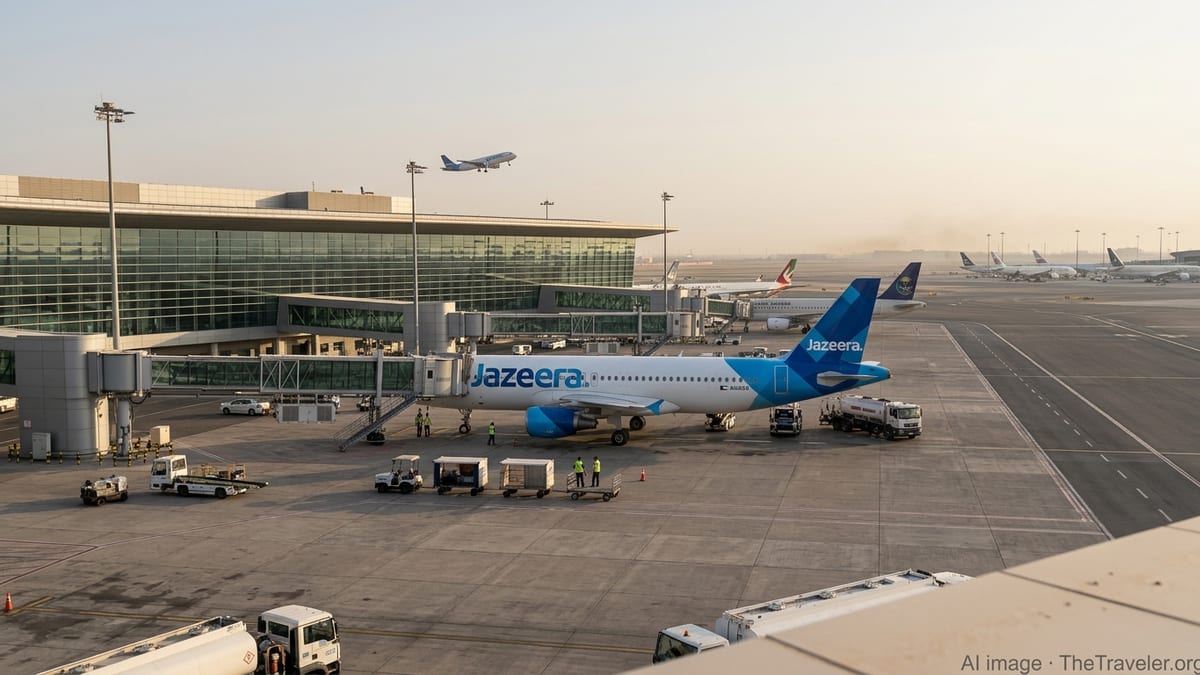
Jazeera Airways is rapidly stitching together a tighter web of regional air links across the Gulf, with expanded daily services that strengthen connectivity between the United Arab Emirates, Saudi Arabia and its Kuwait hub, creating new momentum for business travel, tourism and family visits at a time of robust demand for intra-GCC mobility.
Get the latest news straight to your inbox!
Daily Frequencies Turn Kuwait Into a High-Throughput Gulf Bridge
Publicly available schedules show Jazeera Airways steadily increasing frequencies on key short-haul routes linking Kuwait with major cities in Saudi Arabia and the UAE, turning Kuwait International Airport into a practical bridge for point-to-point and connecting traffic across the northern Gulf. The carrier’s model of high-utilisation narrowbody aircraft and short ground times is designed to support more daily rotations, giving travellers multiple departure options in both directions.
Travel industry analyses of Gulf aviation trends indicate that frequent daily services, rather than limited weekly flights, are now the benchmark for competitiveness in the region’s high-density corridors. For passengers moving between the UAE and Saudi Arabia, Kuwait’s position in the middle of the Gulf, combined with a low-cost fare structure, offers an additional routing choice to complement the large hubs in Dubai, Abu Dhabi and Riyadh.
Regional aviation data also suggests that Gulf passengers are increasingly mixing business and leisure on the same trips, boosting demand for flexible, short-notice bookings. By aligning its schedules to offer multiple daily departures and late-evening or early-morning options, Jazeera Airways is positioning itself to capture this fast-growing segment of travellers who prize convenience and price sensitivity in equal measure.
Restored UAE Routes Add New Options for Abu Dhabi and Al Ain
According to recent industry coverage, Jazeera Airways has restored flights from Kuwait to Abu Dhabi and Al Ain, effectively putting two key UAE gateways back on its route map and deepening cross-border connectivity for both residents and expatriates. The resumption of these routes gives travellers in the UAE more direct access to Kuwait, while also opening new one-stop possibilities onward to Saudi Arabia and other regional destinations through Jazeera’s network.
For Abu Dhabi and Al Ain, the added capacity from a low-cost operator expands the local catchment’s choice beyond the dominant full-service and home-based carriers. Residents in these cities, who previously might have relied on road transfers to Dubai to secure the widest range of flights, can now originate closer to home, cutting travel time and improving overall trip convenience.
The move aligns with a broader shift in the UAE toward budget-friendly aviation, with market reports highlighting rapid growth of low-cost carriers and a surge in price-conscious travellers from Asia and Africa living in the Gulf. In this environment, Jazeera Airways’ restored UAE routes help broaden the competitive landscape and reinforce the UAE’s role as a central pillar in the region’s aviation ecosystem.
Strategic Saudi Links Support Tourism, Umrah and Emerging Hubs
The Kuwait-based carrier has also sharpened its focus on Saudi Arabia, where sustained investment in tourism and infrastructure is driving continued growth in air travel. Publicly available information shows Jazeera Airways operating a mix of scheduled flights and Umrah charter services into the kingdom, targeting both religious traffic and leisure travellers drawn by Saudi Arabia’s new cultural and nature-focused destinations.
Recent reporting indicates that Jazeera Airways has even shifted some operations into Saudi territory temporarily, using airports in the Eastern Province to maintain service continuity during Kuwait’s airspace disruptions. This flexible use of Saudi gateways underscores the deepening operational interdependence between Gulf states and highlights how Saudi airports are emerging as critical back-up and growth platforms for regional carriers.
At the same time, initiatives such as direct flights connecting Kuwait to the Aseer region in southwest Saudi Arabia signal a push beyond the traditional trunk routes of Riyadh, Jeddah and Dammam. By linking Kuwait directly with secondary Saudi regions that are being promoted for domestic and regional tourism, Jazeera Airways is tapping into new flows of Gulf holidaymakers and short-break travellers eager to explore lesser-known destinations.
Low-Cost Capacity Unlocks New Opportunities for Business and Families
Analysts tracking Gulf aviation note that low-cost carriers now account for a significantly larger share of Middle East seat capacity than a decade ago, reflecting a structural shift in how residents move around the region. Jazeera Airways’ expanding daily flights between Kuwait, Saudi Arabia and the UAE fit squarely within this trend, placing downward pressure on average fares and making frequent cross-border trips more achievable for small businesses and families.
For business travellers, the combination of multiple daily frequencies and relatively short sector lengths allows for same-day returns between key markets, a valuable feature for executives and entrepreneurs who need to visit clients or suppliers without losing multiple days in transit. This is particularly relevant along the Kuwait–Saudi and Kuwait–UAE corridors, where energy, logistics, construction and financial services maintain dense commercial ties.
Families and expatriate workers also stand to benefit from the expanded schedule. The ability to choose from several daily flights, often outside traditional peak times, makes it easier to coordinate school holidays, weekend reunions and urgent visits. The prevalence of mixed-nationality households across the Gulf further amplifies demand for flexible travel options that can accommodate complex family networks spanning multiple GCC countries.
Gulf Connectivity Strengthens Regional Economic Integration
Economic research on Gulf Cooperation Council states points to tourism and air transport as key contributors to non-oil growth, with the UAE and Saudi Arabia playing central roles as both origin and destination markets. The continued build-out of short-haul capacity by carriers such as Jazeera Airways effectively tightens the mesh of air links that underpins this integration, facilitating smoother flows of people, trade and investment.
Industry briefings on global aviation performance show Middle East carriers outpacing global averages in passenger growth, with Gulf hubs cited as important drivers of that expansion. As more daily frequencies are added between Kuwait, the UAE and Saudi Arabia, the region gains resilience through multiple overlapping routes and airports, reducing reliance on any single hub and spreading economic benefits more widely.
For governments pursuing ambitious tourism strategies and giga-projects, the presence of a competitive, multi-operator network of daily flights is increasingly viewed as an essential enabler rather than an optional extra. Jazeera Airways’ bold expansion across the Gulf’s busiest corridors, connecting major and emerging cities alike, illustrates how low-cost carriers are complementing the region’s flagship airlines by offering additional capacity, greater choice and more granular connectivity that supports both everyday travel and long-term growth.