

More news on this day
Fort Lauderdale is stepping into a new role on the U.S. air travel map as JetBlue’s latest wave of routes, premium cabins and connections turns the beachfront city into a fully fledged hub for Florida, the Caribbean and Latin America.
Get the latest news straight to your inbox!
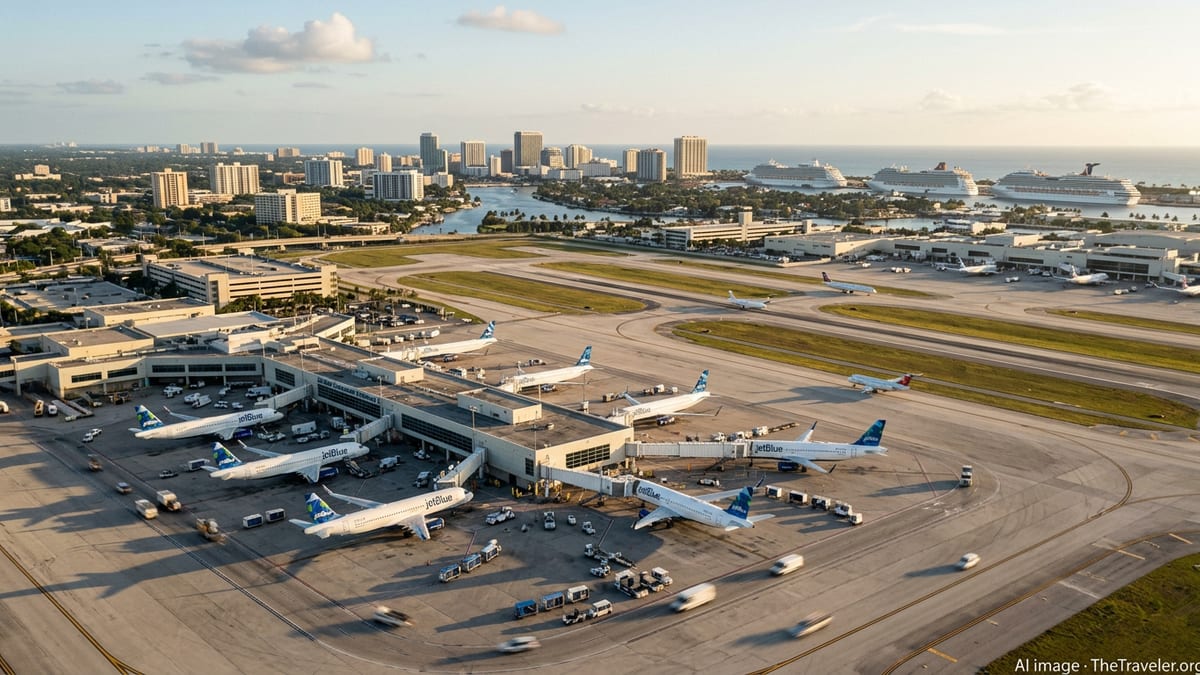
JetBlue’s Biggest Bet Yet on Fort Lauderdale
JetBlue has been steadily growing at Fort Lauderdale–Hollywood International Airport for more than a decade, but its latest moves firmly establish the airport as one of the carrier’s most important focal points. Fort Lauderdale was JetBlue’s first destination when it launched service 25 years ago, and the airline now positions the Broward County gateway as a cornerstone of its South Florida strategy, alongside Miami and Orlando. Recent schedules show JetBlue operating a record peak of more than 110 daily departures in the winter season, with the company outlining plans in recent investor presentations to grow toward roughly 250 daily flights over time.
That scale tips Fort Lauderdale beyond “focus city” status toward what analysts increasingly describe as a de facto hub. JetBlue dominates the airport’s passenger share and has used it to carve out a competitive niche between traditional full-service airlines at Miami and ultra-low-cost rivals that also crowd the South Florida market. The result is a network optimized for leisure, cruise and visiting-friends-and-relatives traffic, with growing options that appeal to small business travelers as well.
The expansion reflects a long-term bet on South Florida’s rapid growth and Fort Lauderdale’s strategic location between major highways, Brightline’s intercity rail and Port Everglades, one of the world’s busiest cruise ports. For travelers, it means more nonstop choices, shorter connections within Florida and a wider menu of price points and onboard experiences than the airport has ever seen.
New Routes Tie Florida, the Caribbean and Latin America Together
JetBlue’s latest timetable filings show Fort Lauderdale at the center of a dense web of routes fanning across Florida and deep into the Caribbean and Latin America. Over the past year the airline has announced or launched numerous new Fort Lauderdale routes, including additional service to Aruba, Guatemala City and secondary Caribbean islands, alongside added frequencies to established leisure destinations. In corporate briefings, JetBlue highlights 17 new routes from Fort Lauderdale in the current expansion phase, spanning both international and domestic markets.
Within Florida, Fort Lauderdale is now a connective spine for JetBlue. The carrier has added year-round nonstop flights to Orlando and Dallas Fort Worth, with Orlando in particular designed to link its South and Central Florida focus cities. These links give travelers options to route through Fort Lauderdale instead of congested hubs farther north, while also supporting connections to Central and South America. Earlier growth phases also saw service to cities such as Tallahassee, expanding access from Florida’s capital to the broader JetBlue network via Fort Lauderdale.
Internationally, Fort Lauderdale has been cultivated as a major gateway to Latin America and the Caribbean. JetBlue markets the airport as a launch point to popular vacation spots and VFR destinations including Colombia, the Dominican Republic and the Lesser Antilles. The addition of Cali, Colombia, to the network from Fort Lauderdale underscores a strategy of using the airport to reach important secondary markets that are underserved from other U.S. gateways. For South Florida residents, that means more nonstop options; for travelers from smaller U.S. cities, it often means a single connection through Fort Lauderdale instead of multiple stops.
This pattern of growth also positions Fort Lauderdale as an attractive embarkation point for cruise passengers. The airport’s proximity to Port Everglades makes same-day arrivals and departures more practical, and a wider range of flight choices can help smooth out the weekend peaks that are typical of cruise seasons.
Mint, Bases and a More Premium Fort Lauderdale Experience
JetBlue’s network expansion at Fort Lauderdale is being matched by an upgrade in onboard products and crew resources. The airline has begun to extend its Mint business-class cabin, long centered on transcontinental and transatlantic routes, to more flights linked to Fort Lauderdale. Recent announcements detail an expanded Mint presence on select routes from Fort Lauderdale to key domestic and Caribbean destinations, signaling that the carrier sees sufficient premium demand in and out of South Florida to justify the extra investment.
To support that premium push, JetBlue plans to open a dedicated Mint inflight crew base in Fort Lauderdale in early 2026. The base will allow the airline to position trained Mint crew members closer to a growing roster of flights operating with its lie-flat product, improving reliability while also deepening its employment footprint in Broward County. The move follows the pattern JetBlue has used at other key airports where Mint has become a core differentiator.
Onboard, travelers can expect the familiar JetBlue mix of free high-speed Wi-Fi, live television, seatback entertainment and complimentary snacks on even short-haul flights from Fort Lauderdale. Mint customers enjoy lie-flat seats, enhanced dining and priority airport services. As more Mint-equipped aircraft cycle through Fort Lauderdale rotations, local passengers are gaining access to a level of service that historically required flying from New York or Boston.
For the airport, the shift toward a more premium product mix raises the profile of Fort Lauderdale as a viable alternative to Miami for certain high-yield travelers. It also encourages other airlines to match or at least narrow the comfort gap, contributing to a broader uplift in the passenger experience across terminals.
Ground Connections and What Travelers Need to Know
Fort Lauderdale’s emergence as a JetBlue hub is also reshaping how travelers move on the ground. The airport sits within a short drive of downtown Fort Lauderdale and Hollywood, with extensive rideshare and rental car facilities, but the most notable recent change is the growing role of Brightline’s intercity rail. JetBlue and Brightline have rolled out an intermodal partnership that lets passengers combine rail and air segments across South and Central Florida, including shuttle links between the airport and Brightline’s downtown station.
The rail-air tie-up is intended to help travelers avoid highway congestion between regional cities such as Miami, West Palm Beach and Orlando, instead using Fort Lauderdale as a flexible switching point between trains and flights. While the agreement is still evolving, it is already expanding the airport’s effective catchment area, drawing passengers from well beyond Broward County who might previously have flown only from Miami or Orlando.
Inside the terminals, JetBlue’s scale translates into more check-in counters, branded gate areas and a larger local staff presence than competing carriers. Travelers connecting through Fort Lauderdale should allow sufficient time to navigate between concourses, particularly during peak cruise and holiday periods, but benefit from relatively straightforward wayfinding and a growing mix of food and retail outlets. For those planning tight cruise connections, earlier arrivals remain the safest strategy, but the broader JetBlue schedule now offers more same-day alternatives if a delay disrupts plans.
Practical details matter. Passengers booking multi-city or connection-heavy trips should pay close attention to minimum connection times, especially when linking international and domestic flights through Fort Lauderdale. JetBlue encourages travelers heading to the Caribbean and Latin America to build in extra time for outbound document checks and inbound customs and immigration, even as the carrier and airport work to streamline flows.
How the Expansion Changes Options for U.S. Travelers
For travelers across the United States, JetBlue’s Fort Lauderdale build-out is gradually changing the map of convenient one-stop journeys. Secondary and mid-size cities in the Northeast and Midwest increasingly see Fort Lauderdale appear as a connection point on JetBlue itineraries to the Caribbean and Latin America, offering an alternative to traditional hubs like Atlanta or Miami. This can mean shorter total journey times, more competitive fares and access to JetBlue’s onboard product for the long southbound leg.
The Fort Lauderdale focus also underpins JetBlue’s efforts to compete more aggressively in Florida itself. By strengthening links between Fort Lauderdale, Orlando and a growing roster of in-state destinations, the airline is effectively stitching together a Florida corridor that serves both residents and visitors. Families planning theme park vacations, snowbirds connecting to Gulf Coast beaches and business travelers shuttling between regional offices now have more nonstops and day-trip possibilities than in the past.
Industry observers note that the strategy carries risks, especially in a market as competitive and seasonal as South Florida. Capacity decisions are closely tied to demand cycles, and schedules can still shift from one season to the next. Even so, JetBlue’s sustained investment in Fort Lauderdale infrastructure, crew bases and premium products suggests that the airport’s role in the network is durable, not experimental.
For now, travelers can expect Fort Lauderdale to feature more prominently in fare searches and route maps, particularly for sun-bound journeys. As JetBlue layers in additional routes and refines its partnership with Brightline, the city’s airport looks set to function less as a secondary option and more as a central gateway in its own right.