

More news on this day
Hundreds of air passengers remain stranded at Amman’s Queen Alia International Airport as the escalating Iran crisis ripples across regional airspace, forcing widespread cancellations, lengthy delays and fresh uncertainty for Jordan’s fragile tourism recovery.
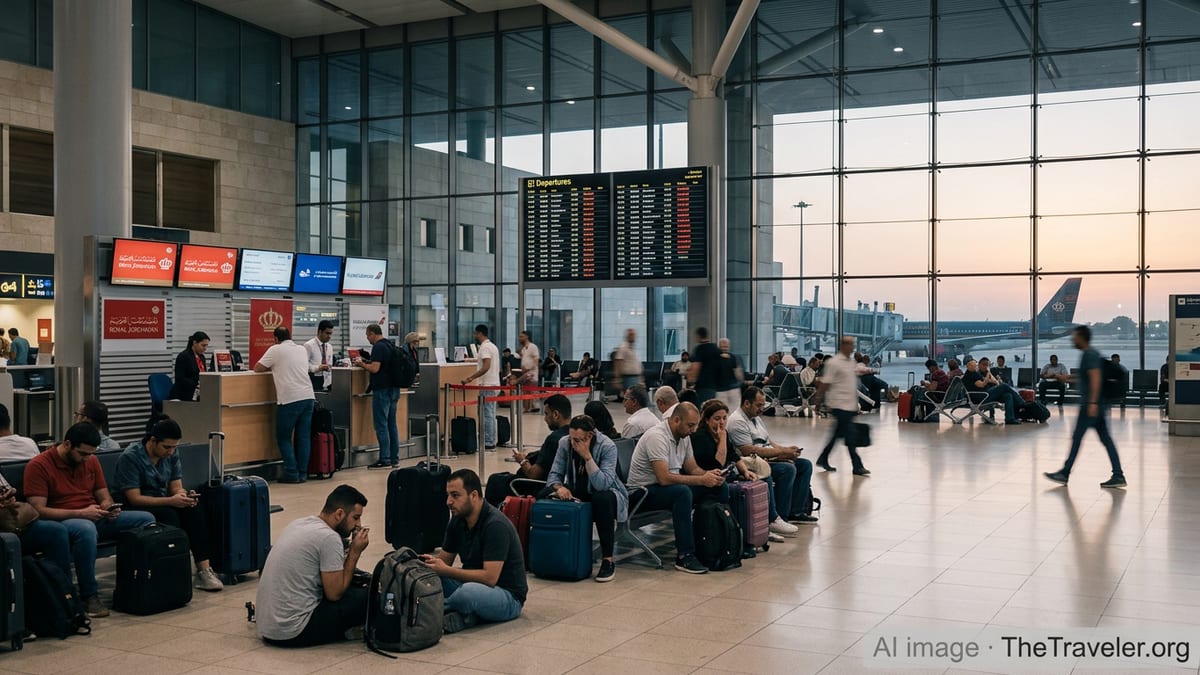
Flight Cancellations Mount at Queen Alia Airport
Operational data and passenger reports from Queen Alia International Airport in recent days point to a sharp spike in disruption, with more than fifty flights cancelled and scores delayed as airlines react to shifting airspace restrictions linked to the Iran conflict. Local aviation trackers counted at least 36 cancellations and over 50 delays in a single 24 hour period earlier this week, leaving departure halls crowded with travellers sleeping on benches, queueing at customer service desks and anxiously checking departure boards.
Royal Jordanian, the national carrier, has been among the most affected airlines at its Amman hub as it juggles aircraft that have been left out of position by earlier diversions, alongside evolving route bans over parts of Iran, Iraq and Israel. While the airline insists its core network is operating, numerous regional and European rotations have experienced last minute cancellations or multi hour delays, particularly services touching Gulf hubs and key European cities.
Low cost operators have not been spared. Budget carrier Ryanair has cancelled multiple services linking Amman with European destinations, including at least one recent Brussels rotation, leaving price sensitive travellers with limited alternatives and expensive rebooking options. Several passengers have reported struggling to secure rerouting under European passenger rights rules, as full flights and constrained capacity across the region shrink the pool of available seats.
Regional heavyweights are also trimming their Amman schedules. Saudia has temporarily suspended or reduced flights on several routes touching Jordan amid wider cuts across its network, while Egypt Air has adjusted services connecting Amman with Cairo and onward African and European destinations. Together with disruption at Gulf hubs, the changes are eroding Amman’s role as a reliable connection point at precisely the moment many travellers had returned to the region after previous rounds of instability.
Iran Crisis Sends Shockwaves Through Regional Airspace
The turmoil in Amman is part of a wider aviation shock triggered by the latest escalation between Iran and its rivals, which has led to missile and drone attacks, air defense activity and shifting military deployments across the Middle East. Governments in multiple countries have responded with varying degrees of airspace closure and restrictions, forcing airlines to cancel flights outright or to adopt long detours that add hours of flying time and strain crew and aircraft rosters.
Jordan’s authorities briefly restricted national airspace after Iranian strikes in late February, before reopening with tougher safety protocols that require real time monitoring of any new launches and allow for rapid re closures on short notice. Even as the skies above Jordan have technically reopened, continued volatility in neighbouring sectors means flight paths that once cut directly across the Levant now zigzag south and west via Egypt or Saudi Arabia, tightening an already crowded corridor of safe routing options.
International airlines operating into Amman say safety remains the overriding priority, with some carriers deciding to keep suspensions in place beyond the immediate period of active strikes. European and Asian operators have warned that as long as Iranian airspace and several adjoining flight information regions remain constrained, services to Jordan and other regional destinations will remain vulnerable to last minute schedule changes, both for operational and insurance reasons.
Industry analysts note that while airlines and regulators are more experienced in handling conflict zone routing than a decade ago, the geographic breadth of the current Iran crisis is creating an unusually dense knot of no fly zones and risk areas. For a country such as Jordan, sandwiched between conflict theatres and reliant on overflight corridors that skirt them, even indirect disruptions can quickly cascade into cancelled rotations and stranded passengers.
Stranded Passengers Face Long Queues and Limited Options
For travellers caught in the middle of the turmoil, the impact is deeply personal. At Queen Alia, families with small children, business travellers and tour groups have reported waiting in terminal corridors for updates that often come only minutes before scheduled departure. Some passengers recount being informed that their flights were operating as normal on airline apps, only to arrive at the airport to find departure boards flashing cancelled or indefinitely delayed.
With hotel availability in Amman tightening, especially near the airport and in central districts, many stranded passengers have opted to remain airside overnight rather than risk missing potential rescue flights or rebooked departures. Airport seating areas have been repurposed into ad hoc sleeping zones, with travellers using jackets and luggage as makeshift bedding while they wait for check in desks to reopen.
Front line airline staff and ground handlers have been left to manage a surge in rebooking and refund requests at service counters. Passengers on Royal Jordanian, Ryanair, Saudia and Egypt Air services have described long lines to reach a human agent, followed by difficult choices between accepting circuitous rerouting via multiple hubs or gambling on later direct flights that may themselves be vulnerable to cancellation.
Consumer advocates caution that while many cancellations are outside airlines’ control due to airspace closures and security directives, carriers still retain legal obligations under different passenger rights regimes, particularly on flights to and from the European Union. However, the sheer volume of affected routes, combined with limited spare capacity, means that even passengers entitled to compensation or alternative transport may struggle to secure timely solutions in practice.
Tourism and Jordan’s Image as a Safe Gateway at Risk
The disruption comes at a sensitive moment for Jordan’s travel and tourism sector, which had been banking on a strong spring season to consolidate its post pandemic recovery. March is typically a high demand month for visits to Petra, Wadi Rum and the Red Sea resort of Aqaba, with many itineraries built around smooth connections through Amman on regional and European carriers.
Tour operators report a growing wave of nervous inquiries and postponements from clients who had planned multi country itineraries combining Jordan with Egypt, the Gulf or the Holy Land. Even when travel within Jordan remains safe and attractions are open, uncertainty over whether travellers can reliably enter and exit via Amman’s gateway is prompting some to delay bookings or to reroute through alternative hubs in the eastern Mediterranean.
Local businesses that depend on inbound tourism, from boutique hotels and desert camps to dive centres and guiding companies, fear that images of stranded travellers at Queen Alia and headlines about cancellations will once again dent Jordan’s hard won reputation as a comparatively stable base in a volatile neighbourhood. Industry groups are urging authorities and airlines to communicate clearly and consistently about risks, contingency planning and the measures being taken to keep air links open where feasible.
Analysts warn that if the Iran crisis drags on, the damage to Jordan’s visitor economy could extend well beyond the immediate period of disruption. Even a temporary perception that the country is difficult to reach, or that travel plans risk being upended at short notice, can push long haul tourists and high spending groups to shift their focus to rival destinations, with knock on effects for employment and investment.
Airlines and Authorities Work on Recovery Plans
In response to mounting pressure, Jordanian aviation authorities and airline executives have been holding regular coordination meetings to review routes, overflight options and emergency protocols. Regulators have stressed that any reopening or expansion of flight paths will be driven by safety assessments, even as they acknowledge the intense economic and political imperative to restore connectivity.
Royal Jordanian is gradually rebuilding its schedule where conditions allow, prioritising routes with high numbers of stranded passengers and essential travel demand. The airline has encouraged customers to monitor flight status channels closely and to opt into notification systems, while also warning that short notice changes remain possible as the regional security picture evolves day by day.
Other carriers with a presence in Amman, including Saudia, Egypt Air and low cost operators such as Ryanair, are weighing up whether to reinstate suspended rotations or to consolidate services in order to better match reduced demand and available safe routings. Some have introduced temporary flexibility policies, allowing passengers to change dates or destinations without additional fees, in an effort to retain customer loyalty amid the turmoil.
Aviation observers say the path back to normality will likely be uneven, with periods of relative calm punctuated by renewed spikes in disruption whenever tensions flare or military activity intensifies. For now, travellers to and from Jordan are being advised to build extra time and flexibility into their plans, purchase comprehensive travel insurance and stay in close contact with airlines as the fallout from the Iran crisis continues to reshape the region’s skies.