

More news on this day
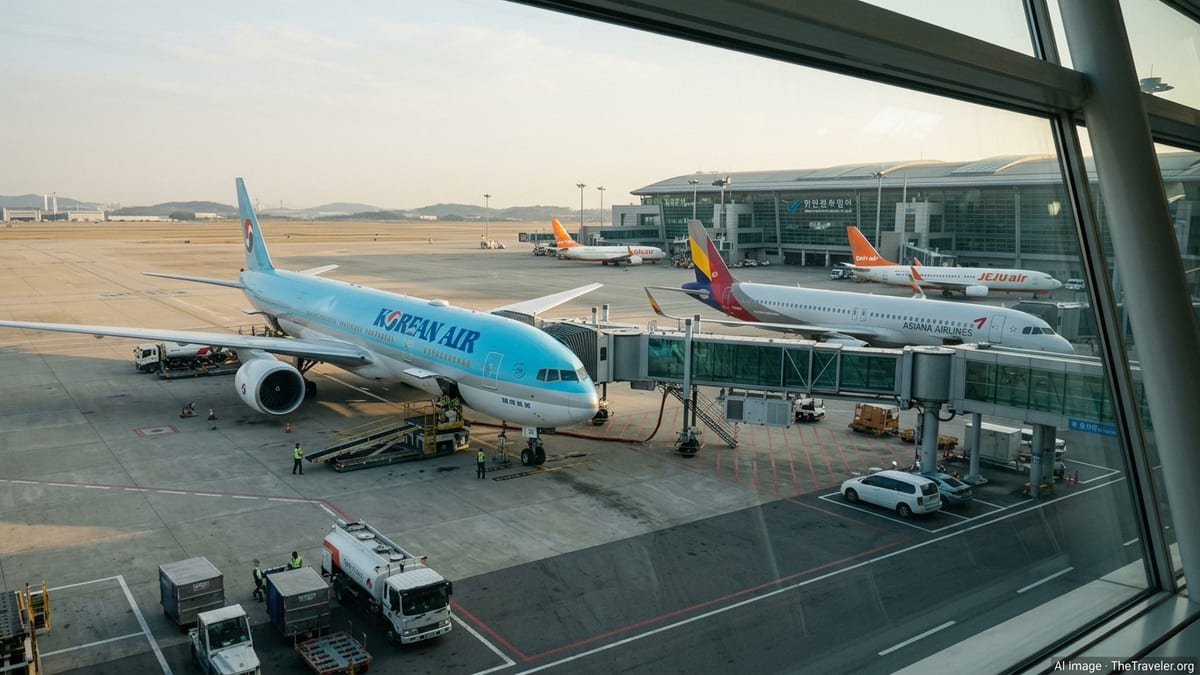
Travelers flying between South Korea and major cities such as New York and Tokyo face higher ticket costs as Korean Air joins Asiana, Jeju Air, Air Busan, T’way, Eastar Jet and other carriers in lifting fuel surcharges in response to a rapid jump in global jet fuel prices.
Get the latest news straight to your inbox!
Global Oil Spike Filters Quickly Into Korean Airfares
Published industry data shows aviation fuel benchmark prices have almost doubled since early January 2026, driven by tighter refining capacity, supply disruptions linked to conflict in the Middle East, and strong post-pandemic travel demand. Jet fuel now accounts for a larger share of airlines’ operating expenses, leaving carriers across Asia with limited options beyond adjusting fares and surcharges.
Analysts note that South Korean airlines are particularly sensitive to swings in fuel costs because of their long-haul reliance on routes to North America and Europe, alongside dense regional networks to Japan and Southeast Asia. As fuel markets tightened in late February and early March, Korean carriers began filing revised surcharge tables for upcoming ticketing periods, citing higher reference prices for aviation turbine fuel.
According to published coverage of Asia-Pacific airline trends, carriers across the region are raising total fares on key long-haul routes by low double-digit percentages, often by adjusting a combination of base fares and separate fuel surcharges. South Korean airlines are following that pattern, adding more weight to the surcharge component so that adjustments can track fuel markets more closely in the months ahead.
For travelers, the practical effect is straightforward: a larger portion of the final ticket price on routes such as Seoul to New York, Los Angeles, London and Tokyo now appears as an itemized fuel surcharge, even when headline promotional fares look unchanged.
How Much More You Could Pay From Seoul to New York and Tokyo
Publicly available surcharge tables and travel-agency guidance indicate that Korean Air has moved its international fuel surcharge bands sharply higher for tickets issued for upcoming travel periods, particularly on long-haul routes that burn the most fuel. While exact amounts vary by cabin, distance band and point of sale, increases on transpacific flights such as Seoul Incheon to New York John F. Kennedy generally translate into surcharges that are tens of thousands of won higher per one-way sector than in recent months.
Asiana Airlines, now under the umbrella of Korean Air but still operating its own network, has introduced parallel surcharge hikes on many international routes. Reports on fare filings suggest that typical long-haul surcharges on routes such as Seoul to North America and Europe have stepped up materially, reversing reductions that were implemented when oil prices were lower in 2024 and early 2025.
On regional routes, low-cost carriers including Jeju Air, Air Busan, T’way Air and Eastar Jet have also raised fuel surcharges for flights between South Korea and major Japanese cities such as Tokyo, Osaka and Fukuoka. Although the nominal surcharge amounts on short-haul routes are smaller than on transpacific services, the percentage increase can feel steep, especially on bare-bones promotional fares where the surcharge now represents a larger share of the total ticket cost.
Travel agencies in Seoul report that a typical round-trip economy ticket from Incheon to Tokyo has recently seen its total tax and surcharge component climb compared with earlier in the year, largely because of the higher fuel element. For popular leisure periods such as spring and early summer, this means travelers heading to Japan or the United States from South Korea should budget for noticeably higher all-in prices than they may remember from 2024 or 2025.
Which Korean Airlines Are Raising Surcharges and Why
Korean Air, the country’s largest full-service carrier, sets its fuel surcharge bands based on average jet fuel prices over a reference period, a practice that is disclosed in its publicly available notices. Once the average fuel price crosses a certain threshold, surcharges automatically move into a higher band for the corresponding ticketing month. This mechanism has now been triggered by the latest fuel spike, pushing surcharges higher on most international routes.
Asiana Airlines uses a similar formula, indexing its surcharges to external fuel benchmarks and adjusting them periodically as conditions change. Industry reports note that Asiana, like Korean Air, had cut surcharges when oil prices eased in 2024, only to raise them again now that fuel has surged. The airline’s long-haul network to cities such as New York, Los Angeles, Frankfurt and Rome is particularly exposed to these cost swings.
Among low-cost carriers, Jeju Air, Air Busan, T’way Air and Eastar Jet have each updated their surcharge schedules on international services, especially to Japan, Southeast Asia and parts of China. These airlines generally rely more heavily on ancillary fees and surcharges to maintain low advertised base fares, so changes in fuel costs are often reflected quickly in the surcharge line rather than in the headline ticket price.
Industry commentary emphasizes that the recent moves are not limited to South Korean carriers. Airlines across Asia, Europe and the Middle East are taking similar steps in response to the same fuel market pressures, so passengers connecting beyond Korea on foreign airlines are also likely to see higher surcharges layered into multi-leg itineraries.
How Fuel Surcharges Are Calculated on Korean Routes
Fuel surcharges are typically calculated using a banded system tied to an established jet fuel benchmark, such as average prices in key trading hubs over a one- or two-month period. When the benchmark remains below a certain threshold, surcharges are set in a low band or even at zero. As the average price rises through preset levels, airlines move up to higher bands, each associated with a specific surcharge amount per flight sector.
South Korean carriers publish these bands and associated surcharges in advance, usually by ticketing period and not by travel date. That means the surcharge you pay depends on when you buy your ticket as much as when you fly. If fuel prices spike and trigger a higher band for tickets issued from, for example, May, travelers purchasing in that month will pay the higher surcharge even if their trip takes place later, when fuel prices may have stabilized.
Another key point for travelers is that fuel surcharges are generally applied per direction and per segment. A round-trip from Seoul to New York with a connection, or a multi-city itinerary combining New York and Tokyo, can therefore accumulate several surcharge components. On some bookings, especially in premium cabins, the combined surcharge total can reach the equivalent of several hundred US dollars.
Because the surcharge is often itemized separately from taxes and base fares, it can move up or down without changing advertised sale fares. This allows Korean carriers to respond more nimbly to oil market movements, but it can also make it harder for consumers to compare total trip costs at a glance across airlines and booking channels.
What Travelers Can Do to Manage Higher Costs
Travel experts suggest that passengers planning trips between South Korea, North America and Japan pay close attention to the breakdown of taxes and fees in fare quotes, not just the base fare. With surcharges now forming a larger share of the total price, small differences in airline policies or ticketing dates can meaningfully change what you pay.
One strategy is to monitor fuel surcharge updates, which Korean carriers usually publish on a monthly or bi-monthly basis, and time purchases when bands are relatively low. However, this can be challenging in a fast-moving fuel market where benchmark prices are volatile and band shifts may not be predictable far in advance.
Passengers using frequent-flyer miles should also check the cash component on award tickets. In some cases, the miles required for an award seat remain unchanged while the fuel surcharge portion rises, eroding the value of the redemption. Comparing award options across alliances and considering departures from different nearby airports, such as Seoul Gimpo or Busan instead of Incheon, can sometimes reveal lower surcharge combinations.
For now, most analysts expect that if global oil prices moderate later in 2026 and jet fuel benchmarks fall back, Korean airlines will eventually move surcharges down again, as they did in previous periods of easing fuel costs. Until then, travelers on popular routes like Seoul to New York and Seoul to Tokyo should be prepared for elevated surcharges to remain a prominent feature of ticket pricing.