

More news on this day
Passengers at Kuwait International Airport faced hours of delays, diversions and mounting frustration on Monday as 66 flights were cancelled amid sweeping Middle East airspace closures that have upended regional and long-haul travel.
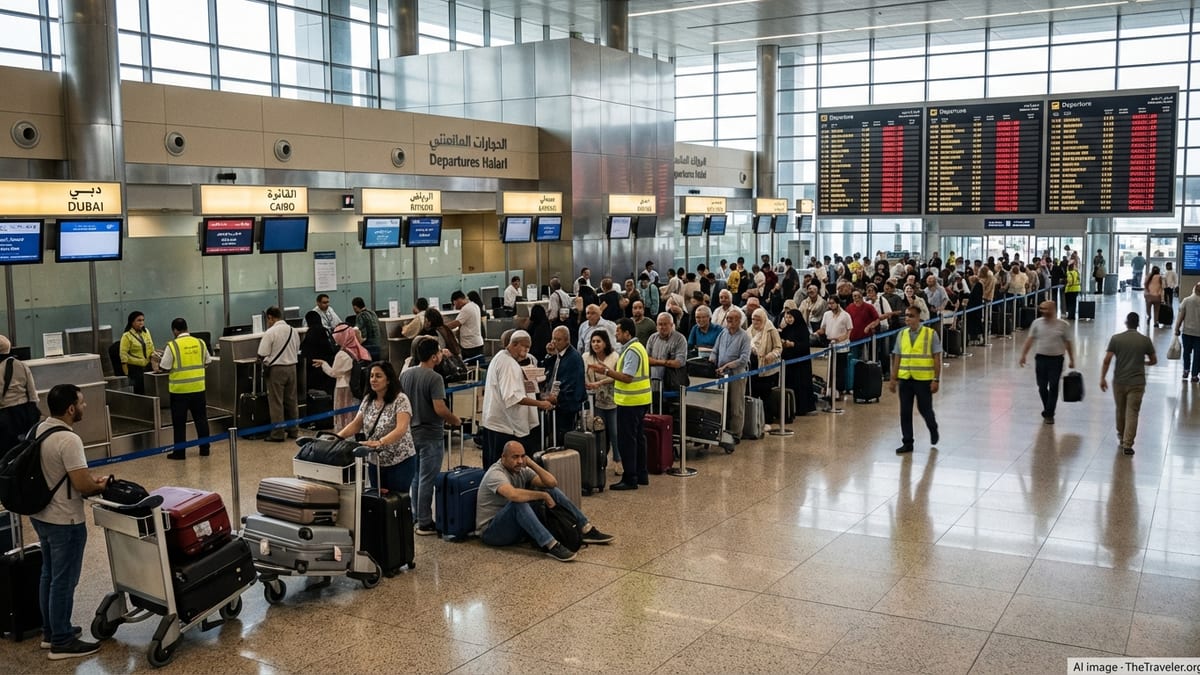
Wave of Cancellations Hits Key Regional Routes
Kuwait’s Directorate General of Civil Aviation confirmed that 66 flights were cancelled at Kuwait International Airport as airlines reeled from the closure of airspace across parts of the Gulf and wider Middle East following strikes on Iran and subsequent regional tensions. The disruption affected a mix of arrivals and departures, with knock-on effects for connecting traffic heading to Europe, Asia and North America.
Services to major regional hubs including Dubai, Cairo, Riyadh and Amman were among the most heavily impacted. Flights to and from these cities are critical not only for point-to-point traffic, but also for onward connections through major carriers based in the United Arab Emirates, Saudi Arabia, Egypt and Jordan. With airspace over Iran, Iraq, Kuwait and several neighboring states restricted or temporarily closed, airlines were forced either to cancel outright or attempt lengthy diversions that proved operationally unworkable.
The cancellations at Kuwait International Airport formed part of a wider pattern of upheaval across the region, as national authorities prioritized safety in increasingly congested skies. Flight tracking data showed swathes of previously busy corridors standing virtually empty, underscoring the severity and suddenness of the disruption.
IndiGo, Emirates, Saudia and Other Carriers Scramble
Airlines serving Kuwait moved quickly to adjust operations as the airspace situation evolved. IndiGo, which in recent years has expanded aggressively into Gulf markets from its Indian hubs, had already curtailed extensive services across the Middle East in response to route closures and safety advisories. Its Kuwait flights were among those affected, leaving many India-bound passengers stranded or facing last-minute rebookings through alternative gateways.
Emirates, which relies heavily on feeder traffic from Kuwait into its Dubai mega-hub, was also hit as Dubai International Airport itself restricted operations and much of the surrounding airspace remained closed or tightly controlled. Some long-haul rotations were re-timed or cut entirely, while others were held on the ground as the carrier coordinated new routings around restricted zones and sought updated clearances from aviation authorities.
Saudi Arabia’s flag carrier Saudia, along with other regional airlines operating Kuwait–Riyadh and Kuwait–Jeddah links, cancelled multiple departures as Saudi airspace and airports coped with a surge of rerouted traffic and their own safety measures. Additional carriers flying to Cairo and Amman similarly pulled flights or imposed rolling delays as they assessed whether safe and efficient alternative routings were possible within crew duty and fuel constraints.
Airport officials in Kuwait said airlines were providing a mixture of rebooking options, hotel accommodation where feasible, and refunds, but acknowledged that the scale and regional nature of the crisis meant many passengers were likely to face extended waits before new travel plans could be confirmed.
Passengers Stranded Amid Confusion and Long Queues
Inside Kuwait International Airport’s terminals, the impact of the 66 cancellations was instantly visible. Long queues formed at airline service desks as passengers tried to secure seats on any remaining departures or rerouted services. Information screens showed multiple lines of red “cancelled” notices next to flights bound for Dubai, Cairo, Riyadh, Amman and other regional cities, while loudspeaker announcements repeatedly urged travelers to remain in close contact with their airlines.
Travelers reported mixed experiences depending on the carrier and class of travel. Some were quickly rebooked on later flights or alternative routes via less-affected hubs, albeit with significantly longer journey times. Others, particularly those on low-cost or heavily disrupted airlines, described long waits for clear information as call centers and ground staff struggled to keep pace with rapidly changing operational decisions.
The disruption was especially acute for migrant workers and transit passengers whose itineraries stitched together multiple regional connections. Many had already flown into Kuwait from Asia or Europe only to discover that their onward legs to Dubai or Riyadh were cancelled, leaving them temporarily stuck in the transit area or forced to clear immigration and arrange short-notice accommodation at their own expense.
Airport staff deployed additional volunteers to help with crowd management and wayfinding, while food outlets and lounges remained busy throughout the day as passengers settled in for uncertain waits. Despite the strain, authorities reported that operations inside the terminal remained orderly, with no major security incidents or medical emergencies linked to the disruption.
Regional Airspace Closures Ripple Through Global Networks
The turmoil in Kuwait was one chapter in a much larger story of instability across Middle East airspace. Following strikes on Iran and subsequent retaliatory actions, several countries including Iran, Iraq, Kuwait, Qatar and others imposed sweeping airspace restrictions, while major hubs such as Dubai, Abu Dhabi and Doha temporarily suspended most or all passenger operations.
These closures severed some of the world’s most heavily used east–west corridors, forcing airlines to either cancel flights or undertake long reroutes via alternative tracks to the north or south. Industry analysts noted that with many carriers already unable to use Russian airspace, the loss or restriction of Middle Eastern corridors added a new layer of operational complexity and fuel cost, making some long-haul services temporarily uneconomical.
For Kuwait, which sits at a crossroads between the Gulf and the wider Middle East, the impact has been particularly sharp. Services linking Kuwait City to Dubai, Riyadh, Cairo and Amman feed into broader global networks, and when those spokes are cut, the entire hub-and-spoke system begins to fray. Airlines must juggle aircraft positioning, crew duty limits and maintenance schedules, often leading to rolling waves of cancellations such as those seen with the 66 flights scrapped on Monday.
Aviation regulators across the region continued to coordinate closely, issuing updated advisories and route guidance. Safety authorities reminded carriers that any resumption of flights through affected airspace would require thorough risk assessments, contingency planning and ongoing monitoring of the security situation.
What Travelers Through Kuwait Should Expect Next
With the situation described by airlines as fluid and fast-changing, passengers planning to travel via Kuwait International Airport in the coming days are being urged to build flexibility into their plans. Industry observers expect further cancellations and schedule adjustments as carriers gradually test new routings and as regional authorities reassess the security picture around key air corridors.
Airlines serving Kuwait have advised customers to monitor flight status closely, sign up for text or app alerts, and avoid traveling to the airport until they have confirmed that their flight is operating. Many carriers, including those most affected such as IndiGo, Emirates and Saudia, are offering fee waivers for date changes, as well as refunds for journeys that can no longer be operated within a reasonable timeframe.
Travel agents and corporate travel managers reported a surge in inquiries from Kuwait-based residents and transit passengers seeking alternative itineraries via less-affected hubs, including some secondary airports in the wider region. However, limited capacity, longer flying times and uncertainty over the duration of airspace restrictions mean that options remain constrained in the short term.
For now, Kuwait International Airport is functioning as a symbol of the broader volatility gripping Middle East aviation. Until airspace across the region stabilizes and major hubs can reliably resume normal schedules, passengers heading to or from cities such as Dubai, Cairo, Riyadh and Amman via Kuwait should brace for ongoing disruption, last-minute changes and the possibility that their travel plans may need to be rewritten more than once.