


More news on this day
Kuwait Airways is rapidly reshaping flight schedules and interim hubs as Kuwait International Airport advances toward a late 2026 shift to its long-delayed Terminal 2, a mega-project set to recast the Gulf state’s role in regional and long-haul air travel.
Get the latest news straight to your inbox!
From Disruption To Strategic Reset
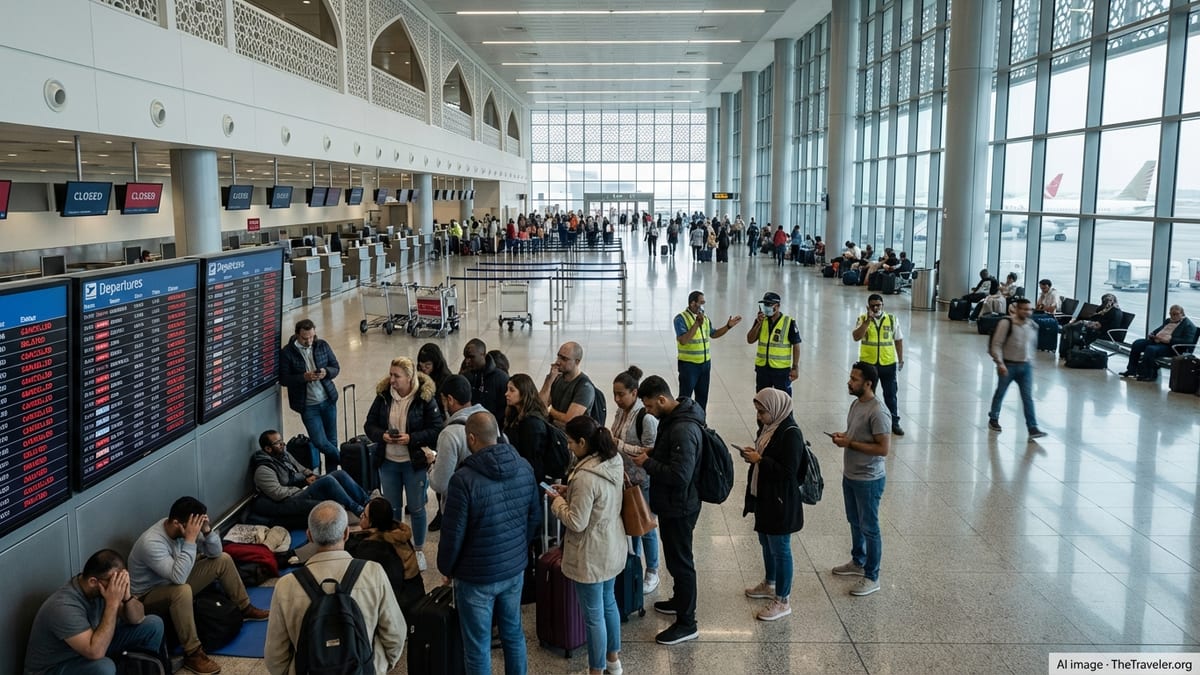
The reshaping of Kuwait Airways’ schedules follows a turbulent period for Kuwait’s aviation sector, marked by temporary airport closures and rerouting of traffic through neighboring countries. Publicly available information shows that damage to existing terminals at Kuwait International Airport earlier in 2026 forced national and private carriers to divert flights, suspend some services and rely on temporary operating bases outside Kuwait.
For Kuwait Airways, these disruptions accelerated a broader reassessment of its network. Industry data and timetable updates indicate that the flag carrier has been recalibrating frequencies on core routes, adjusting departure banks and aligning flight times with alternative hubs, notably Dammam in Saudi Arabia, to preserve connectivity while Kuwait’s main passenger terminals undergo repairs and modernization.
Analysts following the airline’s schedules note that this period of enforced flexibility is also enabling Kuwait Airways to test new patterns of demand. Shifts in departure times on routes linking Kuwait, Europe and Asia, as well as revised connection windows for long-haul itineraries, are being closely watched as the carrier positions itself for a future move into the new Terminal 2 complex.
According to published coverage in regional business media, the carrier is focusing on sustaining key strategic links while trimming or retiming marginal services. This approach is intended to protect Kuwait’s role in regional traffic flows even before the new infrastructure at Kuwait International Airport becomes fully operational.
Terminal 2: Catalyst For A New Hub Strategy
Terminal 2 at Kuwait International Airport is central to Kuwait Airways’ long-term scheduling overhaul. The vast new terminal, designed to ultimately handle up to 25 million passengers annually in its initial stages and significantly more with future expansions, is being promoted as a next-generation hub capable of competing with major Gulf rivals.
Architecture and infrastructure briefings describe T2 as a single, expansive building with a distinctive triangular footprint and three wings of departure gates. The facility is planned to incorporate advanced baggage systems, a large central processing hall and a layout aimed at speeding transfers, with designers emphasizing both passenger comfort and operational efficiency.
Government and project documentation indicate that full operations at Terminal 2 are now targeted for the final quarter of 2026, after a series of delays linked to construction complexity and the wider regional environment. Once open, T2 is expected to consolidate much of Kuwait’s scheduled traffic under one roof, allowing Kuwait Airways to redesign its banked wave structure and restore true hub-and-spoke connectivity from Kuwait City.
In preparation, Kuwait Airways’ current schedule adjustments are being interpreted by aviation observers as a bridge strategy. By experimenting with timings and connection patterns during the interim period, the carrier can identify optimal departure banks and minimum connection targets that will later be migrated into the T2 environment, where additional gates and expanded apron capacity should support more tightly timed connections.
Regional Competition And The Quest For Dominance
The impending shift to Terminal 2 comes as competition among Gulf hubs intensifies. Airports in Dubai, Doha and Abu Dhabi already anchor global networks with dense banks of connecting flights, and reports on Kuwait’s aviation masterplan suggest that policymakers see T2 as the tool to close part of that gap and to secure a larger share of sixth-freedom transfer traffic.
Kuwait Airways’ schedule reshaping reflects that ambition. By prioritizing routes that link South and Southeast Asia with Europe, and by maintaining connectivity to key Middle Eastern and North African destinations, the airline is working to ensure that Kuwait remains present in the lucrative transfer market. Even temporary detours through Saudi airports are being structured to preserve onward options and keep Kuwait Airways visible in global booking systems during the transition.
Industry commentary also points to the airline’s fleet renewal as a supporting factor. A growing mix of new-generation narrowbodies and widebodies gives Kuwait Airways more flexibility to match capacity with demand and to fine-tune schedules in anticipation of the terminal shift. Shorter ground times, improved fuel efficiency and higher seat densities allow the carrier to build more competitive itineraries once it can fully exploit the expanded infrastructure at T2.
As the new terminal advances, regional observers expect Kuwait Airways to refine its departure waves to create tighter banks in the early morning and late-night periods, mirroring patterns seen at other Gulf super-hubs. This strategy is likely to be central to Kuwait’s effort to move from a primarily origin-and-destination market toward a more dominant transfer role.
Jazeera Airways And The Multi-Terminal Landscape
While Kuwait Airways prepares for a future centered on Terminal 2, the wider ecosystem at Kuwait International Airport is also evolving. Jazeera Airways, the country’s principal low-cost carrier, has resumed and expanded activity at its dedicated Terminal 5 after operating temporary dual bases abroad during recent disruptions. Publicly reported statements from the airline highlight a rapid return to full operations from T5 as soon as airport conditions allow.
The coexistence of a full-service national carrier at T2 and a low-cost operator at T5 is expected to create a multi-terminal environment that reshapes passenger flows through Kuwait. Aviation analysts suggest that this division of labor could free up premium gate and slot capacity at T2 for Kuwait Airways’ long-haul and high-yield regional routes, while point-to-point leisure and migrant-worker traffic continue to be channeled through Jazeera’s terminal.
Airport-planning documents and project descriptions indicate that upgrades to airside infrastructure, including new taxiways and expanded parking stands, are being designed to accommodate both carriers’ growth. For Kuwait Airways, this means future scheduling decisions will take place within an ecosystem where connecting passengers may increasingly mix full-service and low-cost legs, potentially expanding the airline’s catchment without overburdening its own terminal.
Observers note that the interplay between Kuwait Airways and Jazeera Airways could prove decisive in establishing Kuwait International Airport as a genuine alternative to the Gulf’s legacy mega-hubs. Coordinated slot timing, complementary networks and differentiated passenger propositions across terminals are likely to be scrutinized by both airlines as the T2 opening date approaches.
A Tight Timeline To Reclaim The Home Hub
With late 2026 targeted for the full opening of Terminal 2, Kuwait Airways faces a compressed window to translate its current schedule experimentation into a durable hub strategy. Timetable data indicates that the airline is gradually reinstating suspended routes, refining connection times and trialing new departure patterns that can be scaled up once the new terminal is available.
Aviation industry reporting suggests that further phases of route and frequency adjustments are probable as construction milestones are reached. The carrier is expected to pivot progressively from reliance on temporary hubs abroad back to a Kuwait-centric model, using the increased gate capacity and modern processing systems at T2 to rebuild its global timetable.
The success of this transition will depend not only on physical infrastructure but also on how effectively Kuwait Airways can align schedules, fleet deployment and ground handling within the new terminal. With regional competitors already entrenched, the margin for error is limited. However, proponents of Kuwait’s aviation strategy argue that the combination of a state-of-the-art terminal and a more agile scheduling philosophy gives the national carrier a credible platform to contest a larger share of regional air travel.
As construction of Terminal 2 advances and temporary workarounds at existing facilities are gradually retired, Kuwait Airways’ evolving schedules offer an early glimpse of how the airline intends to use its rebuilt home hub. The coming two years will determine whether this recalibration translates into lasting air travel dominance or remains a missed opportunity in the Gulf’s intensely competitive skies.