

More news on this day
Kuwait has been plunged onto the front line of the fast‑escalating Iran–U.S.–Israel conflict, after repeated Iranian strikes on Ali Al Salem Air Base and nearby facilities pushed the small Gulf state onto its highest state of alert and triggered urgent travel warnings for foreign nationals.
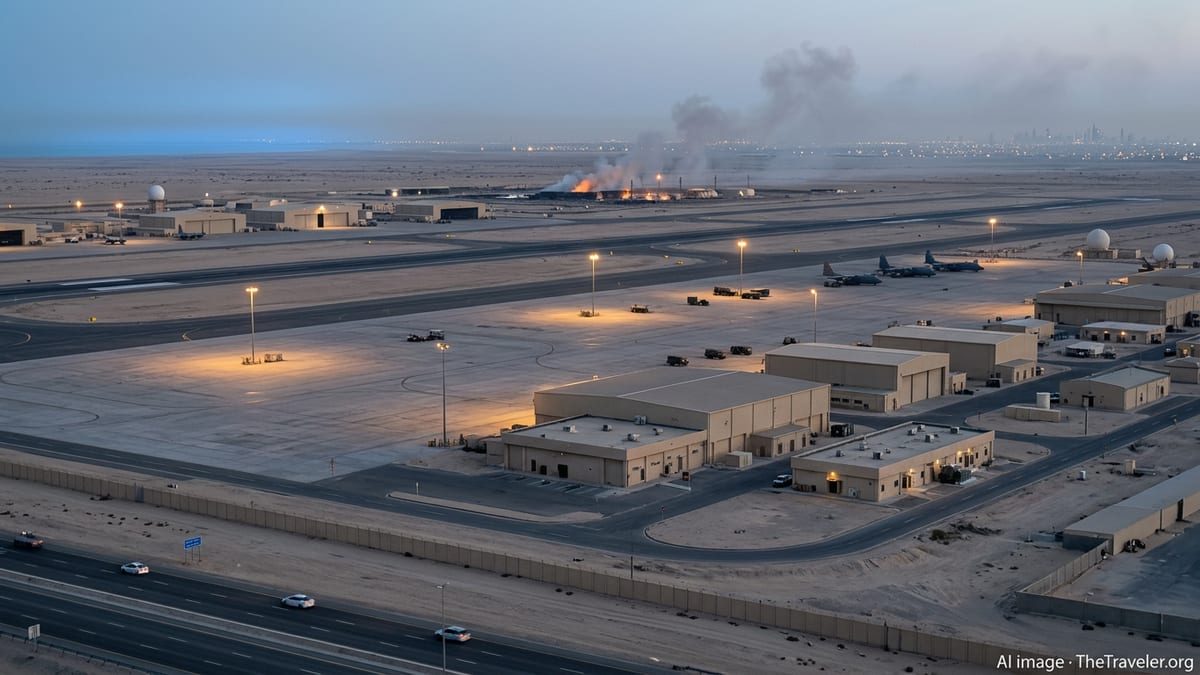
Strategic Air Hub Turned Front-Line Target
Ali Al Salem Air Base, located in Kuwait’s desert interior west of Kuwait City, has long served as one of the United States Air Force’s key regional hubs, hosting the 386th Air Expeditionary Wing and supporting operations and logistics across Iraq, Syria and the wider Gulf. In recent days, it has also become one of the most heavily targeted facilities in Iran’s expanding campaign against U.S. assets in the Middle East.
Beginning on February 28, Iranian missiles and drones have repeatedly homed in on the base, striking runways, fuel depots and communications structures and sending plumes of smoke over the surrounding desert. Satellite imagery published by multiple outlets shows scorch marks, damaged buildings and burn scars on and around the base, underlining the intensity of the bombardment.
Regional military analysts say Ali Al Salem is a logical target for Iran as it tries to disrupt the air bridge that underpins U.S. and allied operations. The base hosts airlift aircraft, intelligence and surveillance capabilities, and acts as a staging point for personnel rotations in and out of the theater. Any sustained degradation of its facilities could complicate Washington’s ability to flow forces and supplies into the wider conflict.
Despite visible damage, U.S. officials insist that core operations continue and that air defenses have intercepted the majority of incoming threats. Still, the repeated salvos have clearly eroded the sense of invulnerability that once surrounded the base and have raised questions about how long Kuwait can remain a stable rear area in a war that is rapidly widening.
Iran’s Message to Washington and Tel Aviv
Tehran has framed its attacks on Ali Al Salem and other regional installations as direct retaliation for joint U.S. and Israeli strikes on Iranian territory and nuclear infrastructure. Iran’s Islamic Revolutionary Guard Corps has publicly claimed operations against U.S. positions in Kuwait, the United Arab Emirates, Qatar, Bahrain and Iraq, presenting them as calibrated blows intended to raise the cost of the campaign against Iran.
By hitting Ali Al Salem, Al Dhafra Air Base in the UAE and other high-profile American sites almost simultaneously, Iran is signaling that U.S. forces are vulnerable across the Gulf, not just in conflict zones such as Iraq and Syria. The strikes are also designed to test and potentially overwhelm layered Western air defenses that rely on radars and interceptors positioned at these very bases.
Diplomats in the region say the choice of targets is meant to send a message to Israel as well. While Iranian munitions are not hitting Israeli territory directly in this phase of the confrontation, the attrition of U.S. logistics hubs and command nodes supporting Israel’s operations is clearly intended to constrain Tel Aviv’s military options.
The result is a dangerous spiral in which each new volley of missiles and drones prompts counterstrikes, new deployments and additional threats, drawing in ever more countries and heightening the risk of miscalculation. For Kuwait, which has long tried to balance relations with both Washington and Tehran, that spiral is now literally on its doorstep.
Kuwait’s Security Posture and Civilian Impact
In response to the strikes, Kuwaiti authorities have moved to their highest alert level, activating air raid sirens, dispersing key command functions and reinforcing security around critical infrastructure, including oil export terminals, power plants and airports. The government has condemned the violations of its airspace and stressed its right to self defense, while simultaneously calling for de-escalation and respect for its sovereignty.
Residents in areas west of Kuwait City have reported hearing explosions and interceptor launches at night, with social media footage showing bright flashes over the desert and debris falling in open terrain. While the majority of military activity remains focused around Ali Al Salem and other restricted zones, the psychological effect on the civilian population is substantial, with many Kuwaitis and expatriates stocking up on supplies and reviewing personal evacuation plans.
Authorities have tightened access to military areas and stepped up patrols on main highways leading north toward the Iraqi border. At the same time, they are keen to project a sense of continuity: commercial life in Kuwait City continues, schools remain open and oil exports are still flowing, although shipping and aviation insurers are closely monitoring the situation and recalculating risk premiums.
Local analysts note that Kuwait’s position is uniquely delicate. The country hosts thousands of U.S. and allied personnel, yet also shares religious, cultural and economic ties with Iran and other neighbors. Managing domestic opinion, safeguarding critical infrastructure and coordinating with foreign militaries on its soil are now simultaneous, high-stakes challenges.
Travel Advisories and What Visitors Need to Know
The security shocks reverberating from the attacks have prompted a swift response from foreign governments. The United States has issued stark warnings advising its citizens to leave much of the Middle East, explicitly including Kuwait, citing the risk of further Iranian strikes and the potential for rapid deterioration in the security environment. Other Western embassies have raised their own alert levels, curtailed nonessential travel and reviewed evacuation contingencies.
For travelers currently in Kuwait, the practical implications are immediate. Commercial flights continue to operate, but schedules may shift with little notice as airlines adjust routes and as airspace restrictions are updated. Travelers are being urged to register with their embassies, keep documents and essential medications close at hand, and follow official security guidance rather than social media rumors.
Hotels in Kuwait City report a growing number of early checkouts by business travelers, while some regional conferences and events have quietly postponed or moved online. Corporations with staff in the country are revisiting duty-of-care protocols, including shelter-in-place plans, secure transportation and remote work options until the situation stabilizes.
Prospective visitors weighing trips to Kuwait in the coming days face a fluid picture. While tourist infrastructure remains intact and day-to-day life in many neighborhoods appears outwardly normal, the presence of an active military target within national borders, and an adversary openly declaring its intent to strike it again, introduces a level of risk that cannot be discounted.
Regional Escalation and Outlook for Travelers
The attacks on Ali Al Salem Air Base are part of a wider pattern of Iranian strikes on U.S. and allied positions that now stretches from Iraq and Jordan to Qatar, Bahrain and the Gulf of Oman. As each side calibrates its moves, neighboring states are scrambling to reinforce their own defenses and to insulate civilian populations and critical economic assets from the fallout.
For travelers and expatriates, the key risk is not only further direct attacks on military facilities but also the potential for spillover effects, from temporary disruptions at airports and seaports to localized power outages or fuel shortages if critical infrastructure is hit. Insurance coverage, corporate travel policies and personal risk appetites are being reevaluated in real time.
Travel security experts stress that conditions can change rapidly and unevenly across the region. A relatively calm day in Kuwait City can be followed by a night of air raid sirens, or by new government instructions affecting curfews, movement near sensitive sites or access to border crossings. The most pragmatic advice is to stay closely attuned to official advisories, maintain flexible itineraries and be prepared to alter plans quickly as the conflict evolves.
What is clear is that Kuwait’s role has shifted. Once seen primarily as a stable staging ground for operations elsewhere, it is now firmly within the theater of active risk. For the global traveling public, that reality turns a previously routine Gulf stopover into a destination that demands heightened awareness, careful planning and an eye on the horizon of a conflict that shows few signs of abating.