

More news on this day
Malaysia Aviation Group is turning the Kuala Lumpur–Doha corridor into a true long-haul superhighway, lifting frequencies to 21 weekly flights from June 30, 2026 and tightening its partnership with Qatar Airways to give travelers across Asia, Europe, Africa and the Americas more choice, easier connections and greater schedule flexibility.
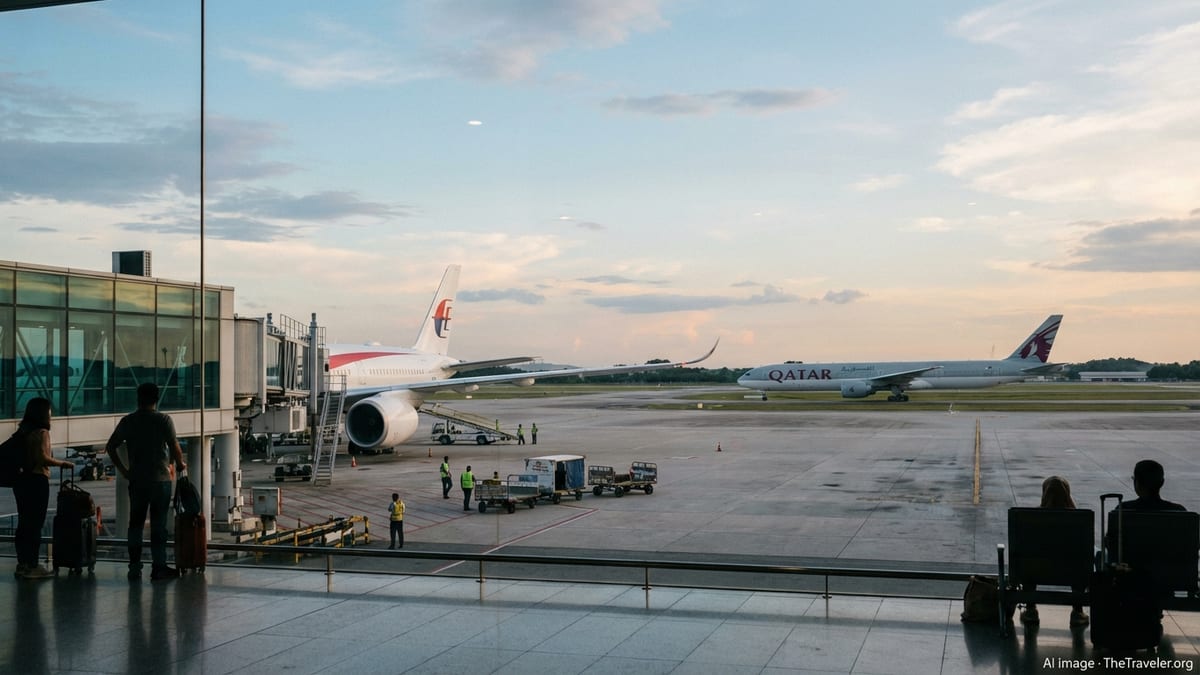
Third Daily Service Turns Kuala Lumpur–Doha Into a True Air Bridge
The latest network move by Malaysia Aviation Group, parent of Malaysia Airlines, will see a third daily nonstop service added between Kuala Lumpur International Airport and Doha’s Hamad International Airport from June 30, 2026. The new rotation builds on the carrier’s existing twice-daily operation and formally elevates the city pair into an intensive 21-flights-per-week air bridge.
For travelers, that jump in frequency means more than just another flight number. The Kuala Lumpur–Doha route has quietly become one of the most important long-haul arteries in the Malaysia Airlines network, acting as a hinge between Southeast Asia, Australia and a web of long-haul destinations across Europe, Africa and the Americas served through Qatar Airways’ hub. With three daily departures in each direction, connections on both ends can be finely tuned to minimize layovers and widen destination choice.
The added capacity will be deployed with widebody aircraft, largely Airbus A330-300s complemented by A350-900s on selected rotations, preserving full-service long-haul amenities such as lie-flat business class, premium economy-style seating and seatback entertainment across cabins. That makes the Kuala Lumpur–Doha bridge not only frequent but also consistently long-haul capable, an increasingly important consideration for travelers comparing one-stop options between Asia and Europe or North America.
Crucially, the expansion comes as demand patterns on the route remain robust, driven by a blend of leisure, corporate and visiting-friends-and-relatives traffic. Despite a more competitive Gulf marketplace, Malaysia Aviation Group is signaling that volumes are strong enough to support a third daily flight while maintaining healthy load factors.
How the New Schedule Works – And Why Timings Matter
The third Kuala Lumpur–Doha rotation is designed to complement the existing overnight and early-morning departures, creating a more even spread of options over the 24-hour cycle. The current pattern sees late-evening and pre-dawn departures out of Kuala Lumpur, feeding early-morning and mid-morning banks in Doha. The new evening service around 20:00 local time will target late-night connection waves in Qatar and improve return timings into Malaysia.
On the Doha–Kuala Lumpur leg, the added departure in the early hours of the morning slots neatly into Hamad International Airport’s overnight connectivity peak. That gives passengers arriving from Europe, Africa or the Americas a relatively short transfer before boarding their nonstop flight to Malaysia, often arriving in Kuala Lumpur in the mid to late afternoon, a convenient time for onward domestic or regional connections.
For travelers, these seemingly small timetable tweaks can translate into tangible gains: shorter overall journey times, the ability to avoid red-eye segments if preferred, and more options to arrive at a destination at a time that best fits hotel check-in, meetings or onward flights. With three departures in each direction, many passengers will find at least one option that aligns naturally with their preferred circadian rhythm.
The frequency also gives Malaysia Airlines more resilience during disruptions. Should weather or air traffic control issues affect one rotation, the presence of two alternative daily flights improves the odds of same-day reaccommodation, a key consideration on long-haul itineraries where misconnecting can otherwise mean overnight delays.
Deeper Malaysia–Qatar Partnership Extends Reach to 120-Plus Destinations
The expanded Kuala Lumpur–Doha bridge is underpinned by Malaysia Airlines’ joint business and extensive codeshare partnership with Qatar Airways, oneworld alliance partner and the dominant carrier at Hamad International Airport. Together, the two airlines will offer access to more than 120 destinations beyond Doha and Kuala Lumpur, stitching together networks that span Southeast Asia, Australia, Europe, the Middle East, Africa and the Americas.
From Kuala Lumpur, Malaysia Airlines funnels traffic from across Malaysia, Indonesia, Thailand, Singapore and the broader ASEAN region into its long-haul departures. In Doha, Qatar Airways then offers onward connections to key European capitals, secondary cities, niche African markets and major North and South American gateways. For passengers, the experience is largely seamless: through-checked baggage, coordinated schedules and reciprocal frequent-flyer earning and redemption across both carriers.
The joint business structure allows the partners to coordinate pricing, capacity and schedules on the corridor, which in turn supports sustainable deployment of a third daily flight. Rather than competing head-to-head and fragmenting demand, Malaysia Airlines and Qatar Airways are increasingly presenting themselves as a unified option for one-stop journeys between Asia-Pacific and the rest of the world.
That cooperation is central to Malaysia Aviation Group’s global strategy. Instead of building an entirely standalone intercontinental network, the group is leaning on a deep alliance with a major Gulf hub carrier, using Kuala Lumpur–Doha as a spine route that connects its strong regional presence in Asia and Australasia to a broader long-haul tapestry.
What Changes for Travelers in Asia, Europe, Africa and the Americas
For travelers based in Malaysia and Southeast Asia, the immediate benefit is choice. Three daily departures to Doha translate into more options to access European cities like London, Paris, Frankfurt, Rome and Madrid in one stop, as well as secondary destinations that previously required complex routings or multiple connections. Frequent flyers can more easily secure preferred departure times and upgrade seats, while leisure travelers gain flexibility around trip planning and pricing.
On the return leg, European and Middle Eastern travelers gain a more flexible gateway into Malaysia and neighboring countries. The combination of Doha’s global reach and Kuala Lumpur’s role as a regional hub means that a single ticket can now more smoothly cover itineraries that include beach destinations such as Langkawi and Kota Kinabalu, cultural hubs like Penang and Yogyakarta, and business centers across the ASEAN region.
The move is also significant for travelers in Africa and the Americas, who are increasingly looking at one-stop options into Southeast Asia that avoid multiple changes of aircraft. From cities such as Nairobi, Johannesburg, São Paulo, New York or Chicago, the pairing of Qatar Airways and Malaysia Airlines through Doha will now be supported by a dense schedule on the final leg into Kuala Lumpur. That reduces the risk of missed connections and can simplify visa and transit requirements compared with more fragmented routings.
For premium travelers, the enhanced corridor provides more opportunities to lock in lie-flat business-class itineraries on both sectors and to benefit from lounge access at both Kuala Lumpur and Doha. Economy passengers, meanwhile, may see more competitive fares and promotional campaigns as the partners seek to stimulate demand and fill the added capacity, particularly during shoulder seasons.
Network Synergies With Australia and the Wider Asia-Pacific
One of the less visible but highly consequential effects of the new air bridge is its impact on Australasia. Malaysia Airlines has been steadily reinforcing its footprint in key Australian markets, operating services from cities such as Sydney, Melbourne, Brisbane, Adelaide and Perth into Kuala Lumpur. With a third daily Kuala Lumpur–Doha flight, the timetable matrix for Australia–Europe and Australia–Middle East itineraries becomes far more granular.
Travelers from Australia can now often choose daylight travel on one leg of their journey, avoid excessively long layovers, or time their arrival in Europe or North America to coincide with business hours or same-day onward domestic flights. The increased frequency also makes Kuala Lumpur a more attractive alternative to other popular transit points in the region, offering a competitive option in terms of total travel time, product quality and fares.
Within Asia, the enhanced Doha connectivity bolsters Kuala Lumpur’s positioning as a secondary superhub. Regional routes into the Malaysian capital, including those from secondary cities in Indonesia, Vietnam, India and China, gain added relevance because they can now connect more efficiently into a global long-haul network. That could support further capacity growth or new city pairs over time as Malaysia Aviation Group aligns its short- and long-haul schedules.
For corporate travel managers in the region, the alignment of Malaysia Airlines and Qatar Airways timetables opens up additional negotiated-fare and service-level options, which can be important for companies with travel patterns spanning multiple continents.
Cabin Experience, Aircraft and Product Consistency on the Route
From an onboard perspective, the Kuala Lumpur–Doha corridor will continue to be operated exclusively by widebody aircraft configured for long-haul travel. Malaysia Airlines has been progressively deploying Airbus A350-900 aircraft on the route, supported by Airbus A330-300s, giving the airline a blend of capacity and efficiency to match varying demand across seasons and days of the week.
Business-class cabins feature fully flat beds, direct aisle access on the A350 and a mix of staggered and paired seating on the A330, catering both to solo business travelers and couples or families. The airline’s focus on Malaysian hospitality is evident in cabin service, with multi-course meals, regionally inspired cuisine and a full bar on longer sectors. For travelers considering one-stop options between Asia and Europe or the Americas, the cabin product is a central part of the value proposition.
In economy, Malaysia Airlines offers personal seatback screens, in-seat power on most seats and a selection of meals that often highlight Southeast Asian flavors while still catering to international palates. The airline’s “economy comfort” style seating, available on selected aircraft, adds extra legroom and a more spacious feel, which can make the roughly seven-and-a-half-hour sector between Kuala Lumpur and Doha considerably more manageable.
Consistency is a key advantage of concentrating long-haul traffic on a defined corridor. By standardizing aircraft types and service delivery on Kuala Lumpur–Doha, Malaysia Aviation Group can more easily maintain product standards, train crews and deliver predictable experiences, something regular travelers on the route are likely to notice and appreciate.
Fares, Loyalty and What to Watch If You Are Booking
With a third daily flight on the Kuala Lumpur–Doha bridge, fare dynamics on the corridor and beyond are expected to evolve. Additional capacity can create downward pressure on prices during off-peak periods, potentially opening windows for attractive promotional fares to Europe, Africa and the Americas. At the same time, peak holiday and business-travel seasons are likely to remain tight, with the extra frequencies serving more to relieve congestion than to significantly lower prices.
Members of Malaysia Airlines’ and Qatar Airways’ frequent-flyer programs stand to benefit from more mileage-earning and redemption opportunities. The dense schedule increases the chances of securing award seats on at least one daily rotation, especially for travelers booking far in advance or willing to be flexible on dates and times. For status holders, the enhanced route also means more chances to enjoy flagship lounges at both ends of the journey, as well as priority services on the ground.
Travelers considering booking should pay close attention to exact travel dates, as the third daily flight begins operating from June 30, 2026. Those traveling before that date will still see two daily Malaysia Airlines flights on most days, while those planning trips for the northern summer and beyond will be able to choose from the full three-flight schedule. As always, schedules remain subject to regulatory approvals and operational adjustments, and passengers are advised to check final timings closer to departure.
For now, Malaysia Aviation Group’s decision to raise Kuala Lumpur–Doha to 21 weekly flights underscores a broader trend: airlines are increasingly using strategic partnerships and focused long-haul corridors to rebuild and expand global connectivity. For travelers, that translates into more ways to cross continents in a single stop, and Kuala Lumpur’s elevated air bridge to Doha is poised to become one of the most important of those pathways.