

More news on this day
Thousands of travelers across China are facing long queues, missed connections and overnight airport stays as major hubs in Beijing, Chengdu, Chongqing, Shanghai, Shenzhen, Hangzhou, Wuhan and other cities delay more than 5,200 flights and cancel over 400, severely disrupting operations for leading carriers including Air China, China Eastern, China Southern, Shenzhen Airlines and XiamenAir.
Get the latest news straight to your inbox!
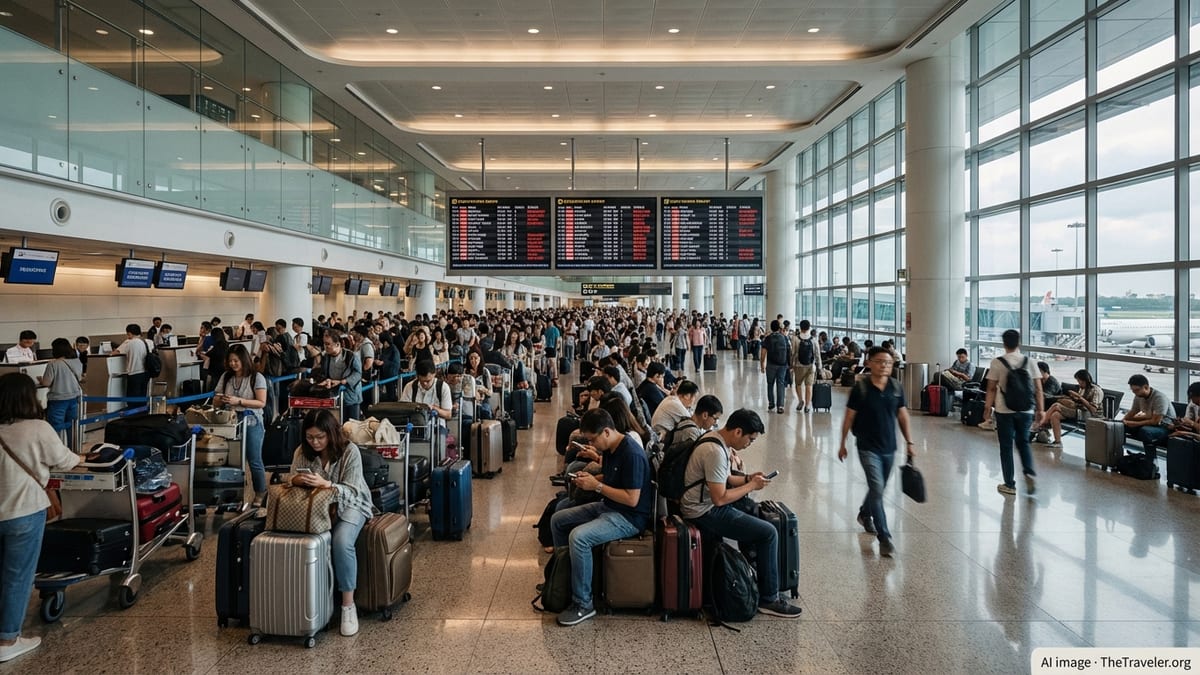
Operational Snarls Hit China’s Busiest Aviation Corridors
Publicly available flight-tracking data indicates that a combined 5,278 flights have been delayed and 429 canceled across multiple Chinese airports in a compressed time window, affecting both domestic and regional routes. The disruption is concentrated at the country’s largest hubs, where tight schedules and heavy route density give airlines little room to recover when operations slip.
In Beijing and Shanghai, prolonged hold times on the ground and in the air have left departure boards dominated by yellow and red status markers. Reports indicate knock-on effects across connections to secondary cities, as late-arriving aircraft cannot be turned around quickly enough to keep subsequent services on time.
China’s three big state-linked carriers, Air China, China Eastern and China Southern, are among the most heavily affected because of their extensive networks through these hubs. Shenzhen Airlines and XiamenAir, which rely on key bases in Shenzhen and Xiamen with links into the same congested airspace, are also seeing large portions of their schedules disrupted.
The current wave of delays highlights how sensitive China’s domestic air system remains to weather, airspace constraints and localized congestion, even as traffic volumes have broadly recovered and in some cases exceeded pre-pandemic levels.
Beijing, Chengdu, Chongqing and Wuhan See Severe Backlogs
In northern and central China, Beijing and Wuhan are experiencing particularly acute pressure. Passengers at Beijing’s main international gateway have reported extended check-in lines and security bottlenecks as multiple departure banks push back later into the day, while arriving flights face longer taxi times amid constrained runway slots.
Further inland, Chengdu and Chongqing, both key gateways for western China, are struggling with aircraft and crews falling out of position. When early-morning departures are delayed or canceled, aircraft that should operate subsequent legs to smaller cities remain stuck, causing gaps in the network that can persist for hours.
Wuhan, an important connecting point for central China, is seeing similar patterns, with heavily used trunk routes into Beijing and Shanghai absorbing delays that ripple across the rest of the schedule. Publicly available information shows a clustering of late departures around peak travel periods, complicating efforts to clear the backlog.
These operational snags are particularly challenging because inland cities have fewer alternative long-haul options. When a wave of delays hits at the same time in Chengdu, Chongqing and Wuhan, rerouting possibilities within a reasonable time frame narrow quickly for passengers trying to move between regional centers.
Shanghai, Shenzhen and Hangzhou Disrupt Business and Leisure Travel
On China’s eastern seaboard, Shanghai, Shenzhen and Hangzhou are seeing flight disruption spill over into both business and leisure travel. Shanghai, with its dual-airport system handling dense domestic and international traffic, is a pivotal node. When flight banks there are pushed back, the impact can spread across coastal corridors, including services to Fujian, Guangdong and further north.
Shenzhen’s role as a technology and manufacturing hub means delays are hitting a high proportion of business travelers, many of whom rely on same-day or next-day returns on short-haul routes. Prolonged disruption increases the risk of missed meetings and production schedule changes, adding an economic dimension to the operational problems in the air.
Hangzhou, a key tourism and e-commerce center, is also reporting elevated delay and cancellation levels. Travelers heading to or from scenic destinations in Zhejiang and neighboring provinces are encountering last-minute schedule changes, while cargo and e-commerce-related flights face knock-on timing issues as ground handling teams juggle shifting arrival windows.
The broad geographic spread of affected airports suggests that the disruption is not isolated to a single weather cell or technical fault, but rather reflects a combination of meteorological conditions, airspace management measures and the tight interdependence of schedules in China’s domestic network.
Impact on Major Airlines and Passenger Experience
For airlines such as Air China, China Eastern, China Southern, Shenzhen Airlines and XiamenAir, the immediate challenge is preserving safety and regulatory compliance while minimizing the number of passengers left overnight at airports. Public data on day-of-operations performance shows high percentages of late departures across their main hubs, with some routes experiencing repeated rolling delays.
When flight programs are disrupted on this scale, carriers must repeatedly adjust aircraft routing, crew rosters and maintenance windows. Even when weather or air-traffic constraints begin to ease, it can take many hours before schedules resemble their planned shape. Larger carriers with deeper fleets may be able to swap aircraft or add extra sectors, but the sheer number of affected flights limits the speed of recovery.
For passengers, the experience is highly variable. Some are being rebooked on later same-day services, while others face overnight waits in terminal seating areas or nearby hotels. Reports indicate that information desks and customer-service counters are heavily congested, underscoring the importance of real-time digital updates and proactive notifications during large-scale disruption.
Travelers on connecting itineraries within China are especially vulnerable, as missed domestic links can invalidate entire multi-leg journeys. This creates additional rebooking complexity for airlines and increases the likelihood of luggage being separated from passengers as bags continue on original routings.
What Travelers Can Do If Their China Flight Is Affected
Passenger-rights frameworks in China differ from those in regions such as the European Union, but there are still practical steps travelers can take when faced with significant disruption. Publicly available guidance from consumer groups generally recommends checking airline apps or official channels frequently, confirming that contact details are up to date, and keeping boarding passes and receipts for any essential expenses.
When delays stretch into many hours or flights are canceled altogether, travelers can typically inquire about rebooking on the next available service, changing routings, or receiving refunds in line with the fare rules of their ticket and applicable local regulations. In some cases, hotels or meal vouchers may be offered, particularly when overnight stays become unavoidable.
Given the current breadth of disruption across major Chinese hubs, travelers planning imminent trips through Beijing, Chengdu, Chongqing, Shanghai, Shenzhen, Hangzhou, Wuhan and other busy airports may wish to allow extra connection time, travel with essential items in carry-on bags, and monitor conditions closely before heading to the airport.
With thousands of passengers still working through the system and airlines racing to reposition aircraft and crews, it may take time for China’s flight network to return to normal patterns. The situation highlights both the scale of demand for domestic air travel and the fragility of tightly wound schedules when multiple pressure points emerge at once.