


More news on this day
Hundreds of passengers across China are facing extensive disruption as major carriers suspend at least 101 flights and delay more than 600 services, snarling busy domestic routes linking cities such as Dongying, Sanya, Hangzhou, Wuhan and Changzhou.
Get the latest news straight to your inbox!
Wide Impact Across Major Chinese Carriers
Publicly available aviation tracking data and domestic media coverage indicate that multiple Chinese airlines, including Shenzhen Airlines, Air China, Hainan Airlines, China Eastern and XiamenAir, have collectively suspended at least 101 flights while more than 600 additional services are reporting delays. The disruption is affecting dense domestic corridors that normally carry high passenger volumes during late May.
The pattern of cancellations and delays spans a mix of full service and regional operators that share hubs at major airports such as Shenzhen Bao’an, Hangzhou Xiaoshan, Wuhan Tianhe and Sanya Phoenix. These airports are key nodes for point to point links as well as for connections to China’s wider domestic network, amplifying the ripple effects for travelers attempting to reach secondary cities.
Recent disruption figures follow weeks of elevated operational stress on China’s aviation system, with earlier data from regional travel and legal publications highlighting clusters of cancellations and hundreds of delays at large hubs including Beijing, Shanghai, Guangzhou, Shenzhen and Xi’an. The latest wave appears to extend that strain further into coastal and central provinces.
Although specific reasons for each individual cancellation vary, publicly accessible dashboards and airport information boards show an accumulation of “late arrival,” “operational control” and weather related notations that together contribute to a complicated travel picture for passengers on affected airlines.
Key Routes Hit in Dongying, Sanya, Hangzhou and Wuhan
Routes touching Dongying in Shandong province, Sanya on Hainan Island, Hangzhou in Zhejiang and Wuhan in Hubei are among those most visibly affected, according to live flight status trackers. These destinations serve as important gateways: Sanya and nearby Haikou for leisure traffic, Hangzhou for both tourism and business travel, and Wuhan as a central China hub feeding flights in all directions.
On the southern coast, Sanya Phoenix International Airport and Shenzhen Bao’an International Airport handle intensive short haul services for carriers such as Hainan Airlines, China Southern, Shenzhen Airlines and others. When flights on these high frequency routes are delayed or canceled, knock on effects can cascade into subsequent rotations, pushing disruption into evening and next day schedules.
In eastern China, Hangzhou Xiaoshan International Airport, which hosts operations by China Eastern, XiamenAir, Hainan Airlines, Air China and regional carrier Loong Air, is reporting clusters of late departures and arrivals. These delays are particularly disruptive for passengers using Hangzhou as a transfer point to smaller cities in Zhejiang and neighboring provinces.
Further inland, Wuhan’s role as a central connecting hub means that suspended or late flights can strand travelers mid journey. Published route information shows Wuhan linked by multiple daily frequencies to Shenzhen, Changchun, Xi’an and other cities on services marketed by Shenzhen Airlines, China Eastern and Air China, making it especially vulnerable when schedules unravel.
Changzhou, Secondary Cities and Network Ripple Effects
While headline disruption often focuses on major coastal hubs, secondary cities such as Changzhou in Jiangsu province are also experiencing the consequences of the current wave of schedule changes. Flights serving Changzhou and similar mid sized markets frequently rely on shared aircraft rotations and tight turnarounds, leaving little room to absorb delays elsewhere in the system.
According to route maps and flight listings, carriers including Shenzhen Airlines, Air China, Hainan Airlines, China Eastern and XiamenAir use a web of such secondary airports to connect regional business centers and manufacturing hubs with larger coastal cities. When an aircraft arrives late from a congested hub, subsequent legs to smaller destinations can be pushed back or removed from the schedule altogether.
These network dynamics are particularly challenging for passengers traveling on multi segment itineraries that combine a large hub with one or two regional stops. Missed connections at airports like Wuhan or Hangzhou can leave travelers stranded overnight or forced to rebook onto indirect routings that significantly lengthen travel time.
As disruption numbers climb into the hundreds, travel industry analysts note that even modest schedule instability on high density domestic routes can quickly ripple outward, creating a complex pattern of localized cancellations and rolling delays that is difficult for passengers to predict in advance.
What Travelers Are Experiencing on the Ground
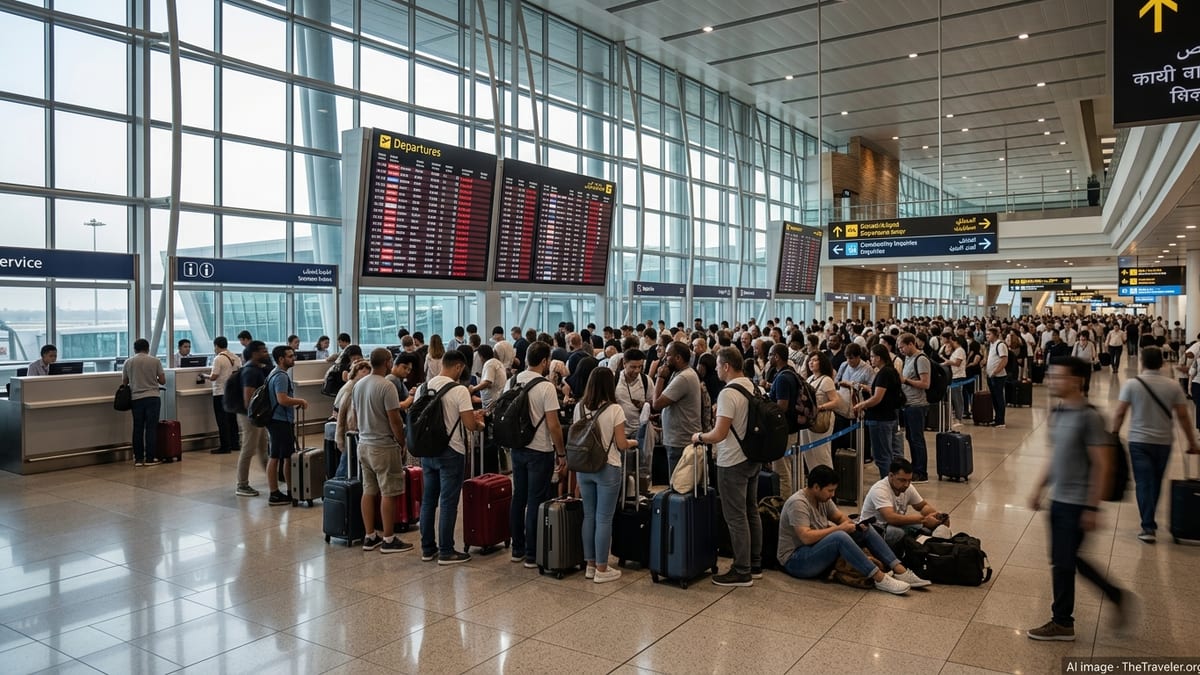
Reports from Chinese social media and local news coverage describe crowded terminal halls, long queues at airline service counters and departure boards dominated by delay indicators at several affected airports. Travelers attempting to reach resort destinations such as Sanya or business centers like Hangzhou and Wuhan are encountering extended waiting times and, in some cases, last minute gate changes.
At airports with multiple affected carriers operating similar routes, passengers are sometimes offered rebooking options on alternative flights later in the day. However, when cancellations cluster around peak departure banks in the morning and evening, re accommodation choices can quickly become limited, especially on popular north south corridors along the eastern seaboard.
Families and tour groups heading to coastal leisure destinations appear particularly vulnerable, as itineraries are often tightly timed around hotel check in windows and local ground transport bookings. Domestic media summaries note that missed connections to onward high speed rail or long distance bus services can add further complexity and cost to disrupted journeys.
Business travelers, meanwhile, face the risk of losing full working days when early morning flights are delayed into the afternoon or evening. Publicly available commentary from corporate travel advisors in the region suggests that some companies are temporarily shifting short haul trips to rail where feasible in order to secure more predictable arrival times.
Guidance for Passengers Navigating the Disruptions
Travel advisories issued through airline notifications, airport announcements and independent travel platforms consistently urge passengers to monitor flight status closely in the hours leading up to departure. Given the scale of the current disruptions affecting Shenzhen Airlines, Air China, Hainan Airlines, China Eastern, XiamenAir and other carriers, same day schedule changes remain a significant possibility on affected routes.
Passenger guidance commonly recommends arriving at the airport earlier than usual to account for potential check in and security bottlenecks, and to allow extra time to switch to alternative flights when options become available. Travelers are also encouraged to keep boarding passes and disruption documentation, which may be needed when seeking refunds, travel credits or other forms of assistance under airline policies.
For itineraries involving smaller cities or tight connections through hubs such as Shenzhen, Hangzhou, Wuhan or Sanya, experts in the travel sector advise building additional buffer time into plans or, when possible, considering more direct routings. This can help reduce the impact of knock on delays from earlier segments in an aircraft’s daily schedule.
While it remains unclear how long the current pattern of cancellations and delays will persist, the breadth of affected routes across Dongying, Sanya, Hangzhou, Wuhan, Changzhou and other cities underscores the importance for travelers in China to maintain flexible plans, stay informed through official airline and airport channels, and prepare for potential last minute adjustments to their journeys.