

More news on this day
Air travel across Egypt and the wider Middle East was plunged into chaos on Monday as cascading airspace closures and airport shutdowns triggered scores of cancellations and delays at Cairo International Airport and major Gulf and Levant hubs, disrupting operations for EgyptAir, Emirates, Qatar Airways, Royal Jordanian and dozens of other carriers.
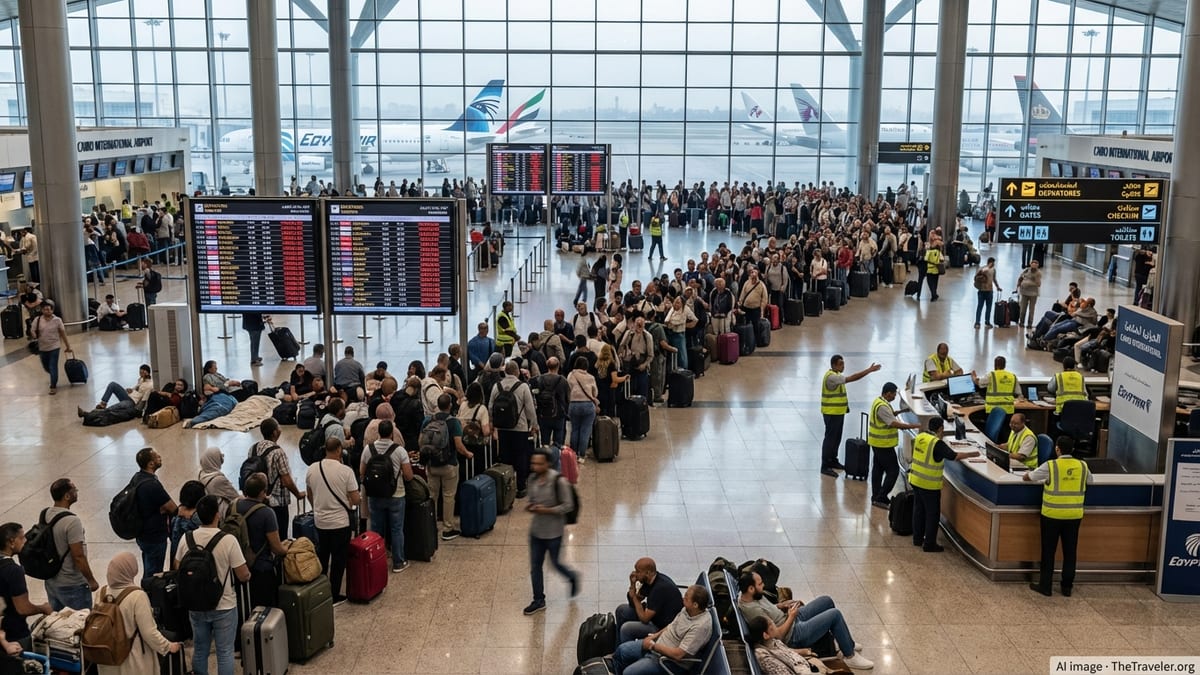
Cairo Buckles Under Strain as Regional Flights Vanish
Cairo International Airport, traditionally one of the region’s key connecting hubs, has been pushed to its limits as regional airspace closures send schedules into disarray. Airport operations teams reported dozens of services scrubbed from departure boards and many more pushed back by hours as airlines scramble to reroute or ground flights that once stitched together Egypt with the Gulf and Levant.
EgyptAir has halted flights from Cairo to a series of Arab capitals after neighbouring countries shuttered their skies amid a sharp escalation in the regional security situation. Services to Kuwait, Dubai, Doha, Bahrain, Abu Dhabi, Sharjah, Amman and Beirut are among those suspended, forcing the airline to consolidate remaining operations on still-viable corridors and to prioritize repatriation and essential travel.
Airport officials say that across the day’s schedule the tally has climbed into the dozens, with more than 70 flights cancelled outright and around 60 others subject to significant delays or rolling rescheduling. While Egypt’s own airspace technically remains open, many of Cairo’s traditional routes depend on overflight permissions and airport accessibility in neighbouring states, leaving aircraft and crews out of position and timetables in tatters.
Passengers transiting Cairo have been particularly hard hit. With onward flights to the Gulf largely suspended and limited spare capacity on remaining routes to Europe and Africa, travellers have found themselves marooned airside for long stretches, queueing for rebooking options and seeking hotel vouchers as airlines struggle to keep up with the shifting operational picture.
Gulf Hubs Go Dark as Emirates and Qatar Airways Halt Operations
The shockwaves extend far beyond Egypt. In the United Arab Emirates, Dubai International Airport and other major hubs have seen operations largely frozen after authorities announced partial but sweeping airspace closures across the Gulf. Emirates and flydubai have suspended the majority of departures from Dubai, while Abu Dhabi-based Etihad Airways has also grounded or rerouted large parts of its network.
Qatar Airways has temporarily halted flights to and from Doha following the closure of Qatari airspace, removing another crucial pillar of global connectivity between Europe, Asia and Africa. Kuwait has enacted similar restrictions, forcing airlines that once relied on multiple Gulf stopovers to either cancel services or undertake lengthy diversions that add hours of flight time and strain aircraft availability.
The impact is global in scope. Long-haul carriers from Europe, North America and Asia have cancelled or diverted flights that would typically transit Gulf hubs en route to Africa, India and Southeast Asia. Aviation analytics firms report thousands of flights cancelled across the region since the weekend, with the number continuing to climb as security advisories evolve and airlines adjust their risk assessments.
For travellers, the result is a patchwork of rebooking policies and waivers. Emirates, Qatar Airways and other major carriers are allowing affected passengers to change dates without penalties or request refunds, but with seats scarce on alternative routings and many airlines also avoiding affected airspace, securing a new itinerary has become a major logistical challenge.
Jordan, Lebanon and Regional Carriers Face Prolonged Uncertainty
In the Levant, Jordan and Lebanon are also grappling with severe disruption as airspace restrictions and precautionary routing changes ripple through airline operations. Royal Jordanian has cancelled numerous flights from its Amman base, particularly services that would normally traverse airspace now closed or heavily restricted. Beirut’s Rafic Hariri International Airport has seen large numbers of flights scrubbed from the schedule as foreign carriers suspend operations into the city.
Regional airlines that connect smaller Middle Eastern cities with Cairo, Amman, Doha and Dubai have been forced to ground aircraft and temporarily shutter routes. This has hit not only tourists and business travellers but also migrant workers and diaspora communities who rely on these links for family visits and essential travel. For many, alternative options now involve complex overland journeys or multi-leg itineraries via Europe or North Africa.
The uncertainty over how long the closures will last is adding to the strain. Some carriers have issued time-limited suspensions, outlining dates through the first week of March, while stressing that further extensions are possible depending on developments. Others have simply declared flights cancelled “until further notice,” leaving passengers and travel agencies to monitor rolling updates and notifications.
Travel industry analysts warn that even if airspace gradually reopens, the effects on airline schedules will persist for several days. Aircraft and crew will be scattered across multiple regions, maintenance windows will need to be recalibrated, and airports will face a surge of backlogged demand as stranded travellers try to resume their journeys all at once.
Knock-on Effects for Tourism, Business and Alternative Transport
The disruption comes at a particularly sensitive time for the tourism economies of Egypt, the UAE, Jordan and other regional destinations, many of which were entering a busy late-winter and early-spring travel period. Tour operators report large numbers of last-minute cancellations and deferments as prospective visitors face not only flight uncertainty but also broader safety concerns across multiple countries.
Business travel has also been severely affected. Corporate travellers heading to major commercial centres such as Dubai, Doha and Cairo are struggling to reach meetings or conferences, with some shifting to virtual formats at short notice. Trade delegations and regional events have been postponed or downsized, adding a further drag to already fragile economic sentiment across key sectors such as aviation, hospitality and professional services.
With many short-haul air routes cut, alternative modes of transport are being thrust into the spotlight. Maritime links across the Red Sea between Egypt and Jordan have increased sailings to accommodate stranded passengers, while some travellers are turning to long-distance bus or private car journeys to reach airports still operating at reduced capacity. These options, however, can add many hours to journeys and are not feasible for all, particularly families with young children or older passengers.
Insurance providers and travel advisers are urging customers to keep meticulous records of expenses and communications with airlines, as claims related to delays, missed connections and additional accommodation mount. Many policies treat large-scale airspace closures as extraordinary events, meaning coverage varies widely and will likely become a source of contention as the disruption drags on.
What Travellers Should Do Now
With the situation evolving by the hour, industry experts stress that travellers should avoid heading to airports without confirmed information about their flights. Passengers scheduled to depart from Cairo, Dubai, Doha, Kuwait City, Amman or Beirut are advised to check their flight status directly with airlines before leaving for the airport and to sign up for real-time notifications where available.
For those already stranded, patience and flexibility are becoming essential. Many airlines are prioritizing passengers based on original travel dates and specific needs, meaning that rebooking opportunities may open first to those who have already missed flights or whose trips involve urgent circumstances. Travellers able to accept rerouting via alternate hubs or to shift travel dates by several days will stand a better chance of securing seats.
Travel agents and tour operators remain an important source of support, particularly for passengers holding complex itineraries or group bookings. Agents often have access to dedicated airline channels and can sometimes piece together multi-carrier solutions that are not immediately obvious through direct booking platforms. However, the scale of the disruption means call centres and support lines are operating under intense pressure.
As airlines, airports and regulators across Egypt, the Gulf and the Levant work to restore at least partial connectivity, the full picture of the disruption is still emerging. What is clear is that the temporary paralysis of key Middle Eastern air corridors has created one of the most acute episodes of travel chaos the region has seen in years, with Cairo International Airport and its fellow hubs at the centre of a rapidly shifting aviation crisis.