

More news on this day
Key Gulf hubs including Doha, Dubai, Abu Dhabi, Riyadh and Muscat remain mired in severe travel disruption this week, as widening conflict between the United States, Israel and Iran triggers rolling airspace closures, mass flight cancellations and a patchwork of relief services that has left many travelers stranded and increasingly desperate for a way out.
Airspace Closures Ripple Across Gulf Gateways
Since February 28, when U.S. and Israeli strikes on Iran were followed by Iranian missile and drone barrages across the Gulf, governments from Qatar and the United Arab Emirates to Saudi Arabia, Oman, Kuwait and Bahrain have moved to close or tightly restrict their airspace. The result has been an unprecedented shutdown of some of the world’s busiest transit hubs, including Doha’s Hamad International Airport, Dubai International, Abu Dhabi’s Zayed International, King Khalid International in Riyadh and Muscat International.
Data from global flight trackers indicates that more than 20,000 flights have been canceled across the wider Middle East in less than a week, with Dubai and Doha alone accounting for thousands of lost services. Airlines have been forced to suspend routes, divert aircraft around newly declared danger zones and ground entire fleets as militaries warn of continuing missile and interceptor activity over key corridors linking Europe, Africa and Asia.
While some restrictions in the UAE are being adjusted day by day, operators and passengers face constantly shifting advisories, curfews and last minute cancellations. Aviation analysts warn that even a partial reopening of airspace will not immediately restore normal operations, given the backlog of displaced aircraft and crew and the sheer volume of travelers who now need to be rebooked.
Jordan and a handful of other states have kept their skies technically open, but carriers are being told to carry extra fuel and plan for extended holding patterns or abrupt diversions. For transit passengers who once relied on the predictability of Gulf mega-hubs, the Middle East has suddenly become one of the most volatile regions on the global air map.
Doha, Dubai and Abu Dhabi Struggle to Restart
In Doha, Qatar’s decision to shut its airspace in the immediate aftermath of Iranian strikes effectively turned Hamad International from a global transfer node into a holding pen. Hundreds of flights were canceled or rerouted in the first days of the crisis, with Qatar Airways halting regular operations and focusing on managing stranded customers already on the ground.
Dubai and Abu Dhabi experienced parallel turmoil after debris from intercepted missiles and at least one suspected strike near Dubai International prompted authorities to suspend passenger operations. Emirates and Etihad initially halted most of their schedules, later reintroducing a limited number of departures under strict safety windows and at sharply reduced capacity. Even as some flights have resumed, both airports continue to operate on emergency footing, with far fewer movements than normal.
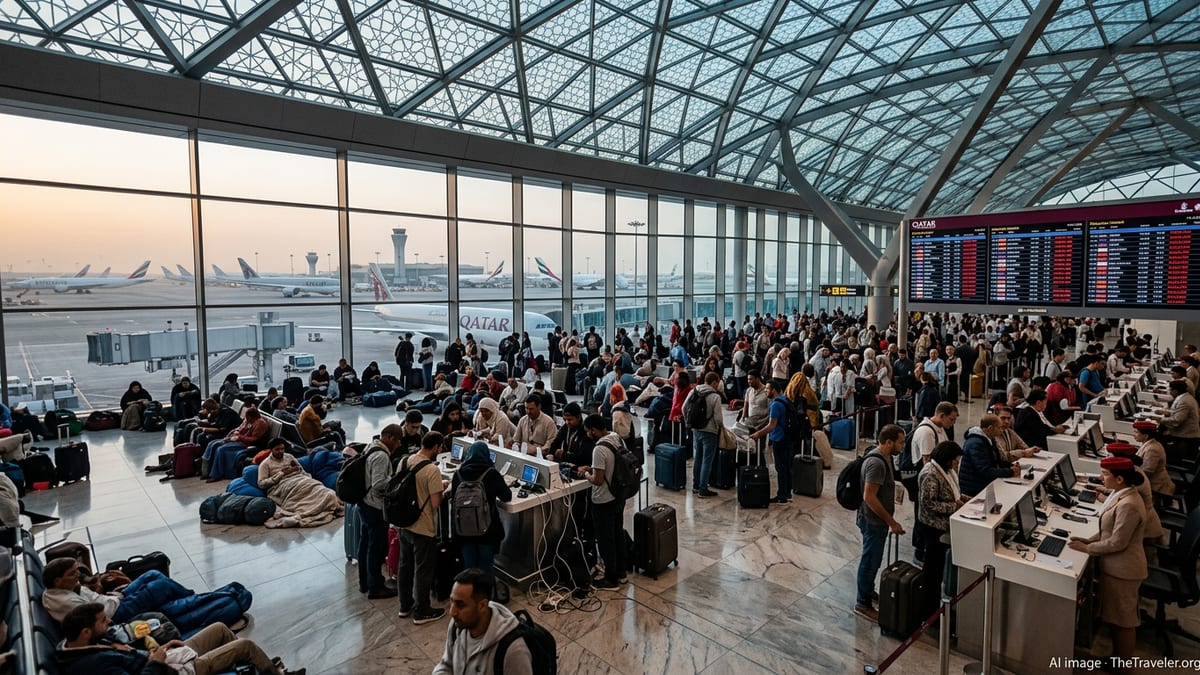
Terminal halls in all three hubs have filled with travelers sleeping on the floor, queuing for rebooking assistance or searching for charging outlets and scarce hotel vouchers. Airport staff describe scenes reminiscent of early pandemic shutdowns, but compressed into a few days and complicated by security concerns and the risk of renewed attacks.
For many customers, a lack of clear, timely information has compounded the stress. Airline apps and websites have struggled to keep pace with real time operational decisions, leaving passengers to rely on departure boards, word of mouth and social media posts to determine whether they will be able to fly at all.
Riyadh, Muscat and Secondary Hubs Become Lifelines
As primary hubs faltered, regional capitals such as Riyadh and Muscat have emerged as critical waypoints in hastily assembled evacuation and relief plans. Saudi authorities, facing their own missile threats, have kept commercial operations tightly controlled in Riyadh while coordinating with carriers to move foreign nationals and residents out of higher risk locations.
Qatar Airways has begun operating a series of relief flights from Muscat to key European cities including London, Berlin, Copenhagen, Madrid and Rome, as well as from Riyadh to Frankfurt. The airline is contacting affected passengers directly, warning that travelers should not attempt to reach departure airports unless they have been specifically notified and rebooked. Seats are scarce, and priority is being given to those whose original itineraries were disrupted by the initial wave of cancellations.
Other international airlines are redeploying capacity to secondary gateways where possible. British Airways and several European and Asian carriers have added one-off or ad hoc services from Muscat and selected Saudi cities, while avoiding the most heavily restricted airspace. However, these options cover only a fraction of the demand, and many travelers face waits of several days before they can secure a seat.
With land borders under heightened security and overland routes across the desert both lengthy and logistically difficult, driving from Doha or the UAE to alternative departure points in Saudi Arabia or Oman is not a realistic solution for most visitors. For now, limited flights from Riyadh, Jeddah, Muscat and a handful of other airports represent the narrowest of escape valves in a region accustomed to seamless connectivity.
Stranded Travelers Confront Uncertainty and Mounting Costs
The human toll of the disruption is increasingly visible across hotels, airport lounges and cruise terminals throughout the Gulf. Tourists have seen long-planned vacations cut short or extended indefinitely, business travelers are missing critical meetings and conferences, and migrant workers on tight budgets find themselves struggling to pay for unexpected nights of accommodation and meals.
Travelers report hours-long queues at airline counters, with some told they may have to wait up to a week for the next available seat to Europe, Asia or North America. Others have been offered refunds that do little to offset the cost of last minute tickets via alternative routes, where prices have surged amid the chaos. Standard travel insurance policies often exclude coverage for war-related events, leaving many to shoulder the financial burden on their own.
Families are also grappling with the emotional strain of separation. With children traveling for school breaks and relatives visiting from abroad, the sudden collapse of Gulf transit options has left parents and partners anxiously tracking developments, uncertain when their loved ones will be able to return home. Those who do manage to secure flights often face complex routings involving multiple stops and long layovers in unfamiliar airports.
Local tourism businesses, from desert tour operators to urban hotels and shopping malls, are bracing for a sharp drop in arrivals during what is normally a busy season. Industry groups warn that even a short disruption could have lasting effects on confidence, as travelers and corporate travel planners reconsider routing itineraries through a region now associated with heightened geopolitical risk.
Airlines and Governments Race to Restore Confidence
Gulf carriers and regional governments are working simultaneously to manage the immediate operational crisis and to reassure the traveling public that the skies will be safe again. Authorities in Qatar, the UAE, Saudi Arabia, Oman, Kuwait and Bahrain are coordinating closely with military partners and civil aviation regulators to assess the threat from further missile launches and to define secure corridors for commercial flights.
Emirates, Etihad and Qatar Airways have all introduced flexible rebooking and refund policies for passengers scheduled to travel during the affected period, allowing date changes and, in some cases, full refunds without penalty. Global carriers such as American Airlines, Turkish Airlines and European flag carriers have issued travel waivers covering journeys to and through major Gulf hubs, acknowledging that onward connections remain highly uncertain.
Security analysts say the pace at which airspace can safely reopen will depend on whether Iranian retaliation tapers off and whether defensive systems around key airports can reliably intercept incoming threats without scattering debris into civilian corridors. Until that happens, airlines are likely to maintain conservative schedules, prioritize relief operations and avoid routing aircraft over the most exposed areas.
For now, the region that built its modern identity on being the crossroads of global travel is experiencing a rare and jarring isolation. Travelers passing through Doha, Dubai, Abu Dhabi, Riyadh and Muscat are discovering that, in a conflict defined by missiles and drones, even the most advanced aviation hubs can be brought to an abrupt standstill.