

More news on this day
Hundreds of passengers across the Middle East and Europe are still facing disrupted journeys as airspace restrictions, airport capacity caps and rolling schedule changes force airlines in the United Arab Emirates, Saudi Arabia, Oman and beyond to cancel and delay flights linking major hubs such as Dubai, Jeddah, Manchester and Barcelona.
Get the latest news straight to your inbox!
Airspace Restrictions Keep Flight Schedules in Flux
Weeks after large parts of Middle Eastern airspace were closed in response to regional conflict, publicly available information shows that flight schedules remain fragile across the Gulf. Advisory documents circulated to travel-management clients in early March highlighted widespread suspensions and delays affecting services touching the United Arab Emirates, Saudi Arabia and Oman, with some routes still listed as suspended or operating on a limited basis into April.
Coverage in regional and international media indicates that closures initially forced many carriers to halt operations into Dubai, Abu Dhabi and other key hubs before a gradual, partial reopening. While designated safe corridors have allowed some services to resume, several neighboring airspaces remain restricted or closed, forcing complex rerouting and longer flight times on journeys between Europe and Asia.
Industry analysis notes that the resulting congestion has pushed demand onto a reduced number of flights, leaving many passengers stranded or forced into extended stopovers as they wait for scarce seats to open. Airlines have responded with temporary waivers allowing itinerary changes, but the patchwork nature of restrictions means that schedules can change with little notice.
Wave of Cancellations and Delays Hits Regional and International Carriers
Operational updates from airlines and airport data show that carriers including flydubai, Saudia, Etihad Airways and IndiGo have all faced significant schedule disruption since the end of February. Flight-tracking reports compiled in early March recorded hundreds of cancellations and delays across the wider region in the days immediately following the initial airspace closures, with services to and from the Gulf particularly affected.
Subsequent reporting on the evolving situation described continued cancellations on certain routes and a pattern of rolling delays as airlines attempted to thread flights through available corridors. Low-cost and full-service carriers alike have adjusted frequencies or temporarily suspended operations to specific cities in Saudi Arabia and Oman, while also trimming services into the United Arab Emirates when capacity or routing options were constrained.
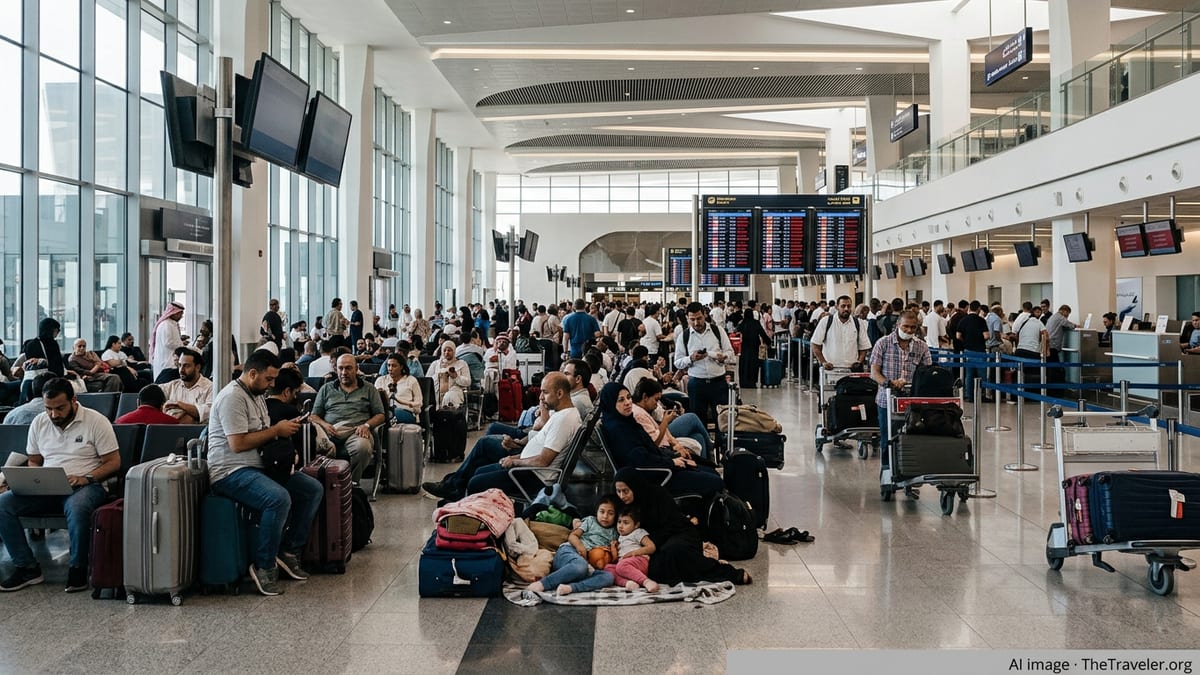
Indian carriers have been notably affected by these changes. IndiGo publicly acknowledged earlier in the disruption cycle that services to multiple Middle Eastern destinations were being adjusted, and passenger accounts on social platforms describe long queues at airline desks and repeated rebookings as schedules were reshuffled. Similar scenes have been reported at Gulf hubs, where travelers on regional and long-haul airlines have waited hours or days for onward connections.
Dubai and Jeddah Hubs Struggle as Europe Feels the Knock-on Effect
Dubai and Jeddah, two of the most important connecting hubs between Europe, Asia and Africa, have been at the center of the disruption. Information compiled from flight-status dashboards and published coverage shows that Dubai International Airport has been operating on a significantly reduced schedule, with airlines such as Emirates and flydubai prioritizing a limited number of routes and passengers with existing bookings while broader capacity remains constrained.
In Saudi Arabia, Saudia has progressively adjusted its operations, including partial resumptions on routes to Dubai and Abu Dhabi while other regional destinations remain subject to ongoing review. Jeddah’s role as a key transit and pilgrimage gateway has complicated recovery, with airlines needing to balance local demand, connecting flows and the continuing uncertainty around airspace access.
The ripple effects are evident at European airports such as Manchester and Barcelona, where passengers booked on itineraries that rely on Middle Eastern hubs have faced sudden cancellations or extended delays. Reports from travelers describe missed connections, last-minute rerouting via alternative hubs and overnight stays in transit hotels as carriers work through backlogs of stranded customers.
Oman Closures and Capacity Caps Add Further Pressure
Separate from conflict-related airspace issues, Oman and capacities across the Gulf have added further complexity to planning. Earlier advisories sent to corporate clients referenced service suspensions affecting Oman-bound flights, contributing to a reduction in alternative routing options for travelers seeking to bypass heavily impacted hubs.
At the same time, Dubai has moved to cap the number of flights foreign airlines can operate into its airports over a defined period, a measure that has sharply reduced the planned schedules of several international carriers serving the emirate. Aviation industry newsletters report that some Indian and Gulf airlines face cuts amounting to dozens of flights per week under the temporary regime, tightening seat availability just as disrupted passengers search for any remaining options.
Analysts note that these restrictions, layered on top of existing airspace constraints, have made it more difficult for carriers such as Saudia, Gulf Air and Indian operators to mount additional rescue or relief flights. As a result, passengers whose original itineraries involved Dubai, Jeddah or Muscat may find that alternative routings through neighboring countries are limited or sold out for days at a time.
Gradual Restarts Offer Relief but Recovery Remains Uneven
Despite the ongoing challenges, there are signs of a cautious restart across parts of the network. In recent days, publicly available statements from regional airlines such as Saudia and Air Arabia have outlined limited resumptions of flights from the United Arab Emirates and Saudi Arabia to selected destinations, often under special schedules that remain subject to regulatory and operational approvals.
Etihad Airways, Emirates, flydubai and other Gulf carriers have also issued rolling updates on their reduced timetables, maintaining flexible rebooking and refund policies for travelers whose journeys fall within the disruption window. Industry observers say these measures are intended to give passengers more leeway to adjust plans as corridors reopen or close.
However, recovery remains uneven. Some routes have returned to near-normal frequencies, while others continue to see sporadic operations, extended detours or outright suspensions. With airspace access still subject to rapid change, passengers connecting through major hubs in Dubai, Jeddah, Manchester and Barcelona are being urged by airlines, travel agents and airport advisories to monitor flight-status pages closely, expect last-minute gate or schedule changes and allow extra time for complex itineraries.