

More news on this day
Thousands of airline passengers across the Middle East are stranded after sweeping airspace closures triggered at least 1,540 flight cancellations and 851 delays in recent days, crippling operations at major hubs in the United Arab Emirates, Saudi Arabia, Egypt, Türkiye, Qatar, Iraq and beyond.
Airspace Closures Ripple Across Key Regional Hubs
The latest wave of disruption began after a sudden escalation in regional conflict on 28 February led several Middle Eastern states, including Iran, Iraq, Kuwait, Qatar, Bahrain and the United Arab Emirates, to close all or part of their airspace. Authorities in Israel and Syria also imposed tight restrictions, effectively sealing off some of the busiest aviation corridors linking Europe, Asia and Africa.
With those skies suddenly off limits, major connecting airports from Dubai and Abu Dhabi to Doha, Jeddah, Cairo and Istanbul have experienced cascading schedule shocks. Data compiled from airline timetables and tracking services indicates at least 1,540 flights involving Egypt, the UAE, Saudi Arabia, Türkiye, Qatar and Iraq have been cancelled since the closures took hold, while a further 851 have departed late or been heavily rescheduled.
Dubai International, one of the world’s busiest hubs, has reported hundreds of cancelled movements as airlines grounded or diverted services that would normally overfly Iranian and Iraqi airspace. In Qatar, Doha’s Hamad International has experienced similarly acute disruption, while traffic flows through Jeddah and Riyadh have surged as carriers attempt to route passengers through Saudi airspace that remains partially open.
The effect is not limited to the Gulf. Cairo and Istanbul, already crowded crossroads between continents, have seen mounting congestion as airlines from Europe, Asia and Africa try to knit together alternative routings that avoid closed flight information regions while still keeping journeys commercially viable.
Emirates, Qatar Airways, Saudia and Pegasus Forced to Slash Schedules
Flag carriers and low cost operators across the region have been forced into rapid, large scale changes to their networks. Emirates has suspended the bulk of its scheduled departures to and from Dubai through at least the first week of March, maintaining only limited repatriation and cargo services. Etihad Airways in Abu Dhabi has followed a similar pattern, prioritising stranded ticketed passengers and essential freight.
In Qatar, Qatar Airways has faced some of the toughest operational constraints, with closures over both Iranian and Gulf airspace depriving the Doha based carrier of its main long haul corridors. The airline has cancelled or suspended numerous routes and is funnelling a reduced number of flights along longer, fuel intensive paths to Europe, Africa and South Asia where safety assessments permit.
Saudi Arabia’s Saudia has cancelled and retimed services into affected neighbouring states, but has also become a key outlet for travellers trying to exit the region. Flights from Jeddah and Riyadh are operating close to capacity as passengers from cancelled Gulf and Levant services rebook via the kingdom’s airports.
In Türkiye, Istanbul based Pegasus Airlines and Turkish Airlines have pared back operations to destinations where airspace or airport closures make regular flying impossible, including parts of the Gulf and Levant. Egyptian carriers have also trimmed schedules at Cairo, Alexandria and Sharm el Sheikh as knock on delays from missed inbound aircraft ripple through the system.
Stranded Passengers Face Long Queues, Scarce Beds and Limited Information
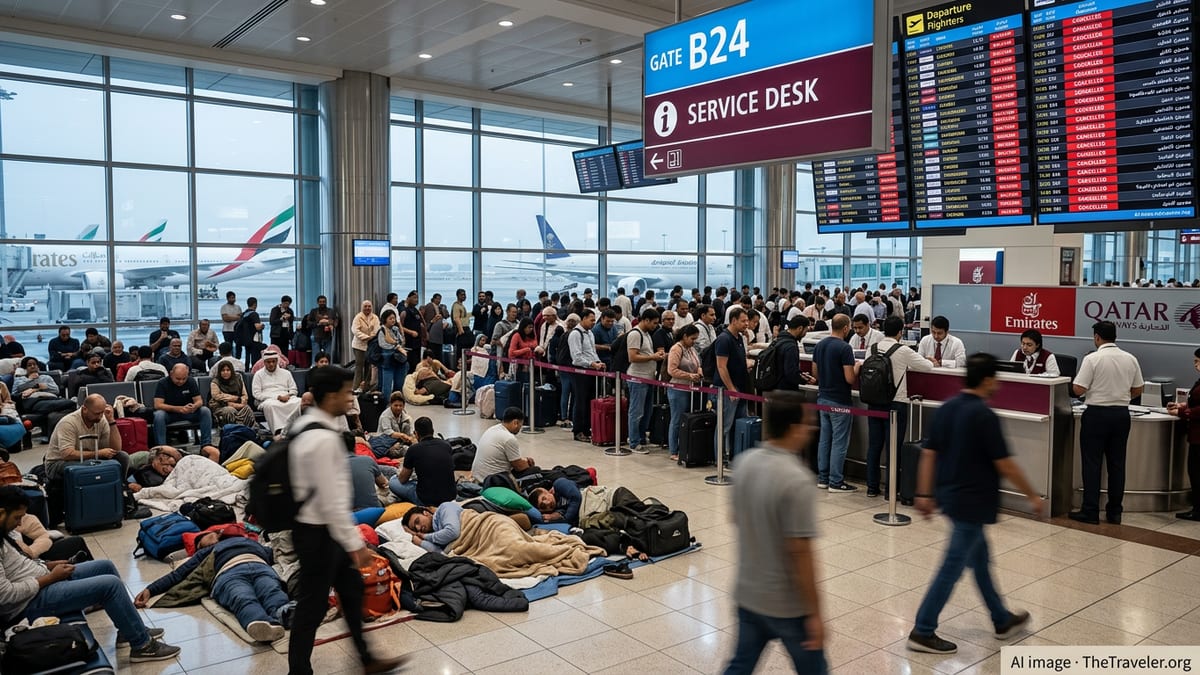
For travellers caught in the middle of the disruption, the numbers translate into days of uncertainty. Across Dubai, Abu Dhabi, Doha and Jeddah, terminal concourses have filled with passengers sleeping on the floor or in long queues at transfer desks as they wait for rebooking, meal vouchers and hotel accommodation.
Reports from travellers describe crowded airport hotels and nearby properties booked solid as airlines struggle to house those whose journeys have been interrupted overnight. With aircraft and crew displaced across three continents, carriers have warned that it may take several days just to reposition assets before they can begin clearing the backlog.
Communication has emerged as a major pain point. While airlines such as Emirates, Saudia, Qatar Airways and Pegasus are sending rolling text messages and app alerts, many passengers say they have received little direct contact and are relying on airport screens or social media posts to understand if and when they might travel. Those on complex itineraries via multiple hubs are particularly vulnerable to missed connections and fragmented support.
At smaller airports in Egypt, Iraq and secondary Saudi cities, stranded travellers face an additional challenge in the form of limited alternative transport options. With regional rail and long distance bus networks unable to absorb the sudden demand, many are effectively confined to airport terminals or nearby towns until replacement flights become available.
Airlines Juggle Safety, Rerouting and Soaring Operating Costs
Behind the scenes, airline operations centres across the Middle East and beyond are engaged in complex rerouting exercises. With large swathes of airspace marked as high risk by regulators and industry safety bodies, dispatchers are plotting longer arcs around closed or contested areas, often over the Caucasus, Central Asia or North Africa instead of the traditional east west corridors through the Gulf.
These detours add hours to flight times and significantly increase fuel burn, crew duty times and maintenance pressures. For carriers such as Emirates and Qatar Airways that built their business models around ultra efficient cross Gulf overflights, the sudden shift to circuitous routings threatens to squeeze margins even on routes that can still operate.
Slot constraints at alternative hubs compound the challenge. Airports like Istanbul, Cairo and Jeddah, while large in their own right, do not have infinite runway or terminal capacity. As diverted flights converge on these cities, congestion leads to departure holds, airborne holding patterns and further delays that propagate through already fragile schedules.
Air cargo is also feeling the strain. With thousands of passenger flights cancelled, valuable belly hold capacity for high value goods such as electronics, pharmaceuticals and perishables has evaporated overnight, pushing more shippers towards dedicated freighters that themselves are competing for scarce routings and landing slots.
How Long Will the Disruption Last for Travelers
Regional governments have signalled that airspace closures are being reviewed on a daily basis, but officials and airline executives caution that a return to normal traffic flows is unlikely in the immediate term. Even if key corridors reopen in the coming days, the task of clearing stranded passengers and restoring aircraft rotations to their intended patterns could stretch well into mid March.
Travel industry analysts note that during previous Middle Eastern airspace disruptions, such as those linked to earlier Gulf tensions, it has typically taken one to two weeks for large hub carriers to unwind accumulated delays and reposition aircraft fleets. The current episode is more geographically widespread, affecting not only the Gulf but also parts of the Levant and Iran, which suggests a potentially longer recovery curve.
For now, airlines and airports are urging travellers to avoid heading to terminals unless they have a confirmed and reconfirmed booking for the same day, and to monitor airline channels closely for schedule updates. Flexible rebooking and refund policies have been introduced by most carriers serving Dubai, Jeddah, Cairo, Istanbul, Doha and Baghdad to encourage passengers whose trips are not time sensitive to postpone travel and help ease terminal crowding.
With thousands of passengers still sleeping in airports from Istanbul to Sharjah, the crisis is serving as a stark reminder of the vulnerability of global aviation to sudden geopolitical shocks. For the Middle East’s big connecting hubs, the coming days will test not only their operational resilience but also their ability to support stranded travellers whose journeys, for now, remain firmly on hold.