

More news on this day
Global aviation is grappling with a new wave of disruption as widespread airspace closures and restrictions across the Middle East ripple outward, forcing mass flight cancellations, diversions and lengthier routes on some of the world’s busiest corridors.
Get the latest news straight to your inbox!
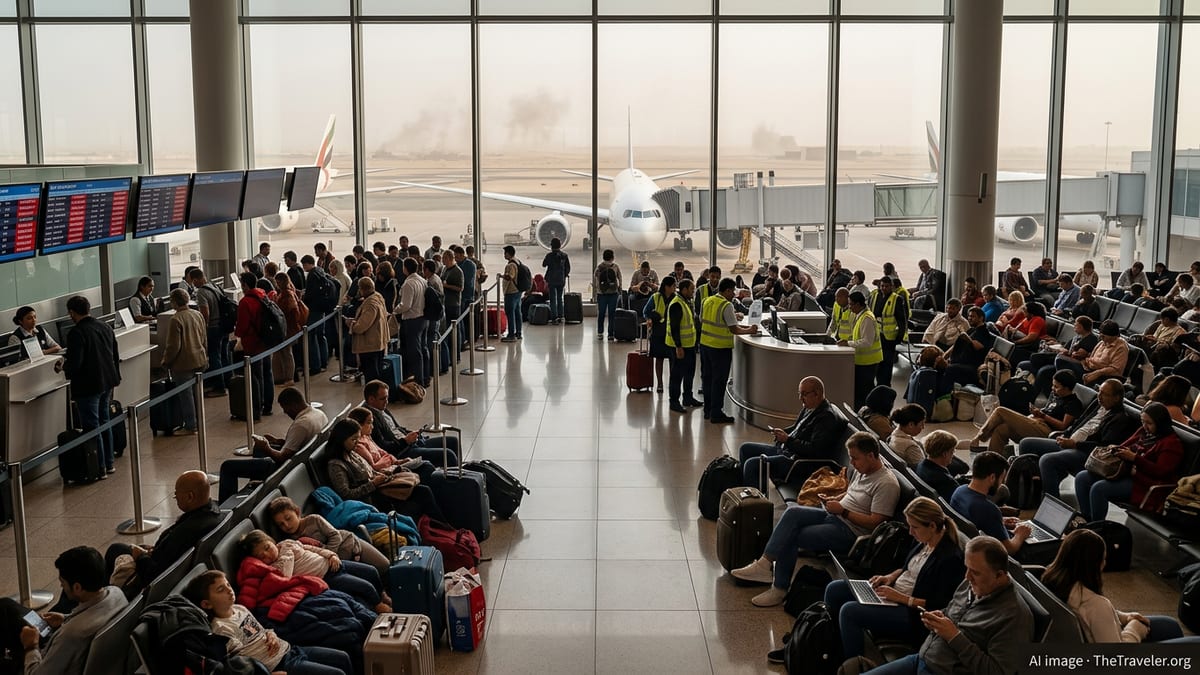
Middle East Closures Create a Black Hole in Global Airspace
The abrupt shutdown or severe restriction of airspace in large parts of the Middle East has effectively removed a central artery linking Europe, Asia and Africa. Conflict and military activity involving Iran, Israel, Gulf states and Western forces have led to full or partial closures over Iran, Iraq, Israel, Jordan, Qatar, Bahrain, Kuwait and the United Arab Emirates, according to multiple operational advisories and industry trackers.
Publicly available risk databases now advise operators to avoid the airspace of at least 10 to 11 states in the region, describing a vast zone of restricted or no-go skies. Aviation analysis notes that this corridor previously carried a substantial share of global overflights, particularly for long haul services between Europe and South and Southeast Asia.
Some states have begun cautiously reopening, but in many cases this has translated into highly controlled access rather than normal operations. Airports such as Dubai International and Abu Dhabi have shifted from total shutdowns to limited schedules, while Doha is operating under tight constraints. Official notices and airline statements indicate that even where runways are open, routing options remain curtailed and schedules are being rebuilt day by day.
The result is what one European air traffic management agency has described as a giant gap in usable airspace, forcing reroutes via the Caucasus, Central Asia and North Africa. Flight times on certain Europe to Asia routes have increased by one to three hours, putting additional strain on aircraft utilization, crew scheduling and fuel planning.
Worldwide Cancellations and Diversions Mount
As the conflict and closures dragged into April, cancellations have become routine at major airports far beyond the Middle East. At Hazrat Shahjalal International Airport in Dhaka, at least 27 flights were canceled in a single morning in early March as airlines lost access to Gulf hubs and overflight corridors, according to disruption tallies published by passenger-rights platforms.
Travel trade publications report that Qatar’s decision to join the United Arab Emirates, Saudi Arabia and other states in tightening airspace restrictions has triggered additional waves of cancellations and suspensions. Nepal Airlines, for example, announced the cancellation of all Kathmandu–Doha services from 13 to 15 April, cutting a vital bridge for migrant workers and tourists traveling onward to Europe and North America.
In the Philippines, regional forums and carrier updates signal sustained cancellations on Manila services to Dubai and Doha extending through at least the end of April. European travelers are seeing similar patterns, with some low cost and network carriers suspending flights to Dubai, Abu Dhabi, Amman and Tel Aviv from parts of mainland Europe into late summer, citing security assessments and constrained airspace.
Even where flights are still operating, diversions and last minute equipment changes remain common. Airlines are redistributing capacity away from the Middle East toward alternative hubs, while some carriers are operating “rescue” or special services under narrow security frameworks to repatriate stranded passengers.
Europe and Asia Feel the Knock-on Effects
Europe in particular is experiencing mounting secondary impacts as it loses access to traditional Middle East transfer hubs and direct overflight routes. Analysis from European economic institutes notes that, because many European airlines are already barred from using Russian airspace, the loss of central Middle East corridors compounds an existing routing challenge, pushing traffic even farther north or south.
Consumer reports from European airports describe growing concern about jet fuel availability. Coverage in major European media outlets highlights warnings from airport associations that, without a resumption of steady fuel supplies from the Gulf, rolling cancellations across Europe are likely. Higher fuel prices and longer tracks are already prompting airlines such as Air New Zealand, AirAsia X, Vietnam Airlines and SAS to trim frequencies or cut select routes.
German carrier group updates suggest that some European airlines are now planning for an extended period of disruption. Lufthansa Group, for instance, has suspended most of its Middle East network until late 2026, rerouting Asia bound passengers over alternative corridors across Central Asia and the Caucasus. Industry commentators note that this represents a fundamental reconfiguration of how certain European long haul networks are structured.
Asian carriers are also adjusting. Some Chinese and other Asian airlines with access to northern routes through Russia and Central Asia are using that advantage to maintain more direct Europe services, while Southeast Asian airlines are adding technical stops or altering schedules. Aviation analysts caution that the new routings may become semi permanent if geopolitical tensions do not ease quickly.
Passengers Face Longer Journeys, Uncertain Itineraries
For passengers, the evolving patchwork of closures, partial reopenings and emergency schedules is translating into confusion and significantly longer travel days. Travel advisories issued in March and early April by insurers, logistics specialists and travel risk consultancies consistently urge travelers to check flight status shortly before departure, build in generous connection times and be prepared for reroutes.
Travel guidance from consumer platforms notes that many itineraries that previously relied on Dubai, Doha or Abu Dhabi as single-stop gateways between Europe or North America and Asia are now being rebooked through secondary hubs in Istanbul, Central Asia or North Africa. In some cases, passengers are being shifted onto multi stop journeys that add several hours of flying and extended layovers.
Reports from affected airports indicate that travelers connecting via Kathmandu, Dhaka and Manila are among those experiencing the most acute disruption, as schedules to Gulf hubs are pared back or canceled outright. Migrant workers bound for the Gulf and onward to Europe are facing difficulties securing alternative bookings, and tourism boards in South Asia are warning of a downturn in arrivals linked to reduced connectivity.
Consumer advocates emphasize that passengers whose flights are canceled or significantly rerouted as a result of airspace closures may be entitled to refunds or rebooking options, depending on the operating carrier and jurisdiction. However, with airlines contending with extraordinary operational constraints, re-accommodating travelers can take days, and popular alternatives often sell out quickly.
Industry Braces for Prolonged Turbulence
Industry forecasts released in recent weeks suggest that the combined effects of the Iran war, elevated security risks and restricted Middle East airspace could weigh on global aviation for months. Economic assessments of the conflict’s impact on transport indicate that airports across the region, which collectively handled a sizable share of global traffic before the crisis, remain either closed, damaged or operating at sharply reduced capacity.
Logistics bulletins from international freight forwarders show that cargo operations are under similar strain. Airlines are reallocating widebody aircraft from suspended passenger routes to freighter or high yield markets elsewhere, while freight is being pushed onto longer transcontinental routings. Supply chain specialists warn that airfreight lead times to and from Europe, the Middle East and parts of Africa and Asia are lengthening, with implications for just in time industries.
Travel risk assessments stress that conditions remain fluid. Although some Gulf and Levant states have signaled interest in gradually reopening controlled corridors, there is ongoing potential for new temporary closures or restrictions in response to military developments. Operators are planning with scenario-based models that anticipate further shocks.
For now, global travelers are advised by public travel hubs and airline notices to monitor bookings closely, remain flexible on routes and dates where possible, and expect continued disruption on any itinerary that previously relied on overflying or transiting the Middle East’s core airspace.