

More news on this day
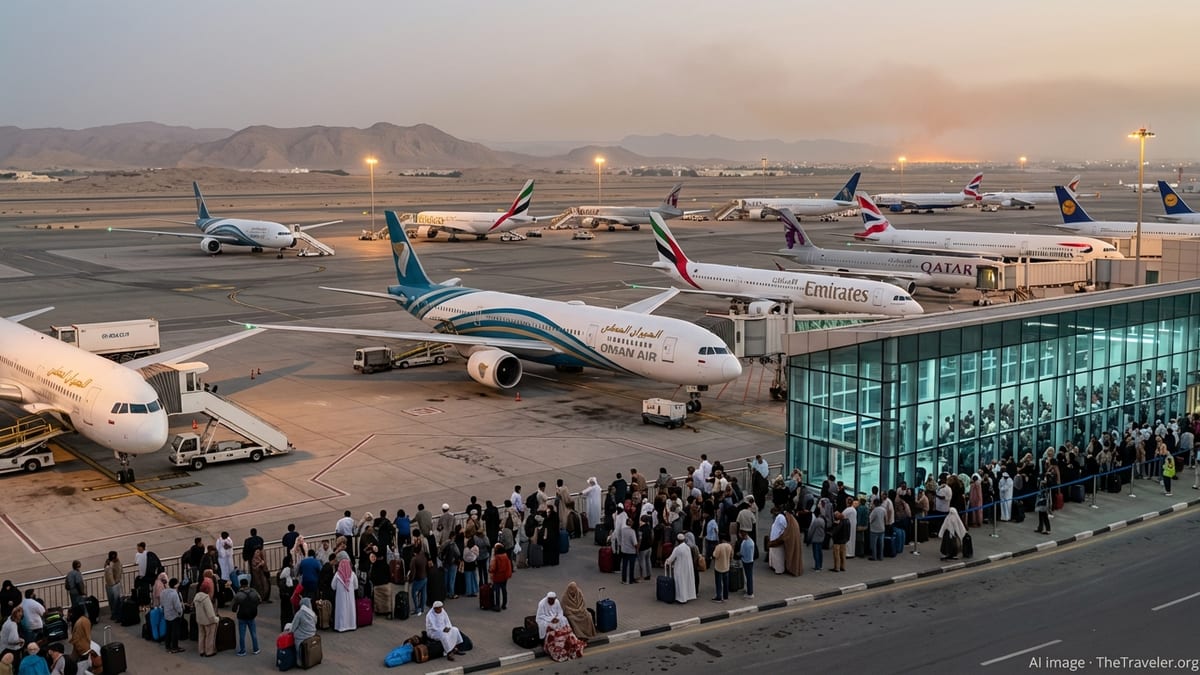
Thousands of passengers have been stranded at Seeb International Airport in Oman after a sudden cascade of airspace closures across the Middle East forced airlines to cancel and divert flights along some of the world’s busiest long-haul routes.
Airspace Turns Into Patchwork of No-Fly Zones
The latest turmoil was triggered on February 28, 2026, when coordinated US and Israeli strikes on Iran were followed by retaliatory attacks on military facilities across the Gulf. Within hours, aviation authorities from Iran to the Gulf Cooperation Council states began issuing emergency notices to airmen, effectively carving vast no-fly zones through the heart of global east–west traffic.
Countries including Iran, Iraq, Israel, Qatar, Kuwait and Bahrain moved to close or heavily restrict their airspace to civilian traffic. Major hubs such as Dubai and Doha, normally linchpins of Europe–Asia connectivity, saw operations suspended as a precaution, compelling carriers to reroute aircraft via longer, less direct corridors or to ground services altogether.
Radar imagery showed large sections of the region abruptly emptying of commercial flights as aircraft were diverted mid-journey, forced back to origin, or sent to alternative hubs outside the conflict zone. The knock-on effects quickly radiated outward to Europe, South Asia and even the Pacific, as airlines scrambled to redesign flight plans on the fly.
Regulators in Europe and Asia issued their own warnings, urging carriers to avoid affected airspace where possible. For many airlines, the combination of distance penalties, fuelling constraints and crew duty limits made outright cancellations more viable than complex detours around an active conflict theater.
Seeb International at a Standstill as Cancellations Mount
In Oman, Seeb International Airport has emerged as one of the hardest-hit facilities. Airport operations data and industry reports indicate that scores of departures and arrivals were scrapped over the weekend, with dozens more delayed, as carriers aborted regional links and suspended high-risk routes.
Oman’s flag carrier announced the cancellation of flights to Moscow, Amman and Khasab and the temporary suspension of services to Dubai, Doha, Kuwait, Dammam and Bahrain, all key short-haul connections that feed Seeb’s international network. While some longer-haul routes technically remain open, frequent delays and last-minute equipment changes have become the norm as airspace options narrow.
Low-cost and regional operators serving Oman, including airlines from India and the wider Gulf, have also been forced to trim or halt operations into Muscat. Local media and travel-industry bulletins describe hundreds of passengers sleeping in terminal halls, queueing for rebooking counters and crowding information desks as rolling updates filter in from airline control centers.
Airport authorities in Oman have framed the disruption as a safety-first response to a highly fluid security environment. With missile strikes and military overflights reported in multiple neighboring jurisdictions, the civil aviation regulator has opted to keep portions of national airspace tightly controlled, significantly constraining what would otherwise be a modest but efficient regional hub.
Ripple Effects Across Global Long-Haul Networks
The closures and restrictions surrounding Oman and its neighbors have dealt a serious blow to global aviation, particularly the dense corridors linking Europe and North America with South and Southeast Asia. Carriers that once relied on direct Gulf transits are now plotting circuitous paths via Central Asia, the Caucasus or the Mediterranean, increasing flight times by up to several hours in some cases.
Flagship airlines from the Gulf, including those based in the United Arab Emirates and Qatar, have cancelled or suspended hundreds of services as their home hubs contend with temporary shutdowns and restricted arrival and departure windows. European and Asian legacy carriers have followed suit, scrapping flights into key Middle Eastern cities and, in some instances, suspending operations to Oman and nearby states for the coming days.
The domino effect has been especially acute for travelers booked on through-tickets that hinge on tightly coordinated connections in the region. A missed arrival into Muscat or Dubai can unravel an entire itinerary to destinations as far afield as Sydney or Singapore, with rebooking options constrained by aircraft availability and the limited capacity of alternative routes that skirt the conflict zone.
Air cargo flows have also been hit, with freight operators warning of delays and higher costs as they retool routings for time-sensitive goods. Logistics analysts say that while dedicated cargo aircraft have more flexibility to operate at less congested times and via secondary airports, the sudden loss of bellyhold capacity on passenger flights through the Gulf will be felt across supply chains in the coming weeks.
Stranded Passengers Confront Uncertainty and Long Waits
Inside Seeb International Airport, scenes of confusion and fatigue have become commonplace. Families returning from school holidays, migrant workers on rotation and business travelers connecting between continents have all found themselves caught in a web of cancellations and rolling delays, often with limited real-time information.
Check-in and transfer halls have filled with passengers camping out on the floor or slumped over trolleys, their journeys stalled as airline staff attempt to manually rebook itineraries around a constantly shifting patchwork of available routes. With hotels near the airport quickly reaching capacity, many travelers have opted to remain airside in the hope of securing scarce seats on outbound services.
Airlines at Seeb and across the region are waiving change fees, offering vouchers and, where possible, arranging accommodation and meal support. Yet the sheer scale of the disruption means that some passengers face waits of 24 hours or more before new travel options can be confirmed, particularly those who need to cross multiple now-restricted jurisdictions to reach their final destination.
Travel insurers and assistance providers report a spike in calls from policyholders seeking guidance on coverage for missed connections, extended stays and emergency re-routing. Advisories urge travelers to stay in close contact with their airlines, continue monitoring official updates from local authorities and build additional buffer time into any essential journeys to or through the wider Middle East in the coming days.
Oman’s Delicate Balancing Act Between Safety and Connectivity
For Oman, the crisis has highlighted the delicate balance between maintaining regional connectivity and shielding its airspace from conflict-related risks. Muscat has historically positioned itself as a neutral mediator in regional disputes, and its aviation sector has benefited from a reputation for stability and reliability even as tensions have flared elsewhere in the Gulf.
The current shutdown and heavy disruption at Seeb International Airport underscore how difficult it is for any state, however diplomatically cautious, to insulate its skies from a major cross-border confrontation. With neighbors closing their airspace and military operations unfolding on multiple fronts, Oman’s aviation authorities have had little choice but to implement their own restrictions and align with international safety guidance.
Industry observers note that once active hostilities ease and airspace begins to reopen, recovery could still be slow. Airlines resetting their schedules must contend with aircraft positioning, crew rostering constraints and lingering passenger hesitancy about flying through what has, for now, become a de facto war zone in the sky.
For travelers and the broader tourism sector in Oman, the hope is that Seeb International Airport can transition from emergency footing back to normal operations in a matter of days rather than weeks. Until then, the chaos playing out in its terminals is a vivid illustration of how quickly the world’s most important air corridors can seize up when geopolitical tensions erupt into open conflict.