

More news on this day
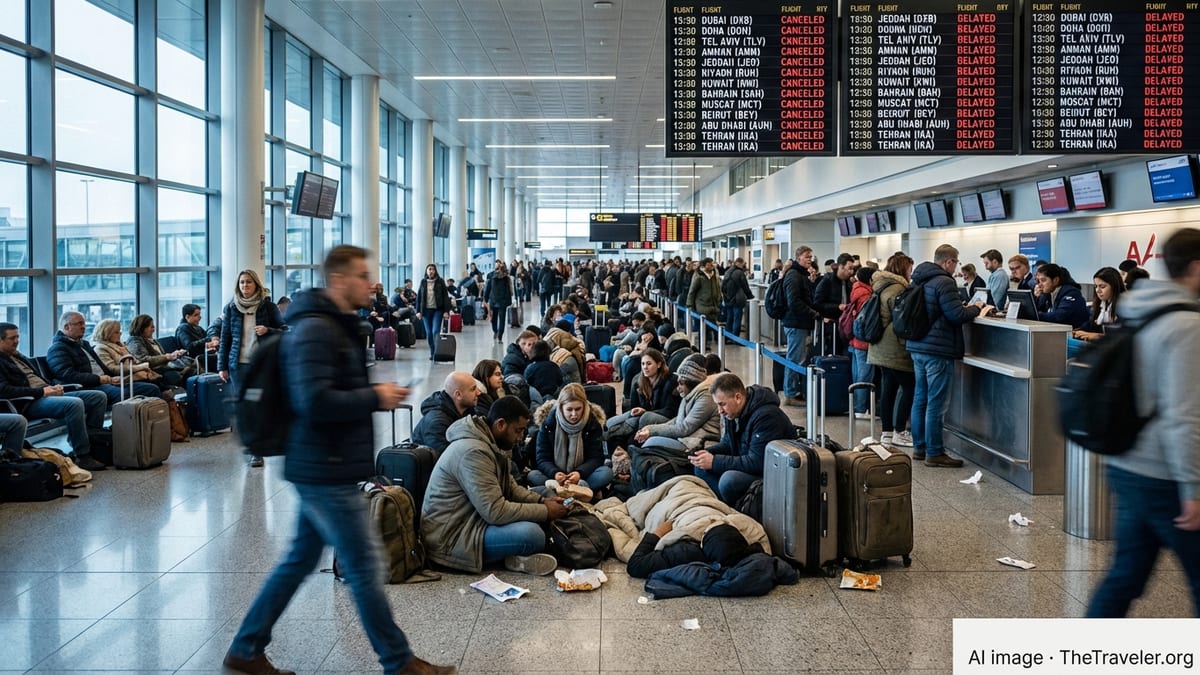
A sudden shutdown of large swaths of Middle East airspace in late February 2026 has unleashed a cascading aviation crisis, with key Gulf hubs closed, tens of thousands of flights canceled or diverted, and passengers stranded at airports from London to Sydney.
Airspace Closures After Strikes Spark Unprecedented Disruption
The shockwaves began on February 28, when joint US and Israeli strikes on Iran were followed within hours by sweeping airspace closures across the region. Iran, Israel, Iraq, Kuwait, Qatar, Bahrain and large parts of the United Arab Emirates imposed blanket bans or tight restrictions on civilian overflights as military activity intensified.
Flight-tracking data showed some of the world’s busiest skies suddenly empty, with commercial aircraft diverting away from the Gulf and northern Middle East corridors that normally funnel traffic between Europe, Africa and Asia. Aviation analytics firms reported that more than a thousand flights to and from the region were canceled in the first 24 hours alone, with total global disruptions quickly running into the tens of thousands.
By March 1, airlines were warning that the shock would not be short lived. With no clear timeline for full airspace reopening and military planners still assessing missile and drone risks, carriers shifted from ad hoc diversions to broader schedule suspensions, reshaping global route maps in real time.
Gulf Mega-Hubs Fall Silent as Airlines Ground Fleets
The most dramatic impact has been felt at the Gulf’s powerhouse hubs. Dubai International, the world’s busiest airport for international passengers, halted operations after authorities ordered a temporary but open-ended closure of Emirati airspace. Nearby Dubai World Central and Abu Dhabi’s Zayed International Airport also suspended most commercial movements, reducing three of the planet’s key east–west gateways to near silence.
Emirates, Etihad and Qatar Airways, whose business models rely on funnelling global traffic through these hubs, canceled or suspended the bulk of their networks. Industry estimates suggest that on a normal day, these three carriers alone move close to 90,000 passengers through Dubai, Abu Dhabi and Doha. Over the weekend, many of those travellers found themselves sleeping on terminal floors instead of boarding connecting flights to Europe, Africa, Asia and Australasia.
Further west, Bahrain International Airport and Kuwait International scaled back operations to essential or emergency movements only as their airspace joined the regional shutdown. To the east, Muscat International in Oman became one of the few remaining Gulf airports with relatively normal activity, though it too faced mounting congestion as airlines scrambled for alternative transit points.
Stranded Passengers Face Long Delays and Patchwork Reroutes
For travellers, the impact has been immediate and deeply personal. At major origin markets such as London, Frankfurt, Mumbai and Sydney, departure boards filled with "canceled" notices for flights bound to or over the Middle East. Passengers on long-haul journeys woke up midair to announcements that their aircraft would divert to Athens, Istanbul or Rome, or even return to their point of departure after hours in the sky.
Airports that typically serve as secondary waypoints found themselves transformed into overnight holding zones. In Athens and Istanbul, transit lounges overflowed with passengers queued at airline desks, clutching paper boarding passes and rebooking vouchers. Many reported being offered hotel rooms only if local capacity allowed, with others handed snack boxes and told to wait for text message updates that might not arrive for hours.
Families connecting between Australia and Europe have been among the hardest hit, as the closure of Gulf hubs destroyed some of the most heavily used one-stop routes between the two continents. Some travellers accepted complex reroutes via Southeast Asia and North America, adding 12 hours or more to journeys that were already among the longest in global aviation. Others simply abandoned trips, opting for refunds or open-date credits rather than navigating the uncertainty.
Global Airlines Rip Up Route Maps and Brace for Higher Costs
Beyond the immediate human drama, the shutdown has forced airlines worldwide into a high-stakes operational puzzle. Carriers that previously threaded through Iranian, Iraqi or Gulf airspace are now plotting longer tracks south over Saudi Arabia, the Arabian Sea and the Red Sea, or north via Turkey and the Caucasus where corridors remain open. Each diversion adds fuel burn, crew duty-time complexity and pressure on air traffic control systems in the remaining available corridors.
European and North American airlines, many of which had already rerouted away from Iran in recent years, are now extending detours further, introducing additional hours on flights to India, Southeast Asia and beyond. Indian carriers, which relied heavily on westbound corridors via Pakistan and the Gulf, are contending with compounded constraints and in some cases have suspended select Middle East and Europe services altogether.
Industry analysts warn that if the disruption persists, the financial fallout will spread quickly. Higher fuel costs, aircraft and crew repositioning, and compensation obligations for stranded passengers threaten to erode margins that were only beginning to recover after the pandemic years. Fare hikes on key intercontinental routes are widely expected as airlines seek to recoup mounting expenses, potentially dampening demand during what is usually a strong booking period heading into the northern summer.
Uncertain Timeline as Security Risks Dictate Reopening
Aviation regulators across the region and in major airline home countries have stressed that safety will determine when and how airspace reopens. Civil aviation authorities in Iran, Israel and the Gulf states are coordinating with military and intelligence services to map active conflict zones, missile trajectories and no-fly areas, with the aim of carving out limited civilian corridors once the most acute threats subside.
Experts note that even a partial reopening will be gradual and tightly controlled, with altitude and routing restrictions likely in place for days or weeks. Airlines may be cleared to overfly certain sectors at specified levels, yet still barred from landing at major hubs until local security assessments improve. This staggered approach could result in a patchwork of possibilities for carriers, favoring those with flexible fleets and multiple hub options.
For now, travellers with bookings touching the Middle East are being urged to monitor airline and airport advisories closely, enroll in flight-alert systems and prepare for last-minute changes. Many carriers have introduced temporary change-fee waivers and more generous refund policies, but availability on alternative routes is tightening rapidly.
With geopolitical tensions still evolving and military planners warning of potential follow-on strikes, the only certainty for global air travel in the coming days is continued volatility. The Middle East’s role as a central crossroads for international aviation means that as long as its skies remain constrained, the ripple effects will be felt in departure halls and arrival lounges around the world.