

More news on this day
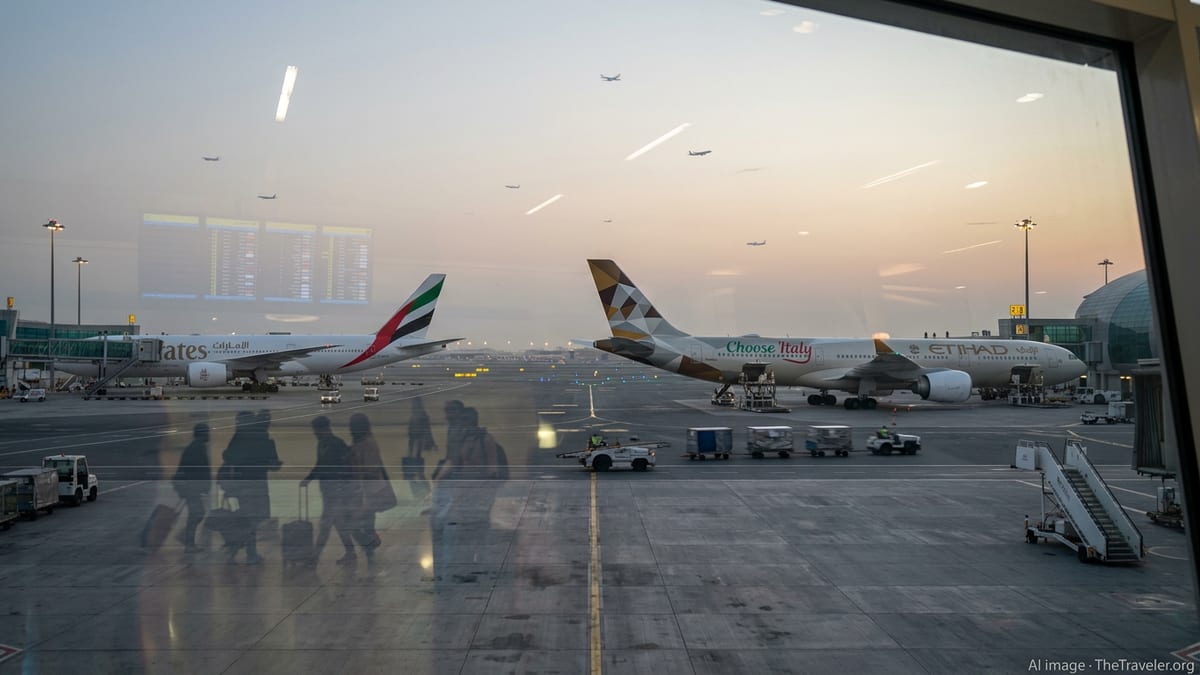
Emirates and Etihad are cautiously restarting flights to the UK and key Gulf destinations after sweeping Middle East airspace closures forced thousands of cancellations, marathon diversions and a rapid redrawing of global long-haul routes.
From Sudden Shutdown to Gradual Reopening
The shock closures began on February 28, when US and Israeli strikes on Iran triggered retaliatory missile and drone attacks that led authorities across the United Arab Emirates, Qatar, Bahrain, Oman, Iraq and Israel to restrict or shut large swathes of airspace. Within hours, radar maps showed normally busy corridors over the Gulf and Iran almost empty as airlines diverted or grounded aircraft.
By March 1, data providers estimated more than 19,000 flights were affected worldwide, with around 3,400 cancellations in a single day as carriers abandoned traditional Europe to Asia routings via the Gulf. Emirates and Etihad, whose Dubai and Abu Dhabi hubs normally funnel tens of thousands of connecting passengers daily, suspended the vast majority of services as air defense systems engaged incoming threats close to their airports.
The closures rippled quickly through global schedules. Europe to India flights via Dubai or Doha vanished from departure boards, Africa to Asia itineraries lost their usual one-stop options, and premium-heavy links between the UK and Australia were abruptly cut. Travel agents describe a scramble to rebook customers via alternative hubs as the picture changed hour by hour.
Four days on, the region has shifted from an acute shutdown to a patchy and highly constrained reopening. Emirates and Etihad are now restoring selected flights to the UK and parts of the Gulf, but on altered routings and reduced frequencies as military activity and overflight restrictions continue.
Emirates Rebuilds a Limited Network to the UK and Gulf
Dubai-based Emirates began operating its first departures since the closures on March 4, initially running a small number of services to priority destinations while keeping its published schedule formally suspended until late on March 7. The airline is focusing on high-demand routes including London, Manchester and Birmingham, alongside regional links to Muscat, Doha and major cities in Saudi Arabia where airspace remains usable.
Aviation analysts say the flights that are running are doing so on nonstandard routings that avoid Iranian and parts of Iraqi airspace. Many long-haul services to and from the UK are skirting north via Turkey and the Caucasus or south over the Red Sea and Arabian Sea, adding four to six hours to journey times in some cases. Crewing constraints, fuel planning and airport curfews are all limiting how many rotations Emirates can realistically operate each day.
For passengers, that means far fewer options than usual. Emirates has urged customers not to travel to the airport unless they hold a confirmed booking on a flight that is showing as operating on the day. The carrier is prioritizing travelers who were stranded by earlier cancellations, with some being rerouted via partner airlines or alternative hubs when seats on Emirates’ own services are unavailable.
Despite the uncertainty, the partial return of Emirates flights to the UK and select Gulf cities marks an important psychological turning point for the industry. However, route planners caution that schedules are being adjusted on a rolling basis, and that any escalation in regional tensions could see newly restored connections suspended again at short notice.
Etihad Restores Services from Abu Dhabi, Eyes Oman and Bahrain
Abu Dhabi’s Etihad Airways has taken a similarly cautious approach. After halting regular commercial operations for several days, the airline began operating limited departures from March 3, initially focused on repatriation and essential travel. As of March 6, Etihad says it is working towards resuming flights to 72 destinations between now and March 19, subject to safety assessments and airspace access.
The network rebuild includes key links from Abu Dhabi to the UK, with London and Manchester returning in a reduced form, and a phased restoration of short-haul services across the Gulf. Flights to Oman, Qatar and Bahrain remain more constrained than usual due to local airspace and airport restrictions, but Etihad is gradually adding frequencies where overflight corridors and ground handling capacity allow.
Travel industry advisories note that while Etihad has published indicative plans, many flights are still being confirmed only a day or two in advance. Passengers who booked tickets on or before February 28 with travel dates through mid-March are being offered flexible rebooking, with options to move journeys later into March without additional fare or change penalties.
Like Emirates, Etihad is rerouting aircraft around conflict zones, often via southern tracks over Saudi Arabia and the Arabian Sea for services to and from Europe. That has operational knock-on effects, including longer block times and tighter aircraft availability, which are likely to keep capacity below pre-crisis levels for several weeks.
How Global Long-Haul Routes Are Being Redrawn
Beyond the immediate disruption to Gulf hubs, the closures are forcing a broader rethink of how airlines link Europe, Africa and Asia. For years, carriers such as Emirates, Etihad and Qatar Airways have dominated traffic flows between the UK and destinations from India to Australia, relying on efficient one-stop connections over the Gulf. With parts of Middle East airspace now effectively off-limits, those routings are being challenged.
Many European and Asian airlines have shifted their long-haul flights north of the conflict zone, threading through Turkish, Caucasus and Central Asian airspace to keep services running. Others are flying further south via the Red Sea and the Horn of Africa. Both strategies add distance and fuel burn, and can push ultra-long sectors close to the edge of aircraft range in poor weather or strong headwinds.
For travelers, the impact is already visible in longer flight times, unconventional routings on flight-tracking apps and the temporary disappearance of some non-essential city pairs. Nonstop flights between Europe and key Indian or Southeast Asian cities are once again in demand as passengers look to avoid the Middle East altogether, even at higher fares. Low-cost long-haul operators, with less flexibility and smaller fleets, have been among the hardest hit.
Meanwhile, airports from Istanbul to Singapore are seeing a bump in connecting traffic as airlines re-bank schedules away from the Gulf. Industry experts warn that if the conflict and associated airspace restrictions drag on, these shifts could harden into a new normal that permanently alters global travel patterns.
What Travelers to the UK and Gulf Need to Know Right Now
For passengers planning trips between the UK and the Gulf states of the United Arab Emirates, Oman, Qatar and Bahrain, the overarching message from airlines and regulators is to verify everything, and assume nothing. Schedules that appear normal weeks from now may be revised repeatedly as safety assessments, military activity and diplomatic negotiations evolve.
Travelers with existing bookings on Emirates or Etihad are being urged to monitor their reservation through the airline’s app or customer portal rather than relying on generic timetables. If a flight is canceled, passengers are typically entitled to a refund or free rebooking, though finding alternative seats in the same cabin can be challenging given the surge in demand and reduced capacity.
Those yet to book may want to build in extra connection time, avoid tight same-day onward links and consider routings via secondary hubs that are currently stable. Travel insurers and consumer advocates also recommend checking policy fine print for coverage related to war, civil unrest and government-mandated airspace closures, which are often excluded or capped.
Above all, industry officials stress that while the resumption of Emirates and Etihad flights to the UK and parts of the Gulf is an encouraging sign, it does not mean a rapid return to business as usual. With no clear timeline for a political resolution to the conflict, travelers should prepare for a protracted period of elevated fares, longer journeys and last-minute schedule changes on some of the world’s most popular long-haul routes.