

More news on this day
Thousands of travellers have been left stranded across the Middle East as airlines including Pegasus, Saudia, Air India, FlyDubai and Emirates suspend or delay hundreds of flights amid escalating regional conflict and rolling airspace closures.
Get the latest news straight to your inbox!
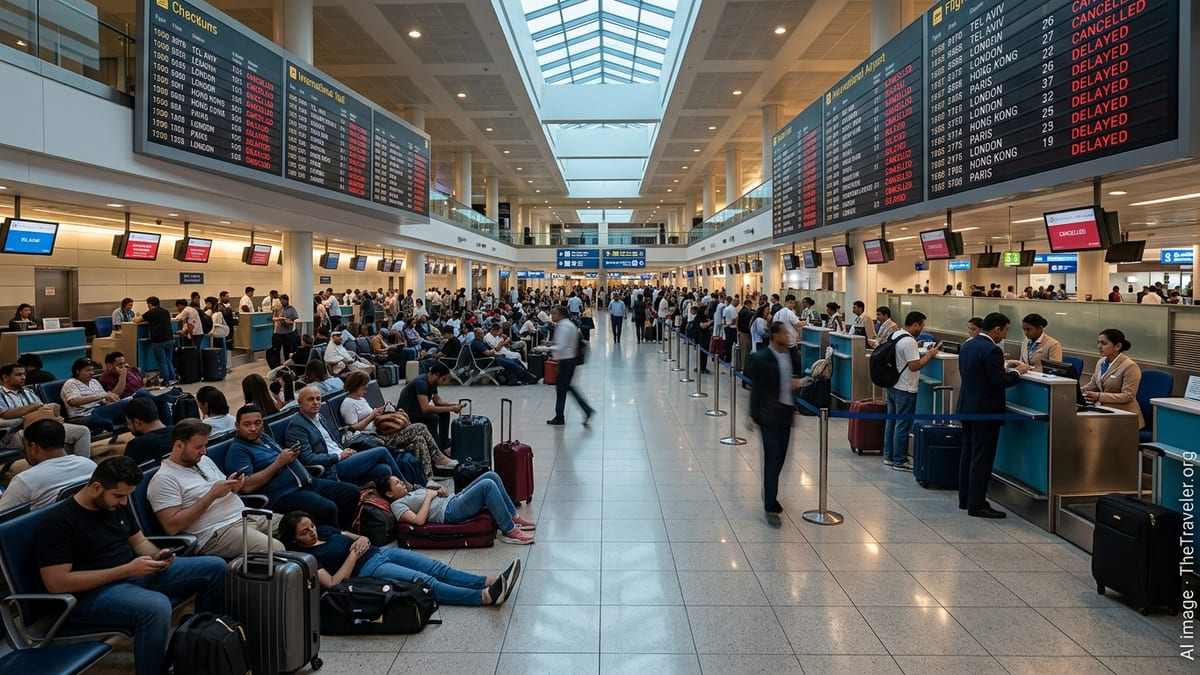
Image by Travel And Tour World
Widespread Cancellations Across Key Gulf and Levant Hubs
Published aviation schedules and tracker data for late March indicate that at least 297 flights have been cancelled or temporarily suspended across major Middle Eastern hubs, with more than 200 additional services delayed. The disruption spans Saudi Arabia, Qatar, the United Arab Emirates, Jordan and neighbouring states that rely on these countries as transit and origin points.
Flight cuts are concentrated around flagship airports such as Dubai International, Abu Dhabi, Doha Hamad International, Jeddah, Riyadh and Amman. In many cases, regularly scheduled passenger services have been replaced with a patchwork of limited evacuations, repatriation flights and cargo operations, often announced at short notice and subject to further change.
Airspace closures and restrictions linked to the ongoing conflict involving Iran have forced airlines to cancel or reroute services that would normally cross the Gulf and northern Middle East. Publicly available routing maps show long detours around closed corridors, adding hours to flight times for the services that are still operating and contributing to additional delays as crews and aircraft reach regulatory limits.
Industry analysts note that while some carriers have begun to restore a fraction of their pre-crisis schedules, the overall number of cancellations and delays remains far above normal seasonal disruption, creating continuing uncertainty for travellers trying to move through the region.
Major Carriers Slash Schedules as Conflict Escalates
Regional and international airlines have reacted with sweeping adjustments to their timetables. Public statements and timetable updates show that Emirates and FlyDubai sharply curtailed operations to and from Dubai during periods when the United Arab Emirates restricted airspace and when a fuel facility incident at Dubai International disrupted airport capacity. Limited flights have since resumed on select routes, but with reduced frequencies and frequent retiming.
Saudi flag carrier Saudia has adjusted services at Jeddah and Riyadh, including temporary suspensions and aircraft swaps on some high-demand regional routes. Reports indicate that while domestic links inside Saudi Arabia are operating on a more regular basis, many international services to conflict-adjacent airspace continue to face cancellations or extended routings.
Indian carriers, notably Air India and its low-cost affiliates, have also scaled back operations to the Gulf. Flight notices circulated by the airline show a mix of partial resumptions and continuing suspensions on routes to the United Arab Emirates, Saudi Arabia and Qatar, reflecting both airspace restrictions and the impact of the separate Pakistan airspace limitations on India–Middle East and India–Europe connections.
Other carriers with large Middle Eastern footprints, including Turkish low-cost airline Pegasus, have been forced to trim their schedules as connecting traffic through Gulf hubs has evaporated. Reduced demand from cautious leisure travellers and corporate clients, combined with higher fuel costs and longer routings, has further weakened the commercial case for maintaining full timetables.
Passengers Stranded From Riyadh to Doha and Dubai
The human impact of the disruption is visible at airports across the region. Travellers have reported being stranded for days in Riyadh, Jeddah, Doha and Dubai after their onward connections were cancelled, sometimes with little warning as airspace restrictions tightened or extended. Many have been forced to sleep in terminals, queue at transfer desks or wait on hold for hours to secure alternative arrangements.
Published coverage from travel and general news outlets describes packed arrival halls and departure gates, with passengers attempting to rebook through remaining operational hubs in Europe, South Asia and the eastern Mediterranean. Some have turned to charter operators or regional low-cost carriers still able to fly around the most restricted areas, often at significantly higher fare levels than before the crisis.
Conditions are especially difficult for travellers who were transiting the Middle East en route between Europe, Asia, Africa and Australasia. With traditional Gulf megahubs operating a fraction of their normal schedules, passengers have had to stitch together multi-stop itineraries via secondary hubs, frequently involving overnight stays and last-minute visa and documentation issues.
Travel insurers and consumer advocates cited in recent reporting indicate a surge in claims and assistance requests, particularly for non-refundable tickets and trips that included multiple airlines on separate bookings. Many travellers are discovering that standard policies treat large-scale geopolitical disruptions as extraordinary events, limiting compensation for out-of-pocket costs.
Ripple Effects on Global Routes and Tourism
The shutdown of large parts of Middle Eastern airspace is reshaping global route maps in real time. Long-haul flights that previously crossed Iran, Iraq and neighbouring airspace are now being rerouted over Central Asia, North Africa or southern maritime corridors. Timetable data and expert commentary show that these diversions can add two to four hours to certain intercontinental journeys, affecting airline operating costs and aircraft availability.
Tourism-dependent economies from the Gulf to the eastern Mediterranean are feeling the effects. Coverage from regional business media points to sharp drops in hotel bookings, package-tour arrivals and forward reservations for summer travel, particularly in destinations that marketed themselves as easy stopover points via Gulf hubs. Some European leisure markets that rely on Middle Eastern feeder traffic are also reporting slower bookings and higher cancellation rates.
Airlines outside the region are adjusting as well. Some European, Asian and North American carriers have added capacity on alternative routes or deployed larger aircraft to bypass disrupted Middle Eastern hubs while still connecting key city pairs. Others have temporarily suspended services to the Gulf and Levant altogether, concentrating resources on markets with more predictable operating conditions.
Industry observers suggest that if the current pattern of closures, extended routings and elevated fuel prices continues, airlines may have to revisit their broader network strategies, potentially accelerating a shift away from single-hub reliance in favour of more distributed connection points.
What Travellers Can Expect in the Coming Weeks
While some airspace restrictions have been adjusted and limited services restored, publicly available notices to airmen and airline advisories indicate that conditions remain highly fluid. Travel specialists suggest that travellers with upcoming itineraries touching Saudi Arabia, Qatar, the United Arab Emirates, Jordan or nearby states should be prepared for continued last-minute changes.
Passengers are being urged, in widely shared travel guidance, to monitor their flight status frequently, to allow extra time for connections, and to consider booking flexible or refundable fares wherever possible. Those already in the region are advised to stay in close contact with their airline or travel agent and to keep contingency funds available for unexpected hotel stays or reroutings.
For now, the scale of disruption, reflected in hundreds of suspended and delayed flights across multiple carriers, underscores how quickly geopolitical tensions in a critical aviation corridor can reverberate through global travel. With no clear timeline for a full restoration of normal schedules, travellers and the industry alike are bracing for a prolonged period of uncertainty in one of the world’s most important air transit regions.