

More news on this day
Escalating conflict and rolling airspace closures across the Middle East are rippling through global aviation, wiping millions of seats from airline schedules and severing key connections between Europe, Asia, Africa and the Americas.
Get the latest news straight to your inbox!
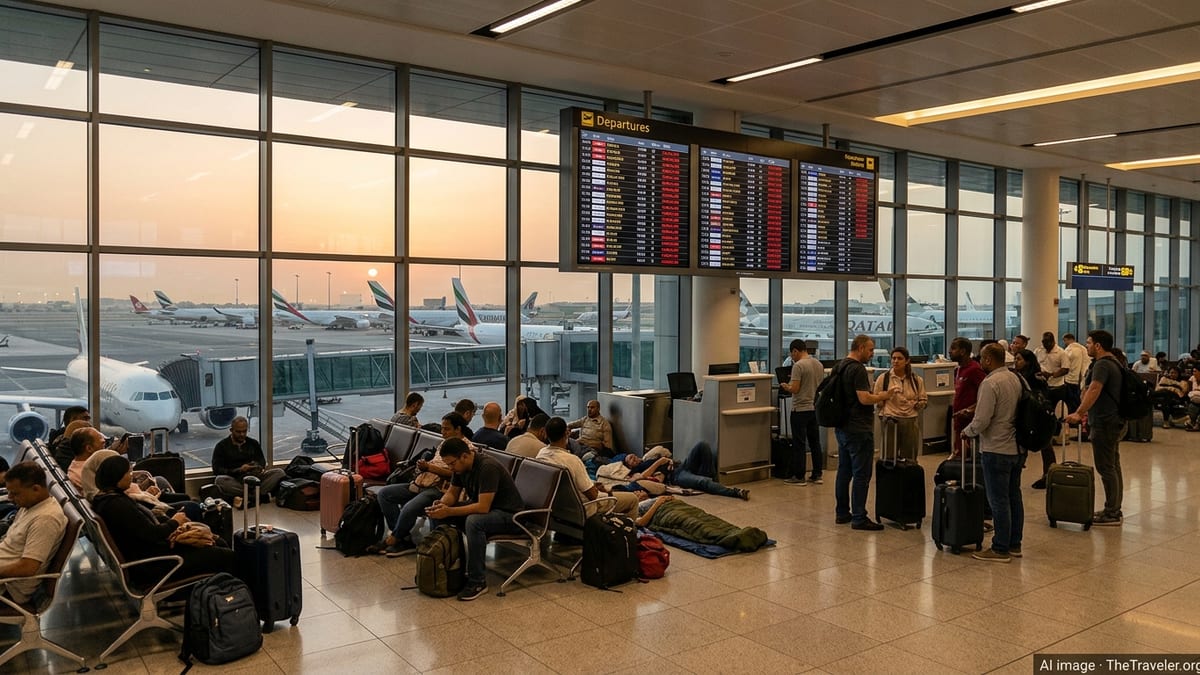
Mass Cancellations As Airspace Closes Over Key Hubs
Recent attacks involving the United States, Israel and Iran have triggered rapid, large-scale shutdowns of airspace across the Gulf and wider Middle East, forcing airlines to ground or divert thousands of flights within hours. Publicly available flight-tracking and schedule data indicate that countries including Iran, Iraq, Kuwait, Bahrain, Qatar and Syria have at times closed their skies or imposed tight restrictions, while the United Arab Emirates has periodically limited traffic around its main hubs in Dubai and Abu Dhabi.
According to analysis of schedule data released in late February 2026, about 1,800 flights operated by major Middle Eastern carriers were cancelled in a single day when airspace closures rippled across the region. Aviation analytics firm Cirium has previously estimated that roughly 90,000 passengers a day normally transit through the big three Gulf hubs of Dubai, Abu Dhabi and Doha, meaning a single day of widespread cancellations can disrupt hundreds of thousands of journeys.
Separate Cirium assessments of the airspace shutdowns suggest that of nearly 3,800 flights scheduled globally to the broader Middle East on one recent weekend, more than 40 percent were cancelled as airlines suspended operations or rerouted around conflict zones. With many carriers still trimming services days after initial strikes, the cumulative loss in available seats now runs into the millions across the current season.
At the same time, airports that normally serve as critical waypoints between continents have seen operations curtailed or suspended. Tehran’s main international airport is reported to have halted commercial traffic entirely, while parts of the Gulf hub system have experienced intermittent shutdowns and reduced schedules amid concerns about missile or drone activity.
From Regional Shock To Global Capacity Crunch
The immediate effect of the conflict has been most visible within the Middle East, where airlines have cancelled large numbers of flights to nearby countries such as Lebanon, Jordan, Iraq and Syria whenever airspace access becomes uncertain. But schedule data and industry analyses indicate that the shock is now radiating across long-haul markets that rely heavily on Middle Eastern hubs to link Europe, Asia, Africa and Australasia.
Published coverage from aviation and logistics specialists shows that, within days of the latest escalation, overall global air freight capacity fell by close to a fifth, reflecting the closure of Gulf hubs and the loss of bellyhold space on grounded passenger flights. On the core Asia–Middle East–Europe corridor, capacity has dropped by more than a quarter compared with typical levels, forcing airlines and shippers to scramble for alternative routings through Central Asia, northern Europe or transpacific links.
For passenger operations, the loss of Middle Eastern transfer points is particularly acute for India and wider South Asia, where a large share of long-haul traffic traditionally flows via Gulf carriers. Some assessments suggest that capacity to and from the region has fallen by more than half on affected days as airlines thin out schedules and reroute aircraft around closed skies, a shift that reduces seat availability well beyond the immediate conflict zone.
These cuts are occurring against a backdrop in which global air travel demand had been expanding, with international routes from Europe to the Middle East previously among the fastest-growing intercontinental markets. Capacity that was set to climb this winter season is now being trimmed back or redeployed, undermining that growth trajectory and complicating planning for airlines and airports alike.
Millions Of Seats Pulled As Airlines Reset Networks
Industry bodies and data providers have highlighted the scale of the seat losses now accumulating across the Middle East and its connected markets. IATA traffic commentary for 2025 already noted that conflicts in Gaza and the wider region had knocked back demand on routes between the Middle East and North America and Europe, even before the latest escalation. With renewed hostilities and airspace closures in early 2026, airlines have responded with much deeper capacity cuts.
Cirium-based analyses cited in recent logistics and aviation reports estimate that about 900,000 airline seats are normally available each day on services to, from and within the Middle East. As carriers suspend operations at closed airports, cancel frequencies to conflict-adjacent countries and add significant flying time to avoid contested airspace, a substantial share of that daily capacity has been temporarily removed. Over several weeks of disrupted operations, the total number of seats stripped from schedules adds up to many millions.
Some major Gulf and regional airlines have issued rolling updates showing entire banks of departures cancelled on certain days, particularly night-time long-haul waves that rely on overflying Iran or Iraq. European and Asian carriers have likewise paused flights to cities such as Beirut and Tel Aviv during periods of heightened tension or redirected services away from traditional Middle Eastern stopovers in favor of longer nonstops.
These shifts are forcing airlines to redraw network maps on short notice, often reassigning widebody aircraft to alternative routes or parking them when viable detours are unavailable. Schedule planners are juggling regulatory safety requirements, crew duty limits and fuel constraints associated with longer routings, all of which constrain how quickly lost seats can be replaced elsewhere in the system.
Travelers Face Longer Journeys, Higher Fares And Lingering Uncertainty
For passengers, the removal of so many seats from the market is translating into longer itineraries, fewer options and the prospect of higher prices where remaining capacity is tight. Reports from booking platforms and travel agents indicate that itineraries between Europe and South or Southeast Asia, which often rely on one-stop Gulf connections, are being rebooked via secondary hubs in Turkey, Central Asia or northern Europe, adding several hours of travel time.
Stranded travelers across multiple continents have described being held on aircraft during sudden airspace closures, diverted to unplanned airports or left to wait days for the next available seat as airlines work through backlogs. With many carriers waiving change fees and offering refunds for cancelled services, revenue forecasts are being reworked even as frontline operations teams focus on repatriations and schedule recovery.
Analysts caution that the impact on airfares will become clearer over the coming months. However, historical patterns during previous regional crises suggest that where large volumes of capacity are withdrawn and demand remains relatively resilient, average fares on key corridors can rise. Business travelers and time-sensitive passengers are often the first to feel the squeeze when premium cabins sell out on the limited number of flights still operating.
The uncertainty is also weighing on tourism-dependent economies that rely on Gulf and Levant gateways for international arrivals. Hotel and destination marketing organizations across the Middle East and nearby regions are monitoring booking trends closely, aware that prolonged schedule instability could dampen visitor numbers well into future seasons even if hostilities ease.
Industry Braces For Prolonged Disruption Amid Geopolitical Risk
While some airspace restrictions have occasionally been eased following short ceasefires or lulls in fighting, aviation bodies warn that geopolitical risk in the Middle East is likely to remain elevated. IATA’s recent financial outlooks for the industry point to conflicts in both Europe and the Middle East as significant downside risks for airlines, noting that sudden airspace closures can unravel carefully calibrated global networks overnight.
Airlines are responding by building more flexibility into their schedules, including holding additional aircraft and crew in reserve where possible and testing alternative routings that avoid the most exposed corridors. Some carriers are also accelerating efforts to diversify their hub strategies, strengthening operations at secondary airports outside the immediate conflict zone to reduce dependence on any single region.
Logistics providers and cargo operators are adjusting in parallel, shifting shipments to corridors that bypass the Gulf entirely or combining air and sea routes to maintain the flow of goods. Analysts note that these workarounds often come with higher costs and longer transit times, which can ultimately be passed on to consumers in the form of more expensive products and services.
With no clear timeline for a durable settlement to the current hostilities, industry observers expect airlines to continue paring back and reshaping their schedules in the months ahead. As millions of seats vanish from traditional Middle East corridors and reappear, in smaller numbers, on alternative routes, travelers and businesses alike are confronting a more fragmented, less predictable global air network.