

More news on this day
Hundreds of passengers across the Middle East and Europe are facing extended delays and unexpected overnight stays as airlines in the United Arab Emirates, Saudi Arabia, Oman and other states cancel 17 flights and delay about 195 more, disrupting operations for carriers including Flydubai, Saudia, Etihad and IndiGo on routes linking Dubai, Jeddah, Manchester, Barcelona and additional hubs.
Get the latest news straight to your inbox!
Fresh Wave of Cancellations Ripples Through Gulf and European Airports
Publicly available aviation data and monitoring by travel-industry outlets indicate that, as of April 12, 2026, a fresh wave of cancellations and delays is sweeping across key airports in the Gulf, with knock-on effects at major European gateways. Seventeen flights operated by carriers such as Flydubai, Saudia, Etihad, IndiGo and several regional airlines have been grounded, while close to 200 additional services are running late.
The latest disruptions are concentrated at major Middle Eastern hubs including Dubai International Airport, Jeddah’s King Abdulaziz International Airport and airports in Oman, but the impact is now clearly visible in cities such as Manchester and Barcelona, where delayed and diverted aircraft are tightening already stretched schedules. Aviation trackers show rolling delays building through the day as affected aircraft miss scheduled departure slots and crews reach operational limits.
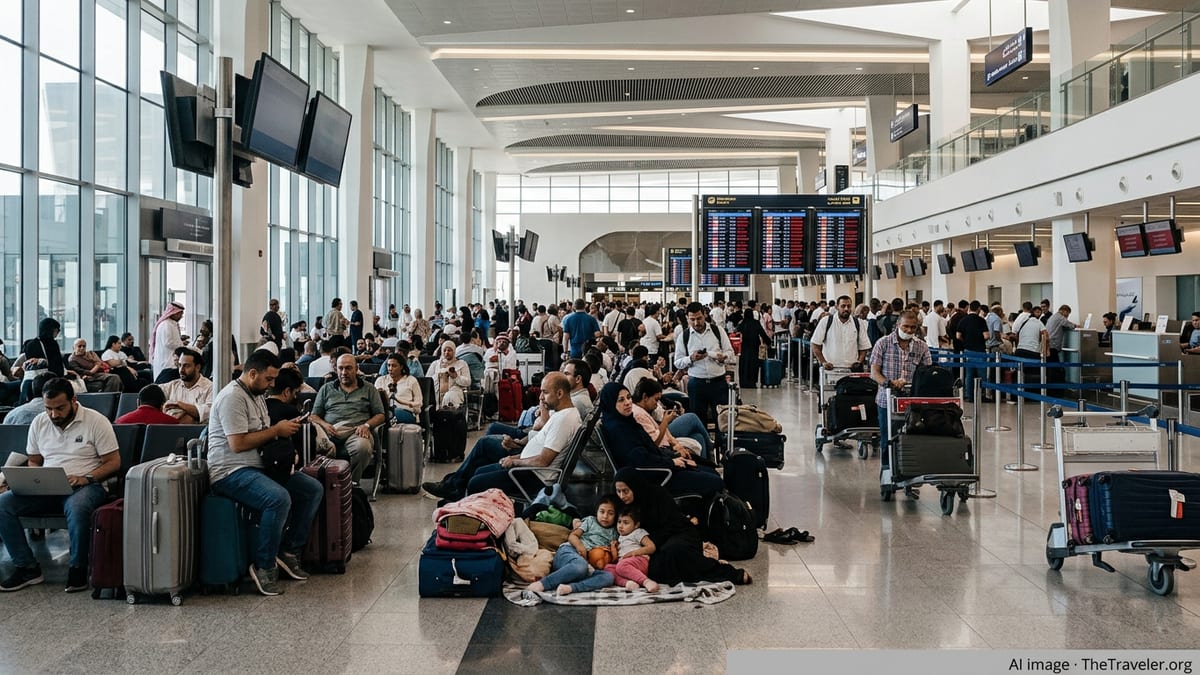
Reports from travel-news platforms describe crowded terminal halls, long queues at transfer desks and passengers struggling to find updated information on revised departure times. In some locations, stranded travelers are being re-routed through alternative hubs, adding extra stops and hours to journeys that would normally be completed in a single overnight sector.
While the number of outright cancellations remains relatively limited compared with the total traffic volume through the region, the scale of delays is amplifying the disruption. Industry analysts note that misaligned aircraft and crew rotations can reverberate across networks for days, especially when airspace options remain constrained and spare capacity is scarce.
Security Tensions and Airspace Limits Keep Schedules Under Pressure
The travel turmoil is unfolding against the backdrop of heightened regional security tensions and evolving airspace restrictions linked to the ongoing conflict involving Iran and several neighboring states. International and regional media coverage in recent weeks has documented widespread airspace closures and rerouting, with some Gulf states imposing tight controls on overflights and airport operations.
Economic and security analyses published this month highlight that large carriers based in the Middle East have already faced sweeping suspensions and reduced schedules since late February 2026, after missile and drone attacks in the Gulf region triggered emergency responses and infrastructure checks. In the United Arab Emirates and Saudi Arabia, temporary closures and capacity caps at key airports earlier in the crisis led to days of almost continuous cancellations.
Although controlled flight corridors through parts of Oman and other neighboring territories have allowed limited services to resume, aviation experts cited in public reports warn that the operational environment remains fragile. Each new security advisory or adjustment in restricted airspace forces airlines to refile routes, extend block times and build additional buffers into already stretched schedules.
This constrained backdrop means that even a relatively modest wave of 17 cancellations and 195 delays can result in disproportionately severe disruption for passengers. Aircraft are spending longer in the air on circuitous routings, turnaround windows on the ground are shrinking and contingency capacity to absorb unexpected shocks is minimal.
Flydubai, Saudia, Etihad and IndiGo Face Network Strain
Among the most affected operators in the current disruption are Flydubai, Saudia, Etihad and IndiGo, alongside several other regional and international airlines that rely heavily on Gulf hubs. Recent operational updates and schedule snapshots reviewed by travel-industry publications show these carriers juggling curtailed frequencies, retimed departures and ad hoc equipment swaps to keep as many routes as possible functioning.
Flydubai’s dense network of short- and medium-haul services from Dubai means that a single delay early in the day can cascade through multiple rotations, affecting passengers across the Middle East, South Asia and Eastern Europe. Publicly available flight-status boards in recent days have shown clusters of Flydubai departures from Dubai operating significantly behind schedule, particularly to Saudi Arabian and regional destinations.
Saudia, which connects Jeddah and Riyadh to a wide range of regional and international cities, is contending with similar knock-on effects. Scheduled flights to and from hubs such as Dubai and key South Asian cities have been repeatedly adjusted, with some services showing extended ground times and others removed from daily rosters as the airline reshuffles aircraft to priority routes.
Etihad and IndiGo are also facing mounting pressure on services touching the Gulf. Published coverage of IndiGo’s operations highlights that the low-cost carrier continues to adjust flights between Indian cities and Dubai, with cancellations and long delays affecting passengers on both origin and return legs. Etihad’s longer-haul operations from Abu Dhabi to Europe and Asia are experiencing embedded delays as aircraft navigate lengthened routings and congested corridors.
Dubai, Jeddah, Manchester and Barcelona See Knock-on Passenger Disruption
The operational turmoil is most immediately visible at front-line hubs such as Dubai and Jeddah, where travelers arriving from or departing to Europe, Asia and Africa are encountering disrupted onward connections. Airport information displays at Dubai International have, in recent days, shown waves of delayed arrivals from South Asia and the wider region, with some onward flights to European cities waiting for late inbound aircraft or substituting smaller jets.
Jeddah’s role as a key gateway for religious travel and labor migration means that any interruption has an outsized humanitarian impact. According to travel and aviation reporting, recent delays on flights linking Jeddah with Gulf neighbors and South Asian cities have left workers, pilgrims and families waiting hours for rebooked connections or last-minute seat releases on scarce outbound services.
The disruption is not confined to the Middle East. Manchester and Barcelona, both important destinations within the broader Gulf-to-Europe network, are seeing knock-on effects from late-arriving aircraft and altered schedules. Publicly accessible tracking sites have recorded late-night arrivals and early-morning departures shifting by several hours, forcing passengers to reorganize ground transport, accommodation and connecting itineraries within Europe.
At some European airports, handling agents and ground-service providers are working through significant backlogs of baggage and rebookings as delayed flights from Dubai, Jeddah and other Gulf hubs arrive outside normal staffing peaks. Travel advisories published by consumer-focused outlets are urging passengers on affected routes to build in extra time, monitor flight status frequently and prepare for schedule changes even after check-in.
Travelers Face Uncertain Timelines as Airlines Seek Stability
For stranded and delayed passengers, the most immediate challenge is uncertainty over when normal operations might resume. With regional security conditions still evolving and airspace restrictions subject to short-notice change, airlines are reluctant to publish firm timelines for a full return to pre-crisis schedules. Industry observers note that even as some carriers restore limited operations, further disruptions remain possible.
Reports from travel advisories and airline updates recommend that passengers booked on routes touching the Gulf in the coming days maintain flexible plans. Many carriers are offering voluntary rebooking options, travel waivers or open-date tickets on affected services, though specific policies vary. Travelers connecting through Dubai, Jeddah, Manchester, Barcelona and other affected hubs are being encouraged to verify their flight status repeatedly on the day of travel.
Longer term, aviation analysts cited in regional and international coverage suggest that the Gulf’s role as a global connecting corridor will continue to be tested as the 2026 crisis unfolds. While temporary corridors through Oman and select neighboring states are keeping a portion of east–west traffic moving, airlines are likely to preserve more conservative schedules, operational buffers and contingency plans even after the current wave of 17 cancellations and 195 delays subsides.
For now, hundreds of passengers remain scattered across terminals from the Middle East to Europe, waiting for replacement flights and clearer guidance. With little sign that the underlying pressures on Gulf aviation will ease immediately, travel experts expect intermittent disruption to remain a defining feature of journeys through the region in the weeks ahead.