


More news on this day
Hundreds of passengers across the Middle East are facing renewed travel chaos as airports in Egypt, the United Arab Emirates, Saudi Arabia, Kuwait and Qatar report dozens of cancellations and lengthy delays, with at least 48 flights scrapped and nearly 300 disrupted across key hubs including Cairo, Dubai, Jeddah, Kuwait City and Doha.
Get the latest news straight to your inbox!
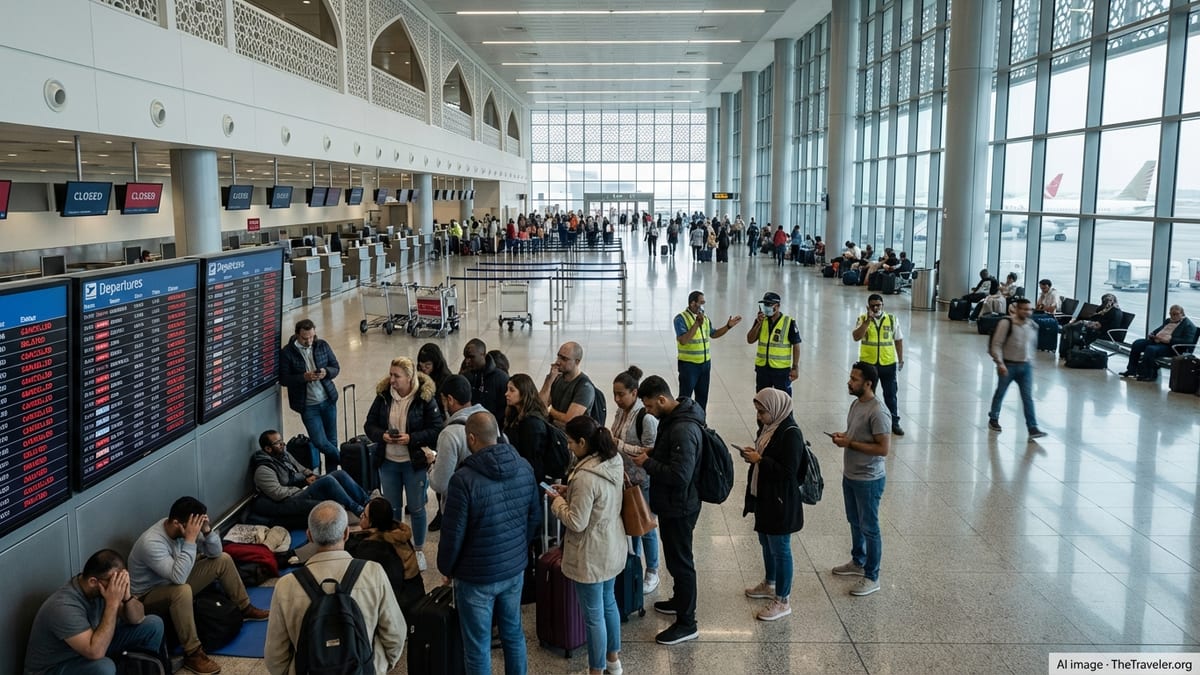
Regional Disruption Returns to Key Middle East Hubs
Published coverage and live aviation data indicate that a new wave of operational restrictions is sweeping major Middle Eastern hubs, compounding the disruption that has persisted since regional airspace closures began in late February. Airports in Cairo, Dubai, Jeddah, Kuwait City and Doha are again reporting clusters of cancellations and rolling delays, affecting both local and connecting traffic.
Recent reporting on regional airspace management shows that regulators in the Gulf have reintroduced flow-control measures, including slot caps and in-route holding patterns, for traffic bound to the United Arab Emirates. These measures follow renewed security concerns and have sharply reduced the number of movements permitted at Dubai International and other Emirati airports, with airlines forced to trim schedules or pad block times to absorb en-route delays.
Advisories from travel and aviation analysts describe a patchwork of closures and partial reopenings that now extends from Egypt through the Gulf. While some international services have resumed on limited schedules, persistent restrictions over and around Iran, Iraq and several Gulf states continue to push airlines into longer routings, which consume extra fuel and leave tight connection banks exposed to missed transfers.
As a result, even a relatively modest tally of 48 outright cancellations and 287 delays in a 24-hour window has proved sufficient to strand hundreds of passengers at hub airports. With aircraft and crews out of position after days of disruption, airlines are struggling to restore normal rotations, and smaller regional carriers appear particularly vulnerable to schedule shocks.
Cairo, Jeddah and Kuwait City See Grounded Aircraft and Missed Connections
In North Africa and the Red Sea corridor, publicly available flight-status boards at Cairo International Airport show multiple EgyptAir services labeled as canceled or significantly delayed on routes to Istanbul, Port Sudan, Asmara, Beirut and Kuwait City. The pattern suggests knock-on effects from regional airspace constraints, with northbound and eastbound departures particularly affected.
Reports from earlier disruption waves this spring highlighted Cairo as a pressure point where delays quickly cascaded into missed onward flights to Europe, the Gulf and North Africa. On heavily trafficked days, more than a third of departures and arrivals at the Egyptian capital have been reported as either canceled or operating with long delays, leaving passengers sleeping in terminals or forced to arrange last-minute accommodation in the city.
In Saudi Arabia, monitoring data and regional aviation coverage describe similar strains at Jeddah and other international gateways. National carrier Saudia has adjusted schedules repeatedly since February in response to changing airspace permissions, and services linking Jeddah with Cairo, the Gulf and South Asia have been particularly exposed to rerouting and extended flying times.
Kuwait City remains one of the most disrupted nodes in the network. Background information on the 2026 Iran war notes that Kuwait’s airspace has experienced repeated closures following drone and missile incidents, prompting extended suspensions of normal passenger operations. Some local carriers have temporarily shifted operations to alternate airports in Saudi Arabia, requiring lengthy road transfers for passengers and severely curtailing direct links to the Kuwaiti capital.
Dubai and Doha Grapple With Capacity Caps and Tactical Holds
In the Gulf, Dubai and Doha continue to feel the impact of renewed regional tension and airspace risk assessments. Travel-industry briefings published this week indicate that the United Arab Emirates has reinstated capacity caps on overflights and inbound traffic, with tactical holds now common for flights bound for Dubai International and Abu Dhabi’s Zayed International Airport.
These measures have sharply reduced the ability of Emirates, flydubai and Etihad to run dense connecting banks through their hubs. When aircraft are held in stacks or forced into longer routings around restricted zones, even minor delays can unravel tight transit itineraries, leaving through-passengers stranded and requiring expensive rebooking across multiple sectors.
Doha’s Hamad International Airport, home base for Qatar Airways, has also grappled with fluctuating restrictions since late February. Earlier airspace shutdowns temporarily halted most inbound and outbound services, while more recent days have brought a mix of partial resumptions and targeted cancellations on routes over or near conflict-affected regions. Aviation analytics cited in recent coverage suggest that Qatar’s hub has seen traffic volumes fall significantly compared with pre-crisis levels, as some long-haul passengers avoid routings that traverse sensitive airspace.
Across these Gulf hubs, reports indicate that many airlines have adopted a conservative approach to scheduling, cutting marginal routes, consolidating frequencies and prioritising trunk services to Europe and Asia. That strategy helps reduce exposure to last-minute airspace changes, but it also means fewer options for travelers who find their original flights canceled or heavily delayed.
Airlines Trim Schedules as Fuel Costs and Rerouting Bite
The latest wave of disruption coincides with a spike in global jet fuel prices, which has triggered broader schedule reductions that are now intersecting with Middle East airspace constraints. Industry-focused outlets report that airlines worldwide have canceled around 13,000 flights for the May to August period as part of a strategic retrenchment in response to fuel trading at the upper end of recent price ranges.
For carriers already forced into longer routings to avoid closed or high-risk airspace, the economics are particularly stark. Analysts estimate that detours around conflict zones can add 8 to 12 percent to fuel burn on certain long-haul sectors, turning once-profitable routes into marginal propositions. In such conditions, airlines are more likely to cancel or downsize flights, especially on routes heavily dependent on connecting traffic through Gulf and Levantine hubs.
Middle Eastern network carriers such as EgyptAir, Saudia and flydubai face a double squeeze: regulatory constraints that limit their ability to use the most direct paths, and cost pressures that make it harder to absorb long-duration delays. Publicly available timetables and recent service updates show a mix of frequency cuts, aircraft down-gauging and the temporary suspension of some destinations in the wider region.
Low-cost and regional airlines are also pulling back. Some have issued notices warning of “fluid” schedules on routes touching the Gulf, with passengers urged to check departure status on the day of travel and to consider more flexible ticket options. For travelers, that translates into a thinner safety margin: when a flight is canceled, there may be fewer alternative departures available the same day.
Passengers Face Long Waits, Rebookings and Complex Detours
For the traveling public, the most visible consequence of the latest disruptions is the growing number of passengers isolated at hub airports across the Middle East. Aviation data aggregated by travel-insurance providers and flight-tracking platforms points to hundreds of passengers currently stuck in transit at Cairo, Dubai, Jeddah, Kuwait City and Doha, with many more facing multi-hour delays or forced overnight stays.
Standard passenger-rights frameworks in the European Union and the United Kingdom provide for compensation and care in cases of long delays or cancellations, but these rules typically exempt airlines from liability when the primary cause is an extraordinary event such as airspace closure or armed conflict. Travel-insurance advisories note that some comprehensive policies may cover additional accommodation and rebooking costs, although coverage varies widely by provider and policy wording.
Travel experts recommend that passengers with imminent departures to or via affected airports build extra flexibility into their plans. That can include allowing longer connection windows, traveling with carry-on luggage only where possible, and closely monitoring airline alerts and airport status boards in the 24 hours before departure. In some cases, rerouting through alternative hubs in Europe, North Africa or South Asia may reduce exposure to last-minute changes in Middle Eastern airspace restrictions.
With no clear timeline for a full normalization of regional traffic, the outlook for travelers remains uncertain. For now, the combination of constrained airspace, elevated fuel prices and fragile airline schedules continues to translate into disrupted journeys and crowded departure halls across some of the world’s most important transit hubs.