

More news on this day
Key Gulf aviation hubs from Doha to Dubai remain severely disrupted as airspace closures linked to the escalating US-Israel-Iran conflict ripple across Qatar, the United Arab Emirates, Saudi Arabia, Oman, Kuwait and Bahrain, stranding tens of thousands of travelers and severing vital links between Europe, Asia and Africa.
War in the Gulf Turns Global Transit Hubs into Pressure Points
The latest wave of missile and drone attacks across the Gulf has transformed some of the world’s busiest transfer hubs into bottlenecks, with airlines racing to adapt to fast-changing airspace restrictions. Since coordinated US and Israeli strikes on Iran began on February 28, Iran has answered with sustained barrages targeting US-linked sites and infrastructure in Gulf states, prompting authorities from Qatar to the UAE and Bahrain to sharply curtail flights for safety reasons.
On March 1 alone, industry trackers estimate that around 19,000 flights worldwide were delayed and more than 3,400 cancelled as airspace closures radiated outward over Iran, Iraq, Israel, Qatar, Bahrain, Kuwait and the United Arab Emirates. Dubai, Abu Dhabi and Doha, which normally handle tens of thousands of transit passengers each day, were forced to suspend or drastically reduce operations as missiles flew and debris reportedly hit areas close to airport facilities.
Although some governments have kept parts of their skies technically open, the overlapping risk zones have effectively shut down vast swathes of the standard corridors that link Europe and North America with Asia and Australasia. Carriers have had to reroute north via the Caucasus or south via Egypt and Saudi Arabia, adding one to three hours to flying times, burning extra fuel and squeezing already stretched fleets and crews.
The result has been an abrupt shock to the global aviation system reminiscent of the early days of the pandemic: full aircraft returning to origin after hours in the air, crews timing out on the ground in the Middle East, and passengers marooned in airports that can no longer guarantee onward connections.
Doha, Dubai and Abu Dhabi: Once Seamless Connections Now Chokepoints
Hamad International Airport in Doha, typically a model of smooth long-haul connectivity, has been among the worst hit. After Iranian missile strikes on Qatar and the closure of Qatari airspace on February 28, hundreds of flights were cancelled over the following days, and Qatar Airways suspended most regular passenger services while focusing on safety assessments and contingency planning.
Qatar’s Civil Aviation Authority has since announced a partial reopening, but only for narrowly defined evacuation and selected cargo operations. Qatar Airways has begun operating limited repatriation flights to key European capitals, with priority for stranded residents and transit passengers whose journeys were interrupted when the war escalated. For most travelers, however, Doha remains effectively off limits as a transfer hub, with tickets rebooked or refunded and itineraries restructured via alternative gateways.
In the United Arab Emirates, Dubai International and Abu Dhabi International have endured days of suspended or heavily curtailed schedules. Emirates and Etihad have gradually restarted a fraction of their vast networks, emphasizing that services remain subject to rapid change as missile alerts and airspace updates continue. Reduced schedules mean that even passengers who manage to secure a seat out of the region often face long layovers elsewhere and last-minute rerouting.
Local low-cost carriers and regional operators have been similarly affected across Sharjah, Ras Al Khaimah and other UAE airports. For now, officials and airline executives stress that safety remains paramount, even as pressure mounts from tourism businesses, expatriate communities and global trade partners who rely on the Gulf’s role as an aviation crossroads.
Saudi Arabia, Oman, Kuwait and Bahrain Caught in the Crossfire
Beyond Qatar and the UAE, neighboring Gulf states are grappling with their own mix of security risks and operational constraints. Saudi Arabia, whose eastern airports sit close to key Gulf shipping lanes, has experienced waves of suspensions and diversions, particularly at Dammam. National carrier Saudia and low-cost airline flynas have temporarily halted numerous services to Doha, Dubai, Abu Dhabi, Bahrain and Kuwait as authorities reassess the safety of flight paths that skirt contested airspace.
Oman, traditionally a quieter aviation player that often benefits when regional tensions rise elsewhere, has been pulled directly into the crisis. Iranian drone attacks on Omani ports and incidents involving tankers off Muscat and near the Strait of Hormuz have heightened security concerns. While Muscat’s airport has remained technically open, it has had to absorb rerouted traffic and act as a staging point for special services and repatriation flights, stretching its capacity and ground resources.
Kuwait and Bahrain, both hosting strategic US military facilities and located on the front line of the contested Gulf air corridor, have imposed restrictions that ripple far beyond their own modest national carriers. Temporary closures of their airspace, combined with those over Iran, Iraq and Qatar, have fragmented what was once a highly optimized web of east–west routing options, forcing airlines into longer, more expensive detours or outright cancellations.
The patchwork of rules changes by the hour as aviation regulators issue new notices and military operations shift. For travelers, that means flights that look confirmed one day can disappear the next, and routings that once involved a single seamless change in Doha or Dubai can now require multiple stops and overnight stays.
Passengers Stranded, Costs Soar and Confidence Shaken
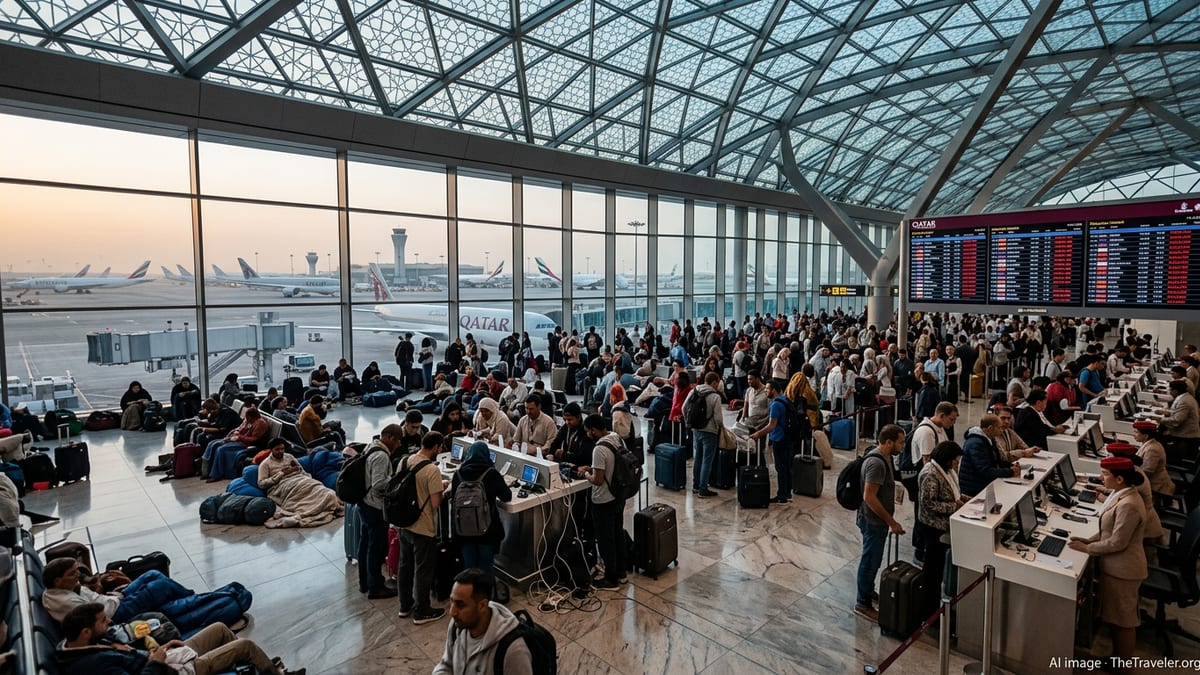
For hundreds of thousands of passengers, the geopolitical chessboard has translated into personal crises. Families attempting to return to Europe from Southeast Asia via Gulf hubs have found themselves sleeping on terminal floors or shuttling between airport hotels as airlines struggle to find spare seats on alternative routes. Business travelers have missed critical meetings, migrant workers are stuck between contracts, and tourists face mounting bills as stays in Dubai, Doha or Muscat extend indefinitely.
Airlines and governments have scrambled to ease the strain. Major carriers have introduced flexible rebooking policies, waiving change fees for tickets issued before the escalation and offering refunds where services are suspended outright. Some have operated relief flights from secondary airports such as Fujairah or via detours through Turkey, Egypt or Jordan, while ground handlers in the Gulf work around the clock to untangle complex rebooking queues.
Yet the sheer scale of the disruption means many will still be left waiting. With Asia–Europe fares on remaining viable routes reportedly tripling in a matter of days, passengers who did manage to leave the region have often done so at significant personal cost. Those staying behind face uncertainty over how long their travel insurance will cover extended accommodation and whether employers will pay for re-routed journeys.
Travel industry analysts warn that beyond the immediate chaos, there may be lasting damage to traveler confidence in the Gulf as a reliable transit region. While security-driven closures are not new to the Middle East, rarely have so many states imposed such sweeping restrictions at the same time, and rarely have the effects been felt so sharply across such a large slice of the global long-haul market.
Airlines Rebuild Schedules Amid Uncertain Outlook
As of March 7, some green shoots are visible. Emirates, Etihad and several regional carriers have begun to publish limited schedules through mid-March, cautiously restoring connections to major cities in Europe, North America and Asia as missile fire ebbs and authorities refine risk assessments. Airlines are adding capacity where alternate routings remain viable, even if longer flying times reduce overall efficiency.
Qatar Airways and other carriers whose home airspace remains most constrained are leaning on neighboring states to mount evacuation and relief flights. Services out of Muscat and Riyadh are being used to move stranded Doha-bound passengers onward, while charter operators and partner airlines assist with ad hoc operations. Travel agents report that many customers are now asking specifically to avoid transits through the core Gulf hubs for upcoming trips, instead favoring routes via Istanbul, Cairo or European gateways, at least in the short term.
Industry groups and safety regulators continue to advise airlines to steer clear of the most volatile airspace until there is sustained de-escalation on the ground. In the meantime, airlines are focused on rebuilding carefully rather than quickly, mindful that another volley of missile or drone attacks could undo any fragile progress and trigger a fresh round of cancellations.
For travelers looking ahead to spring breaks or business trips that typically rely on the Gulf’s unparalleled connectivity, the message is one of caution and flexibility: book with changeable fares, monitor airline alerts closely, and be prepared for plans to shift at short notice as the skies over Doha, Dubai, Abu Dhabi, Riyadh and Muscat remain far from settled.