

More news on this day
Escalating missile and drone attacks linked to the Iran conflict are forcing Emirates, Qatar Airways, Lufthansa and Air France to cancel, divert and reroute flights across the Middle East, sending shock waves through global air travel networks that rely on Gulf and Levant hubs.
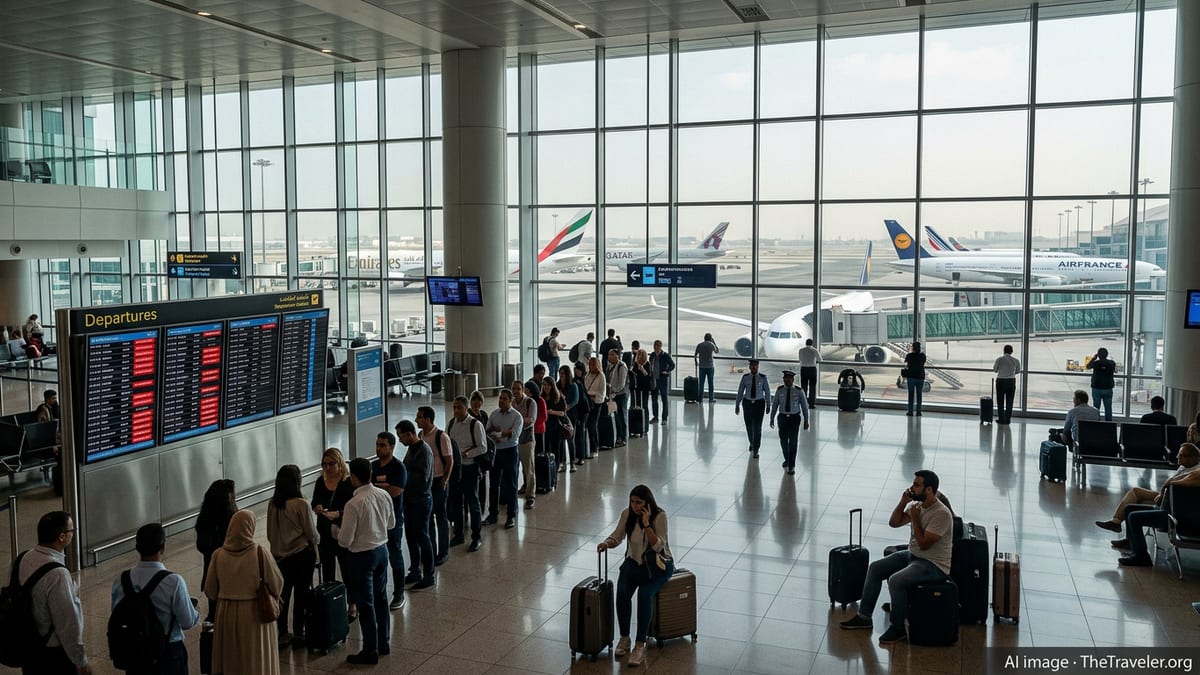
Missile and Drone Strikes Turn Gulf Hubs into Conflict Frontlines
Since February 28, 2026, when U.S. and Israeli strikes on Iran triggered a wave of retaliatory attacks, Middle Eastern airspace has become one of the most volatile regions for commercial aviation in decades. Iran has launched large volleys of ballistic missiles and drones toward the United Arab Emirates, Qatar and other Gulf states, prompting intensive air defense activity and repeated shutdowns of key corridors above the Gulf and surrounding waters.
Dubai, Doha and Abu Dhabi, normally among the most reliable and heavily trafficked connecting hubs between Europe, Asia, Africa and Oceania, have come under direct threat. Authorities in the UAE say they have intercepted hundreds of drones and missiles aimed at major population centers and critical infrastructure, including airports. Even when incoming projectiles are successfully destroyed, the risk from falling debris and the need to keep airspace clear for military operations has forced civil aviation regulators to clamp down on normal traffic.
The result has been rolling closures and severe restrictions across multiple flight information regions, transforming what was once routine long haul flying into a complex exercise in risk management. Air traffic controllers are coordinating civilian schedules around air defense batteries, military patrols and temporary danger zones, leaving airlines with little choice but to cancel services outright or send aircraft on long detours around the Arabian Peninsula.
How Emirates and Qatar Airways Have Been Hit
Emirates and Qatar Airways, two of the world’s largest long haul carriers, have borne the brunt of the disruption. Both airlines temporarily suspended large parts of their operations as Iranian missiles and drones targeted the Gulf, with Dubai and Doha’s airspace repeatedly closed or heavily restricted. On peak days of the crisis, hundreds of flights were cancelled at Dubai International Airport alone, stranding tens of thousands of passengers in hotels, terminals and improvised waiting areas.
In recent days, Emirates has begun to restore a limited schedule from Dubai, gradually reintroducing key routes while warning that services remain subject to late changes. The carrier is prioritizing trunk routes to major cities in Europe, Asia and North America, but many flights are operating on extended routings that skirt the most exposed airspace over the Gulf and parts of the Levant. Travelers are reporting flight times stretched by several hours as aircraft route south over the Arabian Sea or north via Turkey and the Caucasus.
Qatar Airways faces an even tighter squeeze. Doha’s international airport has at times been effectively closed for regular commercial departures, with the airline operating only a small number of relief and evacuation flights through alternative gateways in neighboring countries. For one of the world’s most connectivity-dependent carriers, the sudden loss of its main hub has been a dramatic shock, cutting off usual one stop links between Europe, Africa, Asia and Australasia.
Both Gulf giants are offering rebooking and refunds, but the sheer scale of their networks means recovery will be uneven. Even when airspace restrictions ease, rebuilding tightly banked connection waves and repositioning aircraft and crews will take days, if not weeks, to normalize.
Lufthansa, Air France and European Carriers Reroute and Suspend
European airlines that rely on Middle Eastern destinations and overflight corridors have also been forced into emergency network changes. Lufthansa Group has suspended services to Dubai, Abu Dhabi and several other cities across the Gulf and Levant, including Dammam, Amman, Erbil, Tel Aviv, Beirut and Tehran, with some suspensions now stretching well into late March and beyond. The airline has warned investors that the conflict has introduced the greatest uncertainty to global air traffic since the pandemic era.
Air France has similarly halted flights between Paris and Dubai and Riyadh for at least several more days, and extended suspensions on its routes to Tel Aviv and Beirut. A government charter operated by the carrier and tasked with repatriating French nationals was forced to abandon its mission and turn back after missile activity was reported along its planned flight path, highlighting the unpredictability of the operational environment even for carefully coordinated state flights.
For long haul services that do not terminate in the Middle East, the challenge is overflight. Airlines such as Lufthansa, Air France and others are reshaping routes to Asia and the Indian subcontinent to avoid the most threatened sections of Middle Eastern airspace. This often means longer tracks over the eastern Mediterranean, Central Asia or the Arabian Sea, adding up to four to six hours to certain journeys and driving higher fuel burn and operating costs. Some carriers are trimming frequencies or upgauging aircraft on remaining routes to cope with capacity constraints.
These European decisions cascade across the wider alliance networks. Passengers booked on code share itineraries that once relied on swift transits through Gulf hubs or direct overflight of the region are now being shifted to alternative routings via northern Europe, southern Africa or even North America, often at short notice.
What This Means for Travelers Right Now
For travelers, the most immediate impact is uncertainty. Schedules published on airline websites and booking platforms are being revised repeatedly as governments issue new airspace notices and as missile and drone activity flares or subsides. Even flights that appear to be operating can be delayed for hours while crews wait for updated clearances or for military activity to move away from critical corridors.
Passengers transiting through Dubai, Doha or Abu Dhabi should expect last minute gate changes, irregular operations and, in some cases, overnight stays while they are reprotected onto alternative services. Many carriers are waiving change fees and offering free rebooking windows, but hotel accommodation and meal vouchers may vary by airline and jurisdiction. Travelers connecting between Europe and Asia or between North America and destinations in India, Southeast Asia and Australia are among the most heavily affected, because they depend on the very long haul links now exposed to the conflict zone.
Those with imminent trips to the broader region face a more fundamental question: whether to travel at all. Governments including the United States and several European states have issued strong advisories urging citizens to depart certain Middle Eastern countries while commercial options remain available, citing the risk of further strikes and sudden airspace closures. That guidance is influencing travel insurance coverage and corporate travel policies, with many companies now restricting employee trips to high risk destinations and rerouting essential journeys via safer hubs.
Experts stress that despite the dramatic headlines, the aviation industry has decades of experience managing operations in and around conflict areas, and that airlines are generally conservative about risk. Commercial flights are being kept away from known or suspected missile trajectories, and crews receive real time updates from airline control centers and national aviation authorities. Still, the complexity and speed of developments mean that no itinerary through or near the region can be considered immune from disruption.
How to Navigate Global Travel Risks in the Coming Weeks
With no clear timeline for a deescalation in the Iran related conflict, travelers planning trips through spring should factor in the possibility of continuing airspace restrictions and schedule volatility. Booking non stop routes that avoid the Middle East altogether, even at a higher fare, may reduce disruption risk for some itineraries. Where Gulf or Levant connections are unavoidable, choosing flexible tickets and allowing longer layovers can provide crucial buffers if flights are delayed or rebooked.
Industry analysts recommend checking airline apps and notifications frequently in the 48 hours before departure, as many schedule changes are being pushed in near real time. Monitoring official travel advisories for destination and transit countries is equally important, since a shift in government guidance can lead airlines to pull down routes quickly. Travelers should also review insurance policies carefully, ensuring that coverage explicitly addresses war related disruptions and government warnings, which are often excluded from standard plans.
The current crisis underlines how dependent global aviation has become on a handful of strategically located hubs and narrow air corridors. Emirates, Qatar Airways, Lufthansa and Air France sit at the center of this web, and the missiles and drones now arcing across Middle Eastern skies are testing the resilience of the system they help sustain. For passengers, the coming weeks are likely to bring a mix of creative rerouting, longer flights and, in some cases, difficult decisions about whether to fly at all.