

On the surface, Moose Jaw looks like a classic prairie town: grain country all around, big skies overhead and a compact downtown framed by historic brick facades. Stay a little longer, though, and an entirely different city begins to emerge. Under the streets run tunnels linked with rumrunners and immigrants, on the edges of town a flight demonstration team trains above the fields, and in the middle of it all, geothermal mineral water steams beneath winter skies. This is Moose Jaw, a place that leans into its "notorious" past while serving up warm, small-city hospitality and easy access to the Saskatchewan prairie.
Getting to Know Moose Jaw
Moose Jaw sits in south-central Saskatchewan, roughly 77 kilometres west of Regina along the Trans-Canada Highway. With a population in the mid-30,000s, it is large enough to have a lively downtown, cultural attractions and a strong dining scene, but small enough that many of the main sights are walkable from one another. The city is a long-standing transportation hub on the prairie, historically shaped by the Canadian Pacific Railway and still ringed today by highways that link farms, small towns and provincial parks.
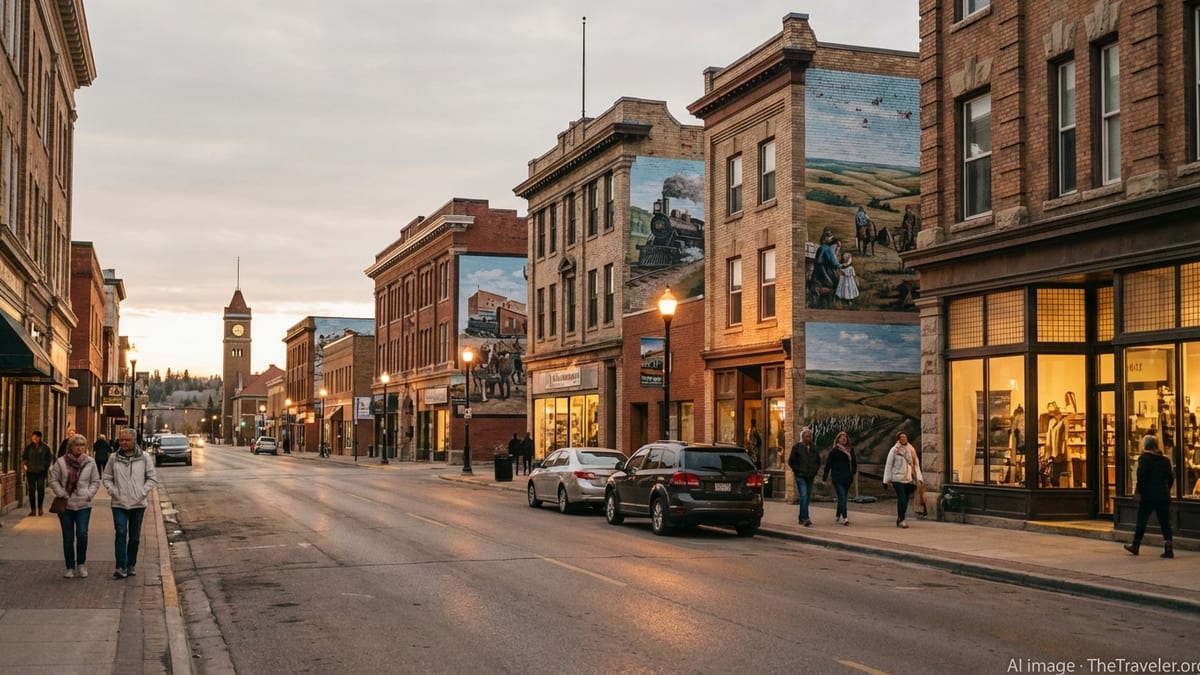
Visitors quickly notice how compact Moose Jaw feels. The historic commercial core clusters around Main Street, where early 20th century buildings now house restaurants, boutiques, coffee shops and galleries. Just a few blocks away, Wakamow Valley traces the Moose Jaw River in a green corridor of parks and trails that can feel surprisingly lush compared with the surrounding open farmland. It is a city where you can visit museums in the morning, soak in mineral pools in the afternoon and end the day watching prairie light fade over grain elevators.
Moose Jaw’s reputation as “Canada’s Most Notorious City” comes from a mix of fact and legend. The nickname nods to stories of Prohibition-era smuggling and organized crime, as well as the city’s role in rumrunning routes between the Canadian Prairies and the United States. Whether every story is fully documented or not, Moose Jaw has embraced the mythology with a playful spirit. Today, history tours lean into the drama while local tourism campaigns highlight both the city’s colourful past and its easygoing present.
Despite that notorious branding, Moose Jaw remains at heart what locals like to call the Friendly City. Travellers will find an approachable destination that rewards wandering, conversation and a bit of curiosity. It is an easy add-on to a wider Saskatchewan itinerary, a short side trip from Regina, or a relaxing base for exploring the surrounding prairie and bird sanctuaries.
A Prairie History Written in Brick and Steam
The story of Moose Jaw begins long before the railway. Cree and Assiniboine people used the area as a winter camp, taking advantage of a sheltered river valley and relatively mild microclimate. The Moose Jaw River and its tributary, Thunder Creek, created a natural corridor in an otherwise open landscape, with access to water, game and travel routes that linked the plains. Indigenous presence and knowledge of this terrain underpin the later settlement that would grow into the modern city.
European and Métis traders were active in the region by the 19th century, but Moose Jaw’s rapid development started in the early 1880s when the Canadian Pacific Railway selected the site as a divisional point. The railway needed dependable water for steam locomotives, and the junction here became a service and logistics centre roughly halfway between Winnipeg and what is now Calgary. Settlement followed quickly, and the community incorporated as a city in 1903. Rail lines, yards and warehouses stitched Moose Jaw into wider North American networks of grain, cattle and manufactured goods.
Walking downtown today, much of that early 20th century growth remains visible in brick and stone. The former Canadian Pacific Railway station at the south end of Main Street, with its clock tower and Tyndall stone cladding, reflects the importance of rail to the young city. Nearby, commercial blocks from the prewar era showcase architectural details such as pressed metal cornices, arched windows and decorative brickwork. Many of these structures now house contemporary businesses, but the facades preserve the feel of a railway-era prairie centre.
Moose Jaw’s history also includes air power and training. Just south of the city lies a military air base that has evolved into a key training site and the home of the Snowbirds, Canada’s aerobatic flight demonstration team. Visitors sometimes catch the sight and sound of jets carving patterns over the fields during training days. Between the long legacy of rail and the continuing presence of aviation, Moose Jaw has been a transportation crossroads in more than one sense.
The Tunnels: Moose Jaw’s Underground Legend
No attraction is more closely associated with Moose Jaw than its tunnels. Beneath the downtown streets lies a network of interlinked basements and passageways built during the early decades of the 20th century. Originally, these spaces served practical purposes: steam pipes, storage, service routes and connections between businesses. Over time, stories began to circulate that they had sheltered Chinese labourers facing discrimination and later supported bootlegging activity during American Prohibition.
Today, the Tunnels of Moose Jaw transform that history and folklore into immersive theatrical tours. Guides in period costume lead groups underground, where sets, lighting and scripted scenes bring specific narratives to life. One tour, often called The Chicago Connection, focuses on rumrunning and the city’s alleged links to American organized crime. Another, Passage to Fortune, explores the experiences of Chinese immigrants working and living in harsh conditions beneath street level. A newer tour set during the Cold War era places visitors in a bunker scenario that evokes nuclear anxieties and espionage themes of the late 1950s.
The tunnels themselves are real, and the themes of migration, discrimination and illicit trade reflect broad historical realities on the prairies. At the same time, some of the most dramatic stories connected to Moose Jaw’s underground world are based on oral histories, family anecdotes and regional lore rather than definitive archival documentation. The attraction acknowledges this mix, presenting the tours as entertainment grounded in history rather than as formal museum exhibits. That balance allows visitors to enjoy the theatre while still engaging with serious topics such as racism, labour exploitation and cross-border smuggling.
For travellers, a visit to the tunnels can be a highlight of any Moose Jaw stay. The tours run year-round, making them especially appealing in winter when temperatures outside can be severe. Because capacity is limited and schedules vary seasonally, advance planning is recommended, particularly in the busy summer months and on holiday weekends. Combining a tunnels experience with a stroll through the surrounding heritage district offers a vivid contrast between the sunlit streets and the shadowy spaces below.
Murals, Mineral Waters and Downtown Life
Emerging from the tunnels, you are immediately back in a downtown that uses its walls as canvas. Moose Jaw is well known for its large outdoor murals, which cover the sides of historic buildings and depict everything from steam trains and early settlers to Indigenous imagery and scenes of daily prairie life. Many were created during mural initiatives that began in the 1990s, and together they transform ordinary alleys and side streets into an open-air gallery. Exploring them on foot is an engaging way to learn about local stories, industries and personalities.
The downtown core is also home to one of Moose Jaw’s signature experiences: soaking in geothermal mineral water at a resort-style spa. Fed by naturally heated, mineral-rich water from deep underground, the pools offer a warm escape even when winter winds sweep across the prairie outside. Guests move between indoor and outdoor sections, often floating under open skies as steam rises into the cold air. In summer, the same pools feel more languid and social, with visitors lingering late into the evening.
Between mural-hunting and spa time, travellers find plenty of reasons to linger downtown. Independent shops sell prairie-inspired art, vintage finds, locally roasted coffee and regional specialties, while restaurants range from casual diners to more contemporary kitchens. The scale is intimate: you can easily cross downtown in less than 15 minutes, yet there always seems to be one more corner cafe or side-street storefront to discover.
At the northern edge of town, another icon welcomes visitors: Mac the Moose, a towering steel and concrete sculpture of a moose that stands beside the visitor centre near the Trans-Canada Highway. Once embroiled in a friendly rivalry with a Norwegian town over which community had the tallest moose statue, Mac now rises more than ten metres high and serves as a popular roadside photo stop. For many visitors, a picture with Mac is as essential as a dip in the mineral pools or a trip into the tunnels.
Prairie Nature and Outdoor Escapes
Beyond the brick downtown and underground tunnels, Moose Jaw opens onto classic prairie landscapes. The most immediate green refuge is Wakamow Valley, a ribbon of parks, trails and riverbank habitat that threads through the city. Locals use it for everyday recreation, from jogging and cycling to family picnics. For visitors, it offers a close look at how the river shapes the local environment, with cottonwood trees, wetlands and open meadows supporting birds and small wildlife.
Walking or cycling paths in Wakamow Valley are generally gentle and suitable for most fitness levels, though surfaces and conditions change with the seasons. In spring and early summer, the valley can feel particularly lush, with wildflowers and new leaves contrasting against the open farmland beyond. Autumn brings golden grasses and bright foliage, while winter transforms the same paths into routes for snowshoeing or carefully layered walks in crisp air.
Travellers willing to drive a little farther find some of North America’s important bird habitats within an easy day trip. Old Wives Lake, about half an hour southwest of Moose Jaw, is a shallow salt lake famed as a stopover for migratory shorebirds and waterfowl. Its mudflats and surrounding wetlands, along with nearby Reed and Chaplin lakes, form part of a designated network for shorebird conservation. Conditions vary with rainfall and season, and facilities are limited in some areas, so it is wise to bring water, sun protection and a sense of patience for long, quiet stretches of road.
To the north and west, small regional parks and reservoirs offer fishing, camping and boating options in warmer months. None are as dramatically scenic as Canada’s mountain parks, but they speak to a prairie style of outdoor life that prioritizes open horizons, long summer evenings and the slow rhythms of lakeshore time. Using Moose Jaw as a base, visitors can combine city comforts with forays into this broader landscape, returning each evening to restaurants, spas and heritage hotels.
Museums, Aviation and Prairie Heritage
Moose Jaw’s museums add another layer to its narrative of movement and settlement. On the edge of the city, a major branch of Saskatchewan’s Western Development Museum focuses on transportation history, reflecting Moose Jaw’s role as a railway and aviation hub. Inside, visitors encounter exhibits on trains, automobiles and aircraft, including displays related to the Snowbirds aerobatic team and the nearby air base. The collection illustrates how technological change reshaped communities across the province over the last century.
South of town, the Sukanen Ship Pioneer Village and Museum offers a different angle on prairie life. This volunteer-run site assembles historic buildings and artifacts from across the region into a recreated small town, with farm equipment, vehicles, a grain elevator and the partially completed ship of a Finnish homesteader who once hoped to sail back to his homeland. The result is an atmospheric place to reflect on the dreams, hardships and improvisation that defined settlement on the Canadian plains.
Within the city itself, heritage properties and self-guided walking routes introduce visitors to Moose Jaw’s built environment. The former railway station anchoring Main Street, older schools and churches, and neighbourhoods of early 20th century homes all contribute to a sense of continuity. Many buildings are still in active use, which means heritage here feels lived-in rather than curated behind glass. As you walk, storefronts and street corners often reveal plaques or public art that add context to what you are seeing.
For those with a particular interest in military or aviation history, it is worth checking whether any public events, flypasts or open houses are scheduled at the nearby base or associated institutions during your visit. These activities are not constant, and security considerations limit access, but from time to time special occasions give civilians a closer look at the aircraft and training operations that have become part of Moose Jaw’s identity.
Planning Your Visit: Seasons, Practicalities and Local Flavor
Saskatchewan’s climate shapes any trip to Moose Jaw, and planning with the seasons in mind can make a significant difference. Winters are long, cold and generally dry, with temperatures routinely well below freezing and windchill that can feel severe to those not accustomed to prairie weather. The reward is bright, clear skies and the chance to experience the mineral spa pools and tunnels when they are at their coziest. Proper winter clothing, including insulated boots and windproof outer layers, is essential if you plan to walk extensively outdoors.
Summer brings warm to hot days and mild nights, with many of the city’s festivals, outdoor events and patio seasons clustered between June and early September. This is prime time for exploring Wakamow Valley, visiting nearby lakes and combining a tunnels tour with downtown wandering. Thunderstorms occasionally roll through, adding drama to the big skies but also reminding visitors to keep an eye on forecasts. Spring and autumn are transitional, with more changeable conditions but often fewer crowds and appealing colours in the surrounding fields and river valley.
Moose Jaw is straightforward to navigate. Most visitors arrive by car, using the Trans-Canada Highway or regional roads from Regina and other Saskatchewan communities. Parking is generally manageable, including in the downtown core, though time limits and pay zones apply in some central areas. The city has local taxi services and limited public transit, but travellers who want to explore beyond the main attractions often find a car helpful. For those arriving by air, Regina’s airport is the nearest major gateway, with rental cars available and a driving time to Moose Jaw of roughly an hour under normal conditions.
Food and drink options in Moose Jaw reflect its size: you will not find the range of a major metropolis, but you will encounter a solid mix of independent cafes, pubs, bakeries and restaurants. Prairie comfort food, locally sourced meats, international cuisines and craft beverages all make appearances on menus. As with many smaller cities, opening hours can be shorter than visitors from larger centres expect, especially on Sundays or in the shoulder seasons, so checking times in advance is wise. Hospitality tends to be informal and friendly, and staff are often happy to share tips on what to see and do nearby.
The Takeaway
Moose Jaw is one of those destinations that quietly exceeds expectations. On a map, it may look like a brief pause on a long stretch of highway across the prairie, but on the ground it reveals itself as a layered, slightly eccentric, thoroughly welcoming place. The combination of underground tunnels, steaming mineral pools, aviation lore and broad river valley invites travellers to slow down and let the city’s stories unfold.
Whether you come for a day trip from Regina or build a longer prairie itinerary around it, Moose Jaw offers a compact, accessible slice of Saskatchewan life. You can trace the arc from Indigenous encampments to railway boomtown, follow theatrical guides into the shadows beneath Main Street, warm up in geothermal waters under a winter sky and watch birds lift off from distant salt lakes. In the process, you will find a community that has learned to embrace both its notorious legends and its everyday charms.
For travellers who enjoy destinations with a sense of humour about themselves, where history mixes with myth and where local people are still eager to share what makes their city special, Moose Jaw is well worth the detour. Come with curiosity, leave with stories and, if the local boosters have their way, start plotting a return visit to see what you missed the first time around.
FAQ
Q1. Where is Moose Jaw and how do I get there?
Moose Jaw is in south-central Saskatchewan, Canada, about an hour’s drive west of Regina on the Trans-Canada Highway. Most visitors arrive by car, often after flying into Regina’s airport and renting a vehicle for the short trip.
Q2. How much time should I plan to spend in Moose Jaw?
A full day is enough to tour the tunnels, explore downtown and visit the mineral spa, but two or three days allow time for museums, Wakamow Valley and day trips to nearby lakes and birding areas.
Q3. Are the Tunnels of Moose Jaw suitable for children?
Many families enjoy the tunnels, especially older children who can follow the theatrical storylines. Some scenes are dark or suspenseful, so very young or sensitive children may find them intense. Checking tour descriptions in advance helps you choose the best fit.
Q4. When is the best season to visit Moose Jaw?
Summer, from June through early September, offers the warmest weather and most outdoor activities. Winter can be very cold but has its own appeal, with quieter streets and the pleasure of soaking in hot mineral pools while snow falls around you.
Q5. Do I need a car to get around Moose Jaw?
Downtown Moose Jaw is compact and walkable, and many key attractions sit close together. However, a car is very useful if you want to reach the Western Development Museum, Sukanen Ship Pioneer Village, regional parks or birding sites such as Old Wives Lake.
Q6. Is Moose Jaw safe for visitors?
Moose Jaw generally feels safe and relaxed, with crime levels typical of a small Canadian city. Normal travel common sense applies, such as keeping valuables secure, being aware of your surroundings at night and checking local advice during severe weather.
Q7. Can I visit the air base or see the Snowbirds up close?
Access to the air base is restricted for security reasons, and visits are usually limited to occasional public events or open houses. Even without base access, you may sometimes see training flights overhead, especially in warmer months, but schedules are not guaranteed for visitors.
Q8. What should I pack for a trip to Moose Jaw?
Pack for temperature extremes, especially outside summer. In winter, bring insulated boots, a warm coat, gloves, a hat and layers. In summer, light clothing, sun protection, a hat and a light jacket for cooler evenings are useful, plus swimwear if you plan to use the mineral pools.
Q9. Are there options for travellers with limited mobility?
Many downtown shops, restaurants and the mineral spa offer step-free access or ramps, and larger attractions typically include accessible facilities. Some areas of the tunnels and historic sites may have stairs or uneven surfaces, so it is wise to contact specific venues in advance about accessibility needs.
Q10. Is Moose Jaw a good stop on a cross-Canada road trip?
Yes, Moose Jaw sits directly on the Trans-Canada Highway and makes an excellent overnight or multi-night stop. Its combination of unique attractions, walkable core and easy highway access is especially appealing to road trippers seeking more than just a place to refuel.