


Mykonos and Santorini sit at the top of most first-time Greece wish lists, and for good reason. Both are wildly beautiful Cycladic islands, but they offer very different types of trips: Mykonos leans into beaches and nightlife, while Santorini trades on caldera views and romance. If you only have time or budget for one, the choice can feel surprisingly high stakes. This guide breaks down the real-world differences, with current examples of costs, hotels, ferry logistics and itineraries so you can pick the island that actually fits your style, not just your Instagram feed.
Get the latest updates straight to your inbox!
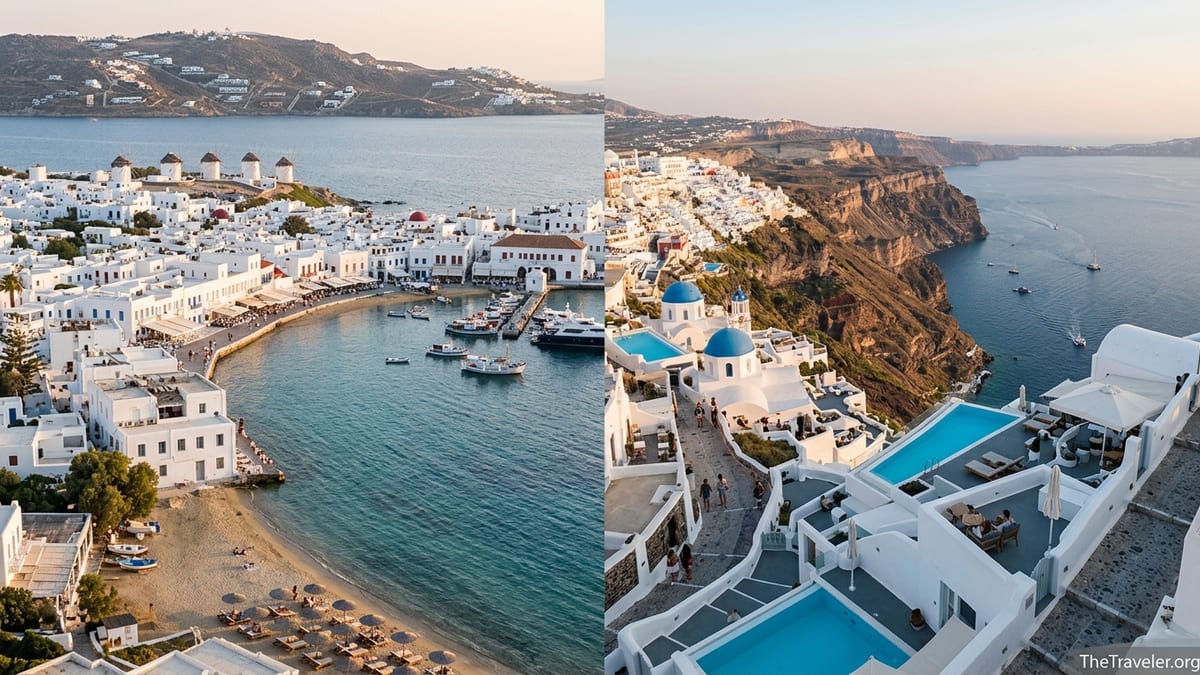
Big Picture: What Each Island Is Really Like
Think of Mykonos as a compact, low-slung island built around beaches and going out, and Santorini as a dramatic volcanic cliff with villages clinging to the rim. In practice, that means Mykonos days revolve around sand, beach clubs and late nights, while Santorini days are about wandering caldera villages, sipping wine with a view and timing dinner to the sunset. Many Greek specialists sum it up simply: Mykonos wins on beaches and nightlife; Santorini wins on romance, scenery and overall uniqueness.
Mykonos Town (Chora) feels like a whitewashed maze right at sea level, with bars spilling onto alleys and sunset spots like the windmills and Little Venice side by side with boutiques. Ten to twenty minutes away by bus or taxi, you are on beaches like Psarou, Paradise and Super Paradise, many of which turn into open-air parties with DJs by late afternoon. On a July afternoon at Paradise Beach, you can easily see crowds dancing on tables by 5 p.m., then shifting to big clubs such as Cavo Paradiso that run until sunrise.
Santorini, by contrast, is split between caldera-edge villages such as Fira, Firostefani, Imerovigli and Oia, and a lower “beach side” made up of resorts around Kamari and Perissa. The famous blue-domed churches and cave hotels are all on the caldera side, looking into the flooded volcanic crater. A typical first night might be checking into a small cave suite in Imerovigli, walking the clifftop path to Fira, and finishing with sunset cocktails at a terrace bar rather than at a club dancefloor.
Both islands are heavily touristed from May to October, with July and August bringing extreme crowds and prices. However, Mykonos tends to feel more like a perpetual party hub in peak season, whereas Santorini’s atmosphere is busy but slightly calmer and more focused on couples and small groups moving between viewpoints, wineries and restaurants.
Beaches and Swimming: Soft Sand vs Volcanic Drama
If you care deeply about traditional beach time, Mykonos is the clear winner. Its south-coast beaches such as Psarou, Ornos, Platis Gialos, Paradise and Super Paradise offer soft, light sand, turquoise water, and full-service beach clubs with sunbeds, umbrellas and waiter service. At Psarou in high season it is common to pay around 60 to 80 euros for a pair of loungers and an umbrella in the second or third row, with front-row sets rising well above 100 euros at elite clubs. At more relaxed spots like Ornos or Agios Ioannis you may find sets starting closer to 30 to 40 euros if you arrive early.
Santorini’s beaches are fascinating but less classic. The island is volcanic, so the main beaches are black-sand or pebble stretches such as Kamari and Perissa, plus the red-rock amphitheater of Red Beach and the white cliff backdrop of Perivolos. The sand can get extremely hot underfoot by midday, and the entry into the water is often steeper and rockier than in Mykonos. Organized sections still offer sunbeds and umbrellas, and prices can be a little lower than in Mykonos, but this is not the island you choose if your dream is long, golden-sand bays or gentle, shallow water for kids.
Interestingly, Santorini’s best swimming for many visitors happens from a boat rather than a beach. Popular semi-private catamaran cruises around the caldera typically cost in the range of 120 to 180 euros per person in high season, including transfers, a meal and drinks. These trips stop near the volcanic hot springs and at quiet coves for swimming in deep blue water, with views of the caldera villages up on the rim. On Mykonos you will also find boat trips to nearby uninhabited Rhenia or to the archaeological island of Delos, but most people still spend the bulk of their water time on organized beaches.
For families, Mykonos’s Ornos and Platis Gialos offer protected bays, soft sand and plenty of tavernas set back from the water, which works well with younger children. On Santorini, Kamari is the most family-friendly, but parents should expect coarse, dark sand and often need water shoes for kids due to pebbles and underwater stones.
Nightlife, Atmosphere and Crowd Profile
Nightlife is where Mykonos earns its reputation. In July and August, the island hosts a steady rotation of international DJs at beach clubs and open-air venues such as Cavo Paradiso and Super Paradise. A typical night might start with sunset drinks in Mykonos Town, continue to Paradise Beach for an open-air party, and then move on to a club that only really fills up after 1 or 2 a.m. Cover charges for major DJ nights can easily reach 40 to 60 euros, with cocktails starting around 18 to 20 euros at upscale venues and beer often 10 euros or more.
The social mix on Mykonos is broad but leans toward groups of friends, bachelor and bachelorette parties, and couples looking for a buzzy scene. The LGBTQ+ presence is strong, especially around venues like JackieO’ Beach Club and bars in Mykonos Town, and there is generally a come-as-you-are, dress-up-if-you-want atmosphere. You will see everything from designer resort wear to simple shorts and linen shirts at different venues on the same night.
Santorini has nightlife, but it is secondary to the island’s main draw. Fira has a bar and club strip where you can bar-hop until the early hours, with places playing chart hits and Greek pop. However, most travelers are in couples or small groups who are more interested in a long dinner with a view than a 4 a.m. finish. A typical evening in Oia or Imerovigli involves booking a cliffside restaurant weeks ahead, timing a multi-course meal to sunset, and then perhaps a final drink at a wine bar instead of another bar crawl.
Both islands are busy and highly social in high season, but the overall mood differs sharply. Mykonos in peak summer feels like a Mediterranean version of a resort club destination, albeit with a prettier town and better design. Santorini feels like a scenic, romantic island where the nightlife exists but is not the main point, and many visitors are in bed not long after midnight to make the most of sunrise light and day trips.
Prices, Hotels and What Your Money Buys
Neither island is a budget destination. Both rank among the most expensive places in Greece for accommodation, dining and transport, especially between late June and early September. That said, recent comparisons from travel planners and hotel data suggest Santorini is often slightly cheaper than Mykonos at similar quality levels, especially in the luxury bracket. As a rough high-season benchmark, a good midrange double room near the action in Santorini might start around 200 to 250 euros per night, while equivalent standard and location in Mykonos can easily push into the 300 to 350 euro range.
On the luxury end, cliffside suites on Santorini with private plunge pools and full caldera views regularly list for 600 to 1,000 euros per night in July and August, with standout properties in Oia and Imerovigli going even higher for prime sunsets. In Mykonos, beachfront suites at marquee names along Psarou or Ornos often cross 1,000 euros per night in full season, sometimes significantly if you are booking late. Beach clubs add another layer of cost: a couple can easily spend 200 euros or more in a day once you factor in sunbed rental, lunch, cocktails and transfers.
Food and drink are expensive on both islands, though Santorini offers slightly more range if you are willing to eat away from the caldera edge. A cliffside restaurant in Oia might charge 18 to 25 euros for a main course and 15 to 18 euros for a cocktail, but walk five minutes inland and you may find hearty tavernas with mains closer to 12 to 15 euros and house wine by the carafe. In Mykonos Town and beach clubs, it is increasingly common to see 20 to 30 euros for mains and upscale pricing on drinks almost across the board, with more modestly priced tavernas mainly in less central villages.
For value, both islands are at their friendliest from late April to early June and again from mid-September to mid-October. During these shoulder periods you can sometimes find caldera-view rooms in Santorini in the 250 to 400 euro range that would be double that in August, and Mykonos hotels may drop their rates by 20 to 40 percent compared with peak. Car rentals also show dramatic swings: travelers report paying as little as 40 to 50 dollars per day for a compact car in June, rising to upwards of 150 to 200 dollars per day for similar vehicles during the busiest weeks of July and August.
Getting There, Ferries and First-Time Greece Routes
Both islands have small airports with frequent summer flights from Athens and seasonal connections from many European cities. For many first-time visitors, though, ferries are part of the adventure. From Athens, high-speed ferries from Piraeus or Rafina to Mykonos typically take around 2.5 to 3 hours, with slower conventional ferries taking up to about 5.5 hours. One-way ticket prices for high-speed economy seats in peak season often sit in the 70 to 100 euro range, with slower boats usually a bit cheaper if you are willing to spend extra hours at sea.
Athens to Santorini ferries run along similar patterns, but the distances are longer. High-speed boats usually take around 4.5 to 5 hours from Piraeus, while slower services can take 7 to 8 hours. Prices for the fastest sailings are again commonly in the 80 to 110 euro range for basic seats in high season, edging higher for business-class lounges or cabins on overnight services where available. Many travelers opt for a one-way flight on this leg, particularly when trying to maximize limited vacation days, since a 45-minute flight can reclaim most of a day that would otherwise be spent in transit.
For a classic first-time Greece route focused on these two islands, a popular pattern looks like: 2 nights in Athens, 3 or 4 nights in Mykonos for beaches and nightlife, then a roughly 3-hour ferry to Santorini for 3 or 4 nights of caldera views and wine tasting before flying out. Ferries between Mykonos and Santorini are frequent in summer and usually take about 2 to 3 hours, depending on the vessel. Traveling in this direction also tends to be slightly smoother for flight connections, as many travelers fly home from Santorini’s airport at the end of their trip.
If your time is tight and you must choose one island to pair with Athens and perhaps Naxos or Paros, your style should drive the decision. Combine Santorini with Naxos or Milos if you want more balance between scenery and less crowded beaches, or join Mykonos with Paros or Ios if you prefer to keep the beach party theme going with slightly softer price points.
Honeymoons, Romance Trips and Special Occasions
For honeymoons and big romantic trips, Santorini almost always edges ahead. The caldera views are genuinely one-of-a-kind: whitewashed cave hotels cut directly into the cliff, many with private plunge pools and terraces looking across the water to the volcanic islands. It is common for honeymooners to spend hours each day simply on their balcony, between room-service breakfasts, late-afternoon dips and sunset wine. Villages like Imerovigli, with its quieter lanes and elevated position, are often recommended as a good compromise between seclusion and access to Fira’s restaurants.
Typical honeymoon days in Santorini include walking the cliff path between Fira and Oia in the morning, visiting a winery such as those near Pyrgos or Megalochori for afternoon tastings, and returning to a hotel with an infinity pool for sunset. Couples often book at least one semi-private catamaran cruise around the caldera and one fine-dining evening at a restaurant directly on the rim, accepting that these will be some of the priciest days of the trip. Many say the cost feels worth it because the setting is so unlike anywhere else.
Mykonos can still be a great honeymoon choice for travelers who care less about quiet seclusion and more about a social, glamorous scene. Upscale, design-forward hotels around Psarou, Ornos and Elia offer private pools, sea views and high-end dining, and you can easily build your days around slow breakfasts, beach time, massages and long lunches that blend into sundowners. For couples who enjoy nightlife but also want pockets of privacy, staying near Mykonos Town and escaping to quieter beaches like Agios Sostis or Fokos during the day can strike a nice balance.
In general, if your dream honeymoon image features the two of you in a private plunge pool looking out over a sheer drop to the sea, choose Santorini. If it features dancing together at a beach club in the sunset glow, then wandering back through whitewashed lanes for a late-night gyro, Mykonos will probably make you happier.
Families, Groups and First-Time Visitors
For families, the answer is less clear-cut and depends on children’s ages and parents’ priorities. Mykonos has the more child-friendly beaches, but its party image can put some parents off. In practice, if you visit in June or September and choose calmer beaches such as Ornos or Agios Ioannis, Mykonos can work very well for families who want easy sand-and-sea days, short transfers and a walkable town. Many hotels in these areas offer family suites or interconnecting rooms, and beach tavernas accommodate kids readily with grilled meats, simple pasta and fresh fish.
Santorini’s steep topography and stairs can be challenging with strollers or very young kids, especially in Oia and parts of Fira. The caldera paths are gorgeous but not designed for pushchairs, and many cave hotels involve narrow staircases and multi-level layouts. For families with older children or teenagers, however, Santorini’s boat trips, volcanic landscapes and small but interesting archaeological sites such as Akrotiri can be a draw. Staying on the beach side in Kamari or Perissa, where resorts are flatter and pools are plentiful, makes Santorini significantly more practical for families.
For groups of friends, Mykonos usually comes out ahead, unless the group’s focus is photography and wine rather than nightlife. Sharing a villa near Mykonos Town or above Super Paradise can spread costs while giving everyone space, and splitting taxi fares or pre-booked transfers makes moving between beaches and town more manageable. On Santorini, large villas with caldera views exist but command very high nightly rates, so groups often compromise by staying slightly back from the rim in areas like Firostefani or in inland villages.
First-time visitors to Greece sometimes worry that skipping one of these two islands means “missing” Greece. In reality, both are only one version of the country, but if you are choosing between them for a first trip, it is usually better to lean into what is unique. If beaches and nightlife are central to your ideal vacation, Mykonos is hard to match. If you are more excited by the idea of waking up to a volcanic panorama and long dinners on a cliff, Santorini will likely feel more special.
The Takeaway
Choosing between Mykonos and Santorini is less about which island is objectively better and more about what you want your days and nights to look like. Mykonos offers classic beaches, a near-24-hour social scene in peak season, and a compact layout that makes beach-hopping easy, at the cost of very high prices and overt party-town energy in summer. Santorini offers an almost unrivaled visual drama, romantic cave hotels, and memorable food and wine experiences in a setting that feels like nowhere else, but its beaches are volcanic and its terrain less friendly for casual strolling and young families.
If your dream Greece trip involves turquoise bays, DJs at sunset, and hopping from one beach club to another with friends, choose Mykonos and consider pairing it with a slightly more relaxed island like Paros. If your dream centers on caldera sunsets, private plunge pools and slow walks along cliff paths, choose Santorini and perhaps combine it with Naxos or Milos for softer beaches and better value. When time and budget allow, a combined route of Athens, Mykonos and Santorini over 8 to 10 days delivers the best of both worlds.
Whichever island you choose, book key elements early for July and August, consider shoulder-season dates for better value, and remember that Greece has dozens of other islands that may suit you even more once you have seen the famous two. Mykonos and Santorini are iconic starting points, but they are only the beginning of what the Aegean has to offer.
FAQ
Q1. Is Mykonos or Santorini cheaper overall?
Santorini is often slightly cheaper at the same quality level, especially for luxury hotels, but both are among the most expensive destinations in Greece, and prices rise sharply in July and August.
Q2. Which island has better beaches?
Mykonos has softer, sandier beaches like Psarou, Ornos and Platis Gialos, with easy swimming and full-service beach clubs, while Santorini’s beaches are mostly black or red volcanic sand and pebbles.
Q3. Which island is better for nightlife?
Mykonos is the clear nightlife hub, with big-name DJs, beach parties and clubs that run until sunrise in high season, while Santorini’s nightlife is concentrated in Fira and is much milder and more bar-focused.
Q4. Which island is better for a honeymoon?
Santorini generally wins for honeymoons thanks to its caldera views, cave hotels and romantic atmosphere, though couples who love nightlife and beach clubs may prefer Mykonos.
Q5. Is either island good for families with young children?
Mykonos can work well for families outside peak party weeks, especially around calmer beaches like Ornos, while Santorini is better for families with older kids who can handle stairs and enjoy boat trips and sightseeing.
Q6. How many days do I need on each island?
Plan at least 3 nights on either island to settle in. Many first-timers spend 3 to 4 nights in Mykonos for beaches and nightlife and 3 to 4 nights in Santorini for views and excursions.
Q7. Can I visit both Mykonos and Santorini in one trip?
Yes, in summer there are regular ferries taking about 2 to 3 hours between the islands, making it easy to spend 3 to 4 nights on each as part of a week-long or 10-day itinerary.
Q8. Do I need a car on Mykonos or Santorini?
A car or ATV is useful on both islands if you want to explore independently, but many visitors rely on buses and taxis, especially in Mykonos where popular beaches are well served by bus from town.
Q9. When is the best time to visit to avoid crowds but still have good weather?
Late May, early June and mid-September to early October usually offer warm weather and swimmable seas with fewer crowds and more moderate prices than July and August.
Q10. Which island should I choose if it is my first time in Greece?
Choose Mykonos if you care most about beaches and nightlife, and Santorini if your priority is iconic views, romance and memorable scenery; both pair well with a third, less busy island if you have extra time.