


On a compact but intensely busy island like Mykonos, how you move around can make or break your trip. Beaches, clubs and villages are scattered around the coast and hills, public transport gets packed in summer, and taxis are far fewer than visitors expect. Planning your transport before you land will save you money, stress and, in peak season, hours of waiting in line.
Get the latest updates straight to your inbox!
Understanding Mykonos Geography and Why Transport Planning Matters
Mykonos is a relatively small Cycladic island, roughly 15 kilometers from north to south, but the distance between where you sleep, swim and go out at night can feel much longer once the meltemi wind picks up and the sun is beating down. Mykonos Town, often called Chora, is the main hub where most people stay, eat and party in the evenings. The island’s best known beaches and clubs, such as Paradise, Super Paradise, Platis Gialos, Psarou and Ornos, are spread along the south coast, while quieter coves like Panormos, Fokos and Agios Sostis sit on the more exposed north side.
Roads are narrow, often with no sidewalks, and traffic in July and August can be intense. The main arteries between Mykonos Town, the New Port at Tourlos, the airport and the south-coast beaches carry tour buses, scooters, ATVs, rental cars, taxis and service vehicles, all competing for space. During peak weeks it is common to see lines of people waiting at the Fabrika bus station or by the Old Port for the next KTEL bus, and long queues at the main taxi rank in Mykonos Town, especially after midnight.
This means you cannot just show up and assume you will find an easy ride. For example, a group arriving on an evening ferry at the New Port in August who have not prebooked a transfer may find the official taxis already committed and the next bus to town full. On the other hand, a couple staying in Platis Gialos in June who plan their days around the bus and water taxi timetable can visit multiple beaches and still return to town for dinner without ever renting a vehicle.
Thinking through where you will stay, which beaches and clubs you care about, and roughly what time of day you will be moving around lets you decide whether to rely mostly on buses, invest in private transfers, or justify a rental car or scooter. This is especially important if you are traveling with children, have mobility issues, or are planning late nights at clubs such as Cavo Paradiso or Super Paradise.
Mykonos Buses: Routes, Times and When They Work Best
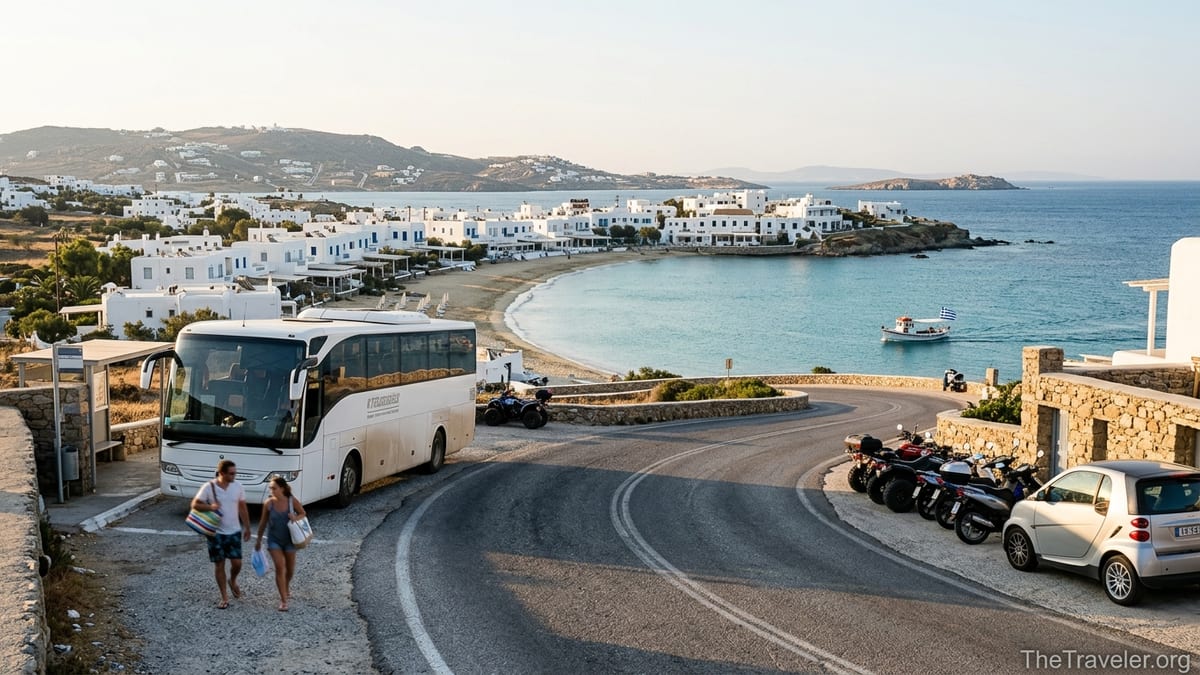
KTEL buses are the backbone of public transport on Mykonos and, in season, can be an efficient and affordable way to get around. The main hubs are Fabrika, also known as the South Station, at the edge of Mykonos Town, and the Old Port station near the waterfront. From Fabrika, summer routes typically run to popular southern spots such as Ornos, Platis Gialos, Agios Ioannis, Paradise, Paraga and Super Paradise, as well as to the airport and the New Port. From the Old Port, buses fan out to Ano Mera village and to beaches including Elia, Kalo Livadi, Panormos and Kalafatis.
In the 2026 summer timetable, buses from Fabrika to beaches like Platis Gialos, Ornos and Paradise usually run every 20 to 40 minutes during the day, stretching to around every hour in the late evening. One example listed in current schedules is the Fabrika to Paradise line, which has services from early morning to after midnight in high season, reflecting demand for beach clubs and late-night parties. Airport buses into town typically operate about once an hour in summer, linking the terminal with both Fabrika and the Old Port, making them a practical option if your hotel lies within walking distance of either hub.
Single tickets are sold at kiosks at the main stations or onboard, with recent fares on comparable Cycladic routes ranging around 2 to 3 euros per journey depending on distance. At Fabrika you might see separate ticket booths and clearly labeled departure bays such as “Paradise,” “Platis Gialos” or “Airport,” and staff directing passengers toward the correct coach. In peak July and August afternoons, buses to Paradise and Super Paradise can fill quickly with beachgoers heading to Tropicana Beach Bar, Paradise Beach Club or Super Paradise’s bars, so arriving 10 to 15 minutes before departure is wise.
Buses work best if you are staying in or near Mykonos Town, Platis Gialos or Ornos and plan to visit popular beaches during the day and return to town for dinner. For example, a family staying in Ornos can take the short bus ride into town in the morning to explore Little Venice and the windmills, then ride back in the afternoon for beach time without worrying about parking. However, if you are leaving a club at Paradise at 4 a.m., you will likely find that the last scheduled bus left hours earlier, which is where taxis, prebooked transfers or your own vehicle come in.
Taxis and Private Transfers: What to Expect and How to Use Them
Visitors are often surprised at how few official taxis operate on Mykonos compared with demand. Ferries, cruise ships and dozens of flights arrive daily in summer, but the island’s licensed taxi fleet is limited, and vehicles are shared between the airport, ports and town. Official cabs are usually silver sedans with a roof sign and a yellow license plate. You will find the main taxi rank in Mykonos Town near the Old Port end of the waterfront, plus smaller stands at the New Port and the airport.
Typical taxi fares are based on a set price list plus surcharges for luggage or night hours. Recent published examples from local operators show rides such as Mykonos Town to Platis Gialos or Ornos in the region of 14 to 20 euros per car, and Town to Super Paradise or Elia around 15 to 25 euros depending on distance and time of day. A couple landing at the airport in the afternoon and heading to a hotel in Platis Gialos might pay roughly 20 euros and reach their accommodation in about 15 minutes, while a late-night run back from Paradise Beach to Chora in peak season can cost more and involve a wait in a taxi queue outside the club.
Because taxis can be scarce at busy times, many travelers now opt for prebooked private transfers. Local companies and hotels offer shared minibuses or private vans that meet you at the airport or New Port ferry pier with a sign and drive you straight to your hotel or villa. Price lists from Mykonos hotels and transfer services show one-way airport or port pickups to central areas like Chora, Ornos or Platis Gialos commonly starting around 25 to 40 euros per room for a shared minivan, and higher for a private luxury vehicle. For a group of four or six people, this can work out similar to or cheaper than finding multiple taxis and saves time and uncertainty.
Private transfers are especially useful if you arrive late at night, are staying in a remote villa inland or on the north coast, or are traveling with a lot of luggage. They are also popular for nightlife, with some upmarket beach clubs such as those at Super Paradise or Psarou working with transfer partners who pick up guests from hotels in town for party nights or dinner reservations. If you know you will want a ride back from a club at 3 a.m., arranging a return pickup time when you book can avoid standing in a crowded taxi queue as the music winds down.
Rental Cars, ATVs and Scooters: Freedom vs Reality on Mykonos Roads
Renting a car, ATV or scooter offers maximum freedom to explore, but on Mykonos it comes with significant caveats. Roads are narrow and often unlit at night, parking is limited around popular beaches and Mykonos Town, and traffic police regularly crack down on unsafe parking and driving. Windy conditions can make scooters and quad bikes unstable, and there are frequent reports of accidents involving inexperienced riders on steep or gravelly stretches leading down to beaches.
Rental car rates vary widely with season and demand. In July or August, a small hatchback from a local company might run from around 60 to 100 euros per day including basic insurance, while in May or late September prices can be much lower. Many agencies have desks at the airport or deliver cars directly to hotels in areas like Platis Gialos, Ornos or Ano Mera, and some require a minimum rental of two or three days in high season. Fuel is sold at a few gas stations around the island; a full tank on a compact car is usually enough for several days of normal touring, given the short distances.
ATVs and scooters are heavily marketed, especially near the airport road, in Ornos and around Mykonos Town. Daily rates for a basic 50–125 cc scooter or a smaller quad bike are often similar to or only slightly cheaper than a car, particularly once full insurance is added. Greek law requires helmets and the appropriate driving license class, and many reputable rental shops will refuse to hand over vehicles to people who lack motorcycle entitlement or experience. A common real-world scenario is a group of friends keen to rent quads for a beach-hopping day who discover at the counter that only one of them has the correct license, and the others must either ride as passengers or switch to a compact car.
If you do rent a vehicle, factor parking into your daily plan. Public parking areas around Mykonos Town fill up in the evening as people arrive for dinner, and beach car parks at Psarou, Super Paradise or Panormos may charge a fee or require use of the beach club valet if you are booking sunbeds. Some hotels in Platis Gialos or Agios Ioannis include parking for guests, which can tip the balance in favor of rental if you plan to explore remote beaches like Fokos or Lia where bus service is infrequent or absent.
Water Taxis and Boat Shuttles: Beach-Hopping by Sea
One of the most enjoyable ways to move between Mykonos beaches in summer is by water taxi. A long-running service on the south coast connects a chain of beaches, typically starting from Ornos or Platis Gialos and stopping at Paraga, Paradise, Super Paradise, Agrari and Elia. Small passenger boats shuttle back and forth throughout the day, allowing travelers to board at, say, Platis Gialos in the morning, hop off at Paradise for lunch and a swim at Tropicana Beach Bar, then continue on to Elia for a quieter late-afternoon atmosphere before returning to their starting point.
Water taxi fares are usually sold either per leg or as a day ticket, with prices varying by operator and season but commonly falling in the mid to high single digits per ride. For example, a traveler staying in Platis Gialos in July might pay a modest fee for the boat to Paradise, and a slightly higher amount to continue onward to Elia at the far end of the chain. Because these services are weather dependent, strong winds can disrupt or reduce frequency, so it is sensible to check the morning schedule posted at the pier or ask staff at the beachfront kiosks.
Beyond the main south-coast shuttle, some resorts and boutique hotels operate their own private boats, either as transfers or as part of organized day cruises. A luxury hotel near Ornos may, for instance, arrange a private two-hour boat charter to take guests along the same sequence of beaches at a fixed rate, or to whisk them directly from the hotel’s pier to a dinner reservation at a seaside restaurant carved into the rocks. Cruise passengers docked at the New Port sometimes use small “sea bus” shuttles that run between the port area and Mykonos Town, avoiding the need to queue for road transport at busy arrival times.
Water taxis are particularly appealing for travelers who want to avoid driving but still see more than one beach in a day. They pair well with staying in Platis Gialos or Ornos, where you can walk from your hotel to the pier, ride to a beach like Super Paradise for the afternoon and then either take the boat or a road taxi back. In high season, returning on one of the last boats before sunset is more relaxing than trying to secure a late-night land taxi from a crowded beach club.
Walking Limits and Getting Around Mykonos Town
Within Mykonos Town itself, walking is usually the best and only practical way to move around. The old center is a maze of narrow, pedestrian lanes that wind past whitewashed houses, boutiques and bars. Cars are generally kept to the perimeter, and even scooters are restricted in many alleys. From the windmills above Little Venice down to the Old Port waterfront is a pleasant 10 to 15 minute stroll, though in the heat of the day the paving stones can reflect quite a bit of sun.
Walking also works well for short connections on the outskirts of town. Many hotels and guesthouses lie within a 10 to 20 minute walk of either Fabrika or the Old Port bus hubs, which lets guests roll suitcases to the station and catch a bus to the airport or beaches. As an example, a traveler staying up the hill above Fabrika might walk down in the morning to catch the bus to Paradise, then return in the evening and walk home, skipping taxis entirely.
However, walking has clear limits once you leave the compact core. The road from Mykonos Town to the New Port is a couple of kilometers and heavily trafficked, with stretches lacking sidewalks. Doing this walk under a strong sun, carrying luggage, while buses and tour coaches pass close by is neither comfortable nor particularly safe. Similarly, the route from Chora to the airport may look short on a map but involves hill climbs and roadside stretches that are not designed for pedestrians. In such cases, it is worth budgeting for a bus or transfer rather than relying on foot.
After dark, Mykonos Town’s lanes remain busy and generally feel safe, but outside the center street lighting can be patchy. If you are staying in a villa up a rural road, walking back after midnight without pavements or consistent lighting is rarely enjoyable. This is where arranging a specific pickup time with your hotel shuttle, a prebooked minivan or a trusted taxi company can make a big difference to how relaxed your evenings feel.
Nightlife Transport: Clubs, Late Buses and After-Hours Rides
Mykonos nightlife is a major draw, and understanding how to get to and from the key party spots will help you avoid stranded, expensive or risky journeys. Many visitors base themselves in Mykonos Town for the evening bar scene in Little Venice, the waterfront and the backstreets around Matogianni. From there, they head out to late-night clubs like Cavo Paradiso above Paradise Beach, Super Paradise’s beach bars or venues at Psarou and Paraga either in late afternoon or after midnight.
During the day and early evening, buses connect Fabrika with Paradise and other party beaches regularly, and some timetables extend into the late evening in summer for club nights. For instance, on nights when a big DJ is scheduled at Cavo Paradiso, extra buses often run from Fabrika to Paradise so that guests can arrive around midnight or 1 a.m. However, the return services may taper off hours before the club actually closes near sunrise, meaning you need a backup plan for the journey back to town.
In practice, most people leaving clubs between 2 a.m. and 6 a.m. rely on taxis, shared transfers or prearranged pickups. It is common for friends to split the cost of a van prebooked at a fixed rate from Paradise back to their hotel area, with example tariffs in recent seasons listing prices from Chora to the main beaches in the 25 to 50 euro range per room or vehicle for late-night slots. Some beach clubs also work with transfer desks that organize rides for departing guests, although wait times can build at peak exit times when hundreds of people are trying to leave at once.
If nightlife is a key part of your visit, your accommodation choice can simplify transport enormously. Staying in Platis Gialos or Paradise itself means you can walk back from the beach bars or club, while basing in Ornos offers more frequent early-evening buses and easier taxi access than remote northern bays. Alternatively, some visitors choose quieter hotels in Mykonos Town but plan one or two big club nights, for which they prebook a round-trip transfer, accepting the extra cost for the sake of safety and convenience.
Peak Season Strategy: Planning Ahead to Save Time and Money
From late June through early September, especially in late July and around mid-August, Mykonos operates at or near full capacity. This is when cruise ships anchor offshore, multiple international flights land daily, and the island’s hotels and villas are packed. In these weeks, transport bottlenecks are predictable: buses that are full by the time they reach your stop, long taxi lines at the airport and in town, and beach car parks that close by mid-morning because every space is taken.
To manage this, start by booking key transfers before you arrive. That means arranging an airport or New Port pickup with your hotel or a reputable transfer company, especially if you are landing between 6 p.m. and midnight or taking a late ferry. For example, a family of four arriving on an evening ferry might prebook a minivan transfer to their villa in Elia for around 40 to 60 euros, eliminating the need to scramble for two taxis with luggage in tow. Similarly, couples staying in remote northern villas often schedule fixed morning and evening shuttle times into Chora, building restaurant bookings around those slots.
Next, think about your daily rhythm. If you plan to ride buses, aim for earlier departures to the beaches and avoid the peak 11 a.m. to 1 p.m. window when crowds are heaviest. Leaving the beach a bit before sunset often makes it easier to find space on buses or arrange a timely taxi back. If you opt for a rental car or ATV, reserve it weeks ahead for July or August dates, not the day you arrive, and be realistic about whether everyone in your group is comfortable driving in local conditions.
Finally, keep a flexible attitude and a backup option. On especially windy days, water taxis may not run; on days when several cruise ships are tendering passengers ashore, queues for buses at the Old Port can grow unexpectedly long. Having the number of a trusted transfer operator, knowing the walking time between Fabrika and your hotel, or understanding which alternative beach has better bus frequency can turn a potentially stressful afternoon into a minor reroute. On Mykonos, a bit of transport planning pays off disproportionately in extra time spent by the water instead of on the roadside.
The Takeaway
Getting around Mykonos is less about distance and more about timing, season and choosing the right tools for your style of trip. Buses are inexpensive and work well for beach days and airport links if you stay near the main hubs of Mykonos Town, Ornos or Platis Gialos. Taxis and private transfers fill the gaps, particularly for late-night clubbing, villa stays and arrivals or departures at busy hours.
Rental cars, scooters and ATVs provide freedom but demand confidence and caution on narrow, crowded roads, and parking can be a daily puzzle in high summer. Water taxis offer a scenic and practical alternative for beach-hopping along the south coast, especially when paired with a base in Platis Gialos or Ornos. Walking is perfect inside the old town but limited and sometimes unsafe on major roads once you step beyond it.
Above all, the more popular your travel dates and the more ambitious your nightlife or beach plans, the more important it is to reserve transfers, rentals and at least a rough daily transport strategy before you arrive. Doing so will help you spend your days in the Aegean breeze instead of in bus queues and taxi lines, and let Mykonos feel like the relaxed island escape it still can be when you move around it on your own terms.
FAQ
Q1. Do I really need to book airport or port transfers in advance on Mykonos?
In peak months such as July and August, advance booking is strongly recommended, especially if you arrive in the evening or late at night, because taxis are limited and often already committed when ferries and flights arrive.
Q2. How reliable are Mykonos buses for getting to the main beaches?
In summer the buses are generally reliable and frequent on the main routes to Ornos, Platis Gialos, Paradise and other popular beaches, but they can be crowded at midday, so plan to arrive at the stop early and have a backup plan at very busy times.
Q3. Is it safe to rent a scooter or ATV on Mykonos if I have little riding experience?
It is not advisable; the roads are narrow and busy, the wind can be strong and accidents are common, so if you are not an experienced rider it is safer to rent a small car or rely on buses and transfers.
Q4. Can I get from the New Port to Mykonos Town without a taxi?
Yes, there are bus services and often small sea buses between the New Port and town in season, and many hotels or transfer companies will pick you up directly from the pier if arranged in advance.
Q5. Are water taxis a good option for visiting multiple beaches in one day?
Yes, the south-coast water taxi routes that link beaches such as Ornos, Platis Gialos, Paradise, Super Paradise and Elia are ideal for beach-hopping without driving, as long as the weather is suitable and you check the daily schedule.
Q6. How late do buses run back to Mykonos Town from the party beaches?
Some routes run into the late evening in high season, particularly to Paradise, but services usually end well before the big clubs close, so for returns after about midnight you should expect to use a taxi or prebooked transfer.
Q7. Is walking a realistic way to get around outside Mykonos Town?
Short walks between nearby hotels, bus stations and the town center are fine, but longer routes to the New Port, airport or distant beaches often lack sidewalks and involve heavy traffic, so they are not ideal for walking, especially with luggage or after dark.
Q8. What is the best area to stay in if I want to rely mostly on public transport?
Staying in or very close to Mykonos Town, Ornos or Platis Gialos gives you easy access to both bus routes and, in the case of the south-coast beaches, water taxis, which together can cover most everyday journeys.
Q9. How far in advance should I book a rental car for Mykonos in summer?
For travel in July and August, it is sensible to reserve a car several weeks ahead, particularly if you want an automatic, a specific size or pickup from a smaller beach area rather than the airport.
Q10. Are private transfers worth the cost compared with taxis on Mykonos?
For groups, late-night club returns, remote villas or arrivals at very busy times, private transfers can be good value and far more convenient than hoping to find one or more taxis when everyone else is trying to do the same.