

More news on this day
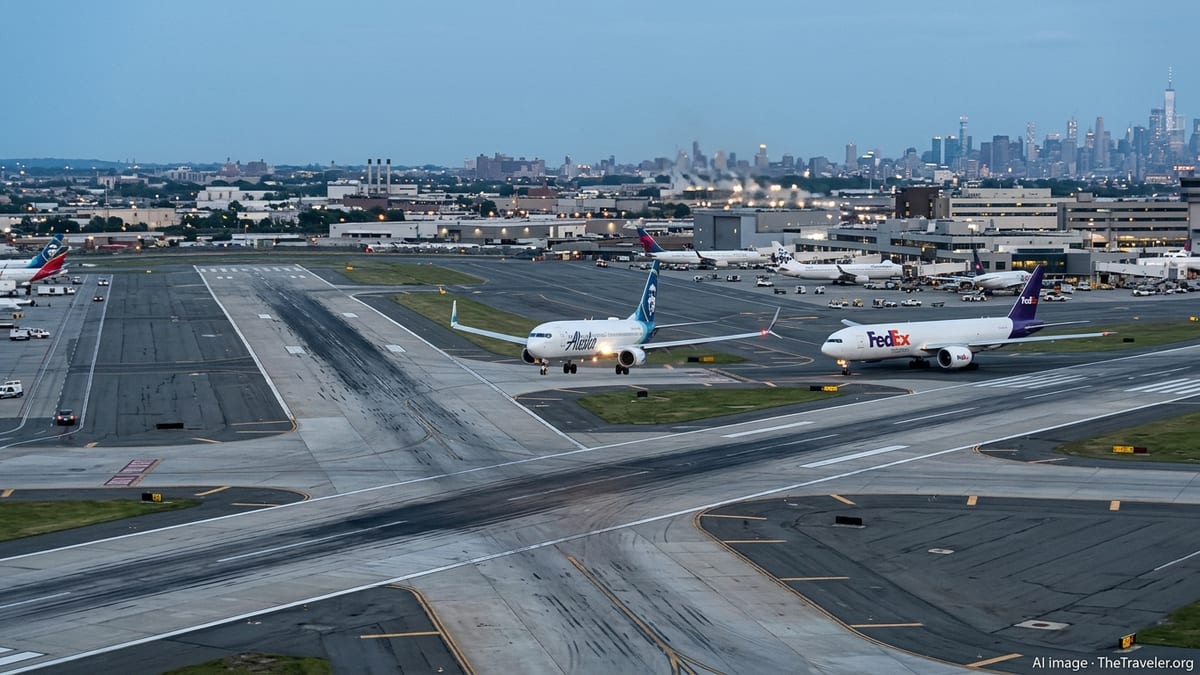
An Alaska Airlines Boeing 737 arriving from Portland and a FedEx Boeing 777 cargo jet inbound from Memphis reportedly came perilously close to colliding on intersecting runways at Newark Liberty International Airport, in an incident that unfolded within seconds and is now drawing renewed scrutiny to ground and air traffic safety at one of the United States’ busiest hubs.
Get the latest news straight to your inbox!
Reports of a High-Risk Runway Conflict
Initial accounts from aviation trackers and early media coverage describe a serious loss of separation involving an Alaska Airlines passenger flight from Portland, Oregon, and a FedEx Express cargo flight from Memphis, Tennessee, as both approached Newark Liberty International Airport. The two aircraft, a Boeing 737 and a Boeing 777 freighter, were reportedly set up to land on crossing or converging runways in busy evening traffic when air traffic control intervened.
Publicly available flight data and reconstructions shared by aviation observers indicate that the Alaska jet had been cleared to land while the FedEx freighter was also on final approach to an intersecting runway. As their flight paths converged, the closure rate between the two large aircraft rapidly increased, compressing the available reaction time to seconds. Controllers then issued urgent instructions that led one aircraft to break off its approach, averting a potential catastrophe.
Although the precise closest distance between the jets has not yet been formally detailed, early analyses suggest that the aircraft came much closer than standard safety margins permit during runway operations at major commercial airports. The fact that both planes were heavy transport aircraft, operating at low altitude and relatively low speed, underscores how little margin would have existed to recover from any additional miscommunication or delay.
No injuries or damage have been reported, and both flights later landed safely. Passengers and crew on the Alaska Airlines flight continued their journeys without the kind of disruption associated with mechanical diversions or emergency evacuations, highlighting how narrowly the event skirted public visibility despite its potential severity.
How a Near Miss Can Develop in Seconds
Runway conflicts of this kind typically develop in a layered fashion, as multiple aircraft are sequenced to arrive and depart in quick succession. At major hubs such as Newark Liberty, intersecting runways allow air traffic controllers to maximize capacity, but they also require precise timing and unambiguous instructions to prevent paths from crossing at the wrong moment.
A standard landing clearance presumes that any intersecting runway will be clear by the time an aircraft crosses it. If an arriving or departing aircraft lingers on a runway longer than planned, or if approach speeds or spacing deviate from expectations, the geometry can shift quickly. Within a span of seconds, what was a safe gap can compress into a high-risk overlap, especially in good weather when traffic levels are at their highest and controllers are trying to avoid unnecessary go-arounds that disrupt schedules.
In the Newark incident, publicly shared radar playback suggests that the Alaska Airlines 737 and FedEx 777 were following normal arrival procedures until their projected paths intersected more closely than standard separation rules allow. The situation appears to have demanded rapid decision-making in the control tower and immediate compliance from both flight crews, reinforcing how heavily modern air travel depends on clear communication and rapid execution when traffic becomes dense.
These dynamics are not unique to Newark. Past runway incursions and near collisions at other major airports, including incidents involving crossing runways and misaligned clearances, illustrate how human workload, airport geometry, and traffic surges can combine to narrow safety margins. The latest episode adds another data point to an already complex picture of systemic risk.
Newark Liberty’s Busy, Constrained Operating Environment
Newark Liberty International Airport serves as a critical gateway for the New York metropolitan region and regularly ranks among the country’s most congested major airports. Its runway layout, surrounded by dense urban development, waterways, roadways, and industrial infrastructure, leaves limited room for expansion and demands tightly choreographed movements on the ground and in the air.
The airport’s intersecting runways are a legacy of earlier eras of aviation, adapted over time to handle today’s larger aircraft and higher traffic volumes. They enable flexible operations under varying wind conditions but also create additional points where flight paths cross at or near ground level. Managing these intersections safely requires heightened vigilance from controllers, pilots, and ground personnel, particularly during peak arrival and departure banks.
Travelers at Newark are already familiar with the ripple effects of such complexity. Even minor disruptions can cascade into delays, gate changes, and missed connections, as airlines and the airport operator work within tight physical and scheduling constraints. While sophisticated scheduling tools and surveillance technologies help mitigate these pressures, the near miss involving the Alaska Airlines and FedEx flights highlights that risks can never be entirely engineered out of such a crowded environment.
For airlines like Alaska, which link West Coast cities such as Portland with the New York region, and cargo operators such as FedEx that rely on Newark as part of vast overnight logistics networks, the airport’s role in national connectivity is indispensable. Any serious safety event or prolonged capacity reduction at Newark would reverberate across passenger itineraries and freight corridors far beyond the New Jersey airspace where this latest scare unfolded.
Investigative Scrutiny and Systemic Safety Questions
In the wake of the incident, publicly available information indicates that federal aviation investigators and regulators are gathering data on the Alaska and FedEx flights, the air traffic communications, and the exact sequence of clearances and instructions. Typical inquiries of this kind draw on radar recordings, cockpit voice and flight data recorders, and tower communication logs to reconstruct every decision and interaction leading up to the moment of risk.
Such probes generally seek to determine not only whether established procedures were followed, but also whether those procedures themselves remain adequate for current traffic levels and airport configurations. Investigators routinely examine factors such as controller workload, staffing, training, and the use of safety technologies, as well as pilot situational awareness and cockpit resource management.
Runway safety has been a recurring focus in recent years, with national tracking systems cataloging a series of close calls across multiple U.S. airports. These incidents, though rare when compared with the total volume of daily flights, provide detailed case studies that can drive changes in procedures, training, and infrastructure. The Newark near miss involving two large commercial jets fits squarely into this broader pattern of concern, especially given the potential consequences had the conflict not been resolved in time.
For the traveling public, the process may be largely invisible, occurring behind the scenes while flights continue more or less as scheduled. Yet the eventual findings from such events often inform incremental improvements, from revised approach sequencing rules to new cockpit alerts, which collectively contribute to the strong overall safety record of commercial aviation in the United States.
Implications for Travelers and the Future of Runway Safety
While most passengers on the Alaska Airlines flight likely experienced the event as no more than a slightly unusual approach or late go-around, the underlying risk profile was far more serious. Episodes like this one at Newark serve as reminders that the seamless, routine feel of modern air travel is maintained by continuous adjustments and safeguards that are tested whenever traffic, weather, or human workload strain the system.
For travelers, the most immediate implications may surface as occasional go-arounds, holding patterns, or minor delays as air traffic controllers build in extra buffers at busy airports during and after high-profile incidents. Airlines may also adapt their own internal procedures or training scenarios to reflect emerging lessons, emphasizing how to respond consistently and decisively when clearances change rapidly close to the ground.
On a broader level, the near collision is likely to feed into ongoing debates over investments in runway safety infrastructure, including improved surface surveillance, automated conflict detection, and redesigned taxiways or intersection layouts where feasible. At space-constrained, high-traffic airports like Newark Liberty, these discussions are particularly complex, balancing operational capacity with the imperative to maintain robust margins of safety.
For now, both the Alaska Airlines Boeing 737 from Portland and the FedEx Boeing 777 from Memphis have become central examples in a growing body of case studies used to evaluate how the aviation system copes when seconds and a few hundred feet of separation are all that stand between routine travel and disaster. As the investigation and analysis progress, the findings are expected to shape how pilots, controllers, and airport planners think about intersecting runway operations at Newark and beyond.