

More news on this day
Athens has brought its coastal tram line directly into Piraeus Port with the long-delayed opening of the new Akti Poseidonos terminal stop, a move expected to ease journeys for thousands of cruise and ferry passengers while reinforcing the Greek capital’s high-profile shift toward cleaner, more integrated public transport.
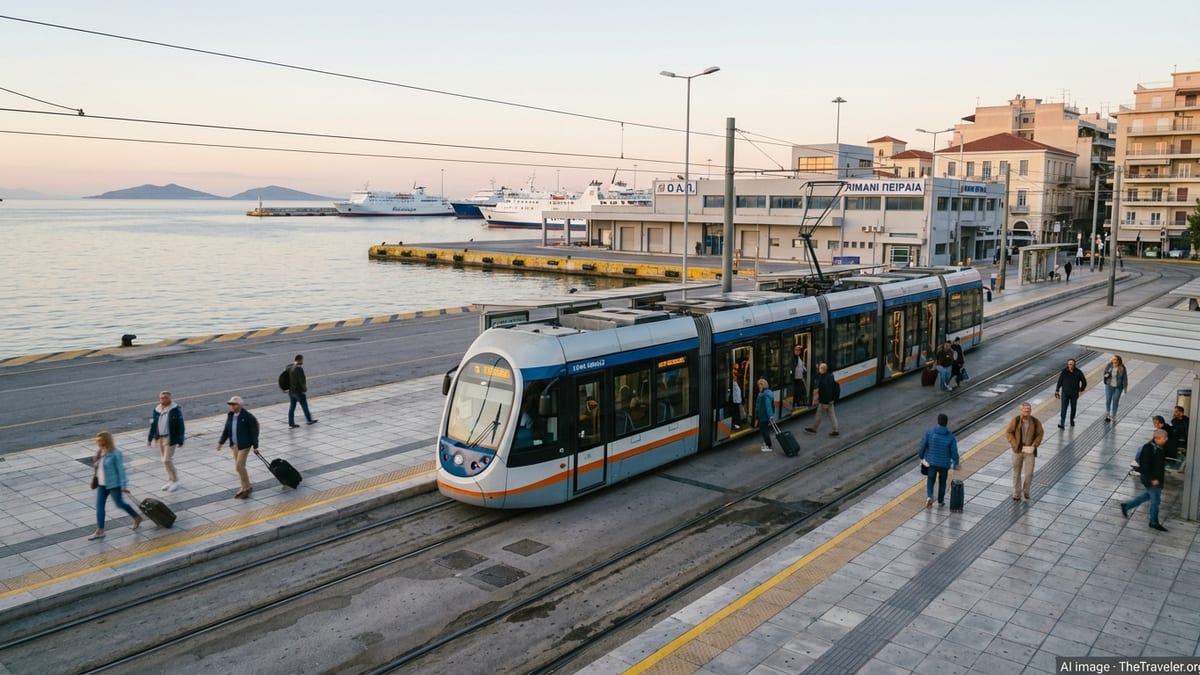
New Terminal Brings Tram to the Heart of Piraeus Port
The new Akti Poseidonos stop, which entered full operation in mid-February 2026, finally completes the extension of Tram Line T7 to the waterfront of Piraeus, one of Europe’s busiest passenger ports. For the first time, modern low-floor trams now stop within a short walk of key ferry gates, giving travelers a direct electric connection between the Athenian Riviera, southern suburbs and the port.
Until this week, the coastal tram’s terminus in Piraeus was Agia Triada, leaving passengers to cover the remaining distance to the main port area on foot or by bus and taxi. The new terminal shifts the end of the line to the seafront, shortening the so-called last mile for visitors hauling luggage and locals commuting to ships and nearby workplaces.
The project had been physically completed for several years but remained frozen over a technical conflict between tram infrastructure and trolleybus overhead cables at a critical junction. Transport authorities say the issue has now been resolved through targeted removal and reconfiguration of part of the trolley network, clearing the way for safe operation of the trams along the final stretch.
Officials describe the opening as a small but symbolically important milestone in a larger effort to recast Athens and Piraeus as cities where low-emission, rail-based transport frameworks the daily movement of residents and the millions of tourists who pass through each year.
Closer Connections for Cruise and Island Travelers
The most immediate impact of the Akti Poseidonos stop will be felt by ferry and cruise passengers. The new terminal brings the tram within roughly a five-minute walk of Piraeus’ central metro hub and main embarkation gates, connecting sea routes to the islands with rail links to the city’s hotel districts and airport.
Travel agents and port businesses expect the change to be particularly beneficial during the summer peak, when Piraeus can see tens of thousands of passengers on a single day and taxis and buses struggle to keep up. A direct, predictable tram option running at regular intervals is designed to take pressure off road traffic, cutting queues and reducing the anxiety of travelers trying to make tight ferry departures.
For cruise lines marketing Athens and the Aegean as low-stress, sustainable destinations, the tram’s arrival at the port offers a tangible improvement to the ground experience. Passengers can now disembark in Piraeus and reach central Athens or the beach suburbs without negotiating multiple transfers or relying on private coaches, aligning with the industry’s push to reduce onshore emissions.
Local residents are also expected to benefit. Many workers in logistics, hospitality and maritime services commute daily between Piraeus and other parts of the metropolitan area. With the tram now stopping closer to major employment zones along the quays, their trips should become more reliable and less dependent on congested surface routes.
Tram Line T7: From Voula’s Beaches to Piraeus Port
Tram Line T7, which now terminates at Akti Poseidonos in Piraeus and Asklepieio Voula in the southern suburb of Voula, has evolved into a spine for the coastal corridor. Running past marinas, beaches, residential districts and commercial hubs, it ties the seaside suburbs directly to Piraeus and, via connecting metro services, to the rest of Athens.
The Piraeus extension builds on earlier investments that pushed the tram deeper into the city’s historic port area. Since late 2021, the Piraeus loop has allowed trams to circulate around the urban core, stopping near municipal institutions such as the town hall and the Dimotiko Theatro metro station. The new terminal at the waterfront now anchors that loop to the maritime gateways themselves.
For visitors staying in coastal neighborhoods such as Glyfada or Voula, the tram offers a single-seat ride to Piraeus Port without the need to change to buses or the metro. That simplicity is central to the strategy of making rail-based options more attractive than private cars, especially for journeys to and from the islands where passengers tend to carry bulky luggage.
Transport planners see the strengthened Line T7 as an example of how targeted expansions, rather than sweeping megaprojects, can meaningfully alter mobility patterns when they connect existing nodes more intelligently. By turning an underused dead-end into an active seafront terminal, the network gains both capacity and clarity of purpose.
Part of a Wider Overhaul of Athens’ Public Transport
The tram’s arrival at Piraeus Port comes amid a broader overhaul of Athens’ public transport system, as authorities channel hundreds of millions of euros into modernizing buses, trams and metro infrastructure. Investments announced in the past two years range from new rolling stock and refurbished trains to expanded contactless ticketing and upgraded safety systems.
On the rail side, the European Commission has backed projects to renovate aging metro trains on Line 1, which already links Piraeus to northern suburbs, extending their lifespan and improving energy efficiency. At the same time, the tram network is seeing targeted upgrades, from power systems to station facilities, with an eye on reliability and passenger comfort.
Road-based services are also being reshaped. The Urban Transport Organization of Athens has embarked on a major fleet renewal program, bringing hundreds of new vehicles into service, including large numbers of battery-electric buses. Policy makers argue that pairing such investments with better rail connectivity will give residents a credible alternative to driving, especially as traffic congestion worsens and environmental pressures mount.
The government has additionally experimented with extended operating hours on key routes, including round-the-clock weekend metro and tram services on selected lines. These efforts point to a vision of public transport as a dependable backbone for a metropolitan region that increasingly attracts visitors year-round, rather than only at the height of summer.
Trolleybus Cables Make Way for Cleaner, More Flexible Transport
The opening of Akti Poseidonos is closely linked to another, more symbolic change in Piraeus: the gradual dismantling of the trolleybus overhead cable network. Authorities began removing cables in and around the port in late 2025, arguing that fixed-wire trolley systems are costly to maintain, visually intrusive and less flexible than the latest generation of electric buses.
Deputy Transport Minister Konstantinos Kyranakis has described the shift as a definitive transition toward cleaner, more adaptable electric mobility. As trolleybus lines are withdrawn or shortened, they are being replaced by battery-electric buses that can operate without overhead infrastructure, potentially serving a wider range of routes and detours without complex engineering works.
The cable removal also addressed the long-standing technical blockage that had prevented the tram extension’s final activation. In the key junction area near the port, trolleybus wires and tram lines competed for the same space, raising safety and interoperability concerns. With the wires now taken down and routes reorganized, transport engineers were able to certify the tram terminus for regular operation.
While some Athenians see the end of the trolleybus era as the loss of an urban icon, transport planners frame it as a necessary step in rationalizing the network. They point out that the energy supplied to trolleybuses will now power a wider mix of electric vehicles, from buses to trams, with lower operating costs and fewer physical constraints.
Benefits for Local Businesses and the Urban Fabric
For the city of Piraeus, the tram’s closer embrace of the port is not just a transport upgrade but an urban development tool. Shop owners, cafe operators and hotel managers along the coastal strip expect that better rail access will encourage more visitors to linger in the area rather than rushing directly between ferries and central Athens.
The removal of overhead trolley cables and poles has already changed the visual character of key streets, opening up views toward the sea and historic buildings. Local officials hope that as pavements are improved and public spaces redesigned around the tram tracks and stops, a more pedestrian-friendly, waterfront-oriented identity will emerge.
Improved tram and metro integration also supports the city’s ambitions to diversify tourism beyond high-season island traffic. With fast, low-emission connections in place, Piraeus can position itself as a year-round base for visitors interested in maritime heritage, cultural venues and gastronomy, rather than serving purely as a gateway.
At the same time, increased footfall must be managed carefully. Residents have expressed concerns about crowding on narrow sidewalks and the potential for short-term rentals to squeeze housing supply. City planners argue that strong public transport is a prerequisite for tackling such challenges, not a cause of them, as it reduces dependence on private cars and guides development toward existing corridors.
Supporting Greece’s Climate and Tourism Strategies
The tram extension dovetails with Greece’s national climate and tourism policies, which emphasize reducing emissions in popular destinations while maintaining growth in visitor numbers. Transport is a major source of greenhouse gases, and port cities like Piraeus face particular pressure due to cruise ship traffic and high volumes of road vehicles.
By making it easier for travelers to move between ships, the city and the wider region without relying on taxis or private cars, the new stop is expected to trim local air pollution and noise levels. Officials say that if even a modest share of passengers switch from road to rail for their port transfers, the cumulative effect over a busy summer season could be significant.
For the tourism industry, the enhanced connectivity strengthens Athens’ pitch as a city break and cruise hub that aligns with evolving traveler expectations around sustainability. Large tour operators and independent travelers alike are paying closer attention to how destinations manage visitor flows and carbon footprints, and infrastructure like the Akti Poseidonos terminal provides a visible answer.
Greek authorities have repeatedly highlighted such projects in discussions with European institutions and investors, framing them as examples of how relatively modest infrastructure changes can contribute to broader environmental commitments while improving the day-to-day experience of residents and guests.
What Passengers Can Expect on the Ground
With the new terminal in service, passengers arriving at Piraeus Port can look for modern, low-floor tram vehicles with wide doors and generous space for luggage, strollers and mobility aids. Services on Line T7 run at regular intervals, and the alignment has been designed to allow quick transfers to the metro and other local transport modes.
Wayfinding within the port area is being updated to reflect the new stop, with signage guiding travelers between ferry gates, tram platforms and metro entrances. Transport operators urge passengers to build in a small time buffer when connecting between ships and trams during the initial weeks of operation, as staff fine-tune operations and get feedback from users.
Digital tools, including mobile ticketing apps and contactless bank card payments at validators, are widely available across Athens’ public transport network. Officials encourage visitors to take advantage of these systems, which can reduce queues at ticket machines and simplify transfers between buses, trams and the metro.
For regular commuters, the key test will be reliability. Authorities have pledged close monitoring of service punctuality and passenger loads on Line T7, and they indicate that additional vehicles and schedule adjustments are possible if demand at Akti Poseidonos grows faster than anticipated in the coming months.