


More news on this day
Across the heart of Central Asia, a new generation of “Iron Silk Road” railways is knitting together China, the region’s landlocked republics and onward routes to Europe, promising faster journeys for goods now and setting the stage for future passenger travel across Eurasia.
Get the latest news straight to your inbox!
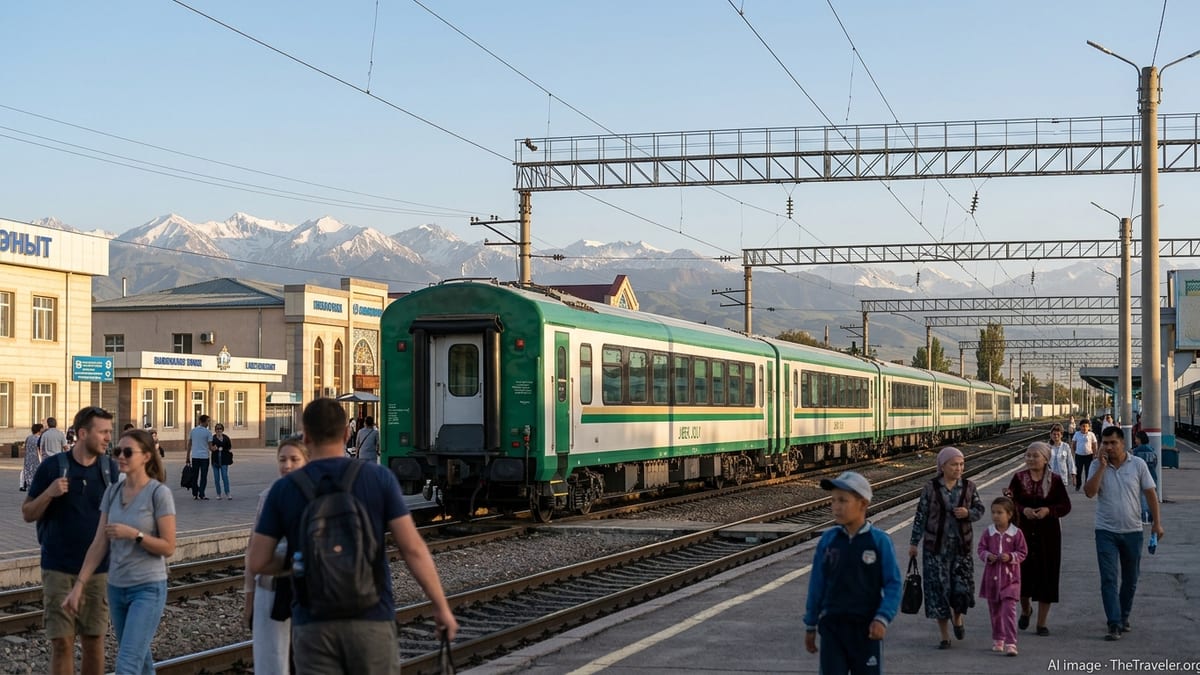
A Strategic Spine Through Central Asia Takes Shape
Central Asia is emerging as the pivotal land bridge in a changing Eurasian transport map. Governments across the region are advancing rail projects that link western China with Kazakhstan, Kyrgyzstan, Uzbekistan and beyond, forming what analysts increasingly describe as a new Iron Silk Road. Publicly available information shows that these lines are designed to shorten journeys between East Asia and Europe while reducing dependence on routes that cross Russia or congested sea lanes.
At the core of this shift is the so-called Middle Corridor, formally the Trans-Caspian International Transport Route, which moves freight from China through Kazakhstan and across the Caspian Sea to Azerbaijan, Georgia and Türkiye before reaching European markets. Reports by international organizations describe the corridor as a 4,000 kilometer multimodal chain of rail, road and sea links that is drawing rising volumes of cargo in the wake of geopolitical tensions along more traditional trade paths.
For Central Asian states, long reliant on Soviet era rail grids that pointed north, this emerging east west spine marks a profound reorientation. Recent analyses indicate that Kazakhstan now positions itself as a gateway to a regional market of around 100 million consumers around the Caspian, with rail links reaching both western China and ports on the Black Sea and Mediterranean.
China–Kyrgyzstan–Uzbekistan Railway Unlocks a Missing Link
The flagship project in this new wave of construction is the planned China–Kyrgyzstan–Uzbekistan railway, a long discussed line that would cut directly across the Tien Shan mountains from Kashgar in China’s Xinjiang region into Kyrgyzstan before entering the Fergana Valley in Uzbekistan. Technical studies and recent transport sector reporting show that the three countries agreed in 2024 to move ahead with construction, aiming to complete a route that would bypass existing detours through Kazakhstan.
Industry assessments suggest that once operational, the line could shorten the rail distance between China and markets in the Middle East and Europe by several hundred kilometers. It is also expected to become a central segment of the China–Central Asia–West Asia Economic Corridor, a Belt and Road Initiative pathway that links Chinese manufacturing centers with energy producers and consumers across Eurasia.
For Kyrgyzstan and Uzbekistan, both of which are landlocked and heavily dependent on road networks over challenging terrain, the project offers the prospect of faster, year round rail access to deep sea ports via onward connections across the Caspian and through the South Caucasus. Analysts note that this could support diversification of exports, from minerals and metals to agricultural products, while also opening realistic possibilities for future cross border passenger trains that would connect Central Asian cities more directly with western China.
Middle Corridor Upgrades Aim to Cut Days off Eurasian Journeys
Alongside new construction in Central Asia, countries in the South Caucasus and Türkiye are upgrading key sections of the Middle Corridor that will carry much of the redirected traffic. An OECD study on the corridor describes how investment priorities have focused on relieving bottlenecks at ports on the Caspian Sea, expanding rail capacity across Azerbaijan and Georgia, and modernizing the east west line into Türkiye.
One of the most significant projects in this chain is the Kars–Tbilisi–Baku railway, linking eastern Türkiye with Georgia and Azerbaijan. Sector reports note that after a period of modernization works, the line was reopened in 2024 with increased capacity, reinforcing its role as a key link between the Caspian basin and European rail networks. The upgraded route allows cargo to move more efficiently from Kazakhstan’s Caspian ports via ferry to Azerbaijan and then by rail through the Caucasus toward the European Union.
Data from regional research centers indicate that freight volumes on the Middle Corridor have increased severalfold over the past seven years, with Kazakhstan reporting more than 4.5 million tonnes transported annually along the route. While this still represents a small share of the total China Europe trade flow, transport economists argue that every hour shaved from border procedures, trans loading operations and port waiting times strengthens the corridor’s competitiveness against maritime shipping and northern rail lines.
From Freight First to Future Passenger Opportunities
Most of the new Silk Road rail activity across Central Asia is freight focused, yet the infrastructure being built has clear implications for future passenger travel. Railway engineering documents describe double tracked sections, upgraded signaling and new tunnels that are compatible with higher speed services, even if current plans prioritize container trains and bulk cargo.
Existing examples across Eurasia demonstrate how freight led corridors can later host international passenger trains. Long distance services already connect Chinese hubs with cities in Central Asia and the Caucasus on a limited basis, and regional forums on connectivity have highlighted the potential for regular passenger connections once border procedures and rolling stock standards become more harmonized.
Tourism boards in Kazakhstan, Uzbekistan and Georgia are increasingly promoting overland journeys as part of broader Silk Road themed itineraries, emphasizing that improved rail links reduce travel times between capitals and major cultural sites. Analysts suggest that as new lines such as the China–Kyrgyzstan–Uzbekistan railway come online and as the Middle Corridor matures, there is likely to be greater scope for transcontinental rail tickets that allow travelers to cross from East Asia to Europe via multiple Central Asian and Caucasus stops.
Challenges Remain as Central Asia Seeks a Larger Role
Despite the momentum, specialists caution that the new Silk Road railway network in Central Asia still faces substantial hurdles before it can rival established sea and northern rail routes. Studies by development banks and think tanks point to persistent infrastructure gaps, limited interoperability between national railway systems and administrative barriers at border crossings that can add days to journeys.
There are also capacity constraints at key points such as Caspian Sea ports and the rail ferry connections that link Central Asia with Azerbaijan. Cargo must often be transferred between different gauge systems, and delays at customs posts can reduce the time savings that overland routes promise compared with maritime shipping. Recent policy analysis argues that without streamlined procedures and coordinated investment across multiple countries, the Middle Corridor risks underperforming relative to expectations.
Nevertheless, the trend toward diversifying supply chains away from single country dependencies continues to favor Central Asia’s emerging rail network. As more trains begin to run over new alignments and upgraded lines, the region is positioned to capture a larger share of trans Eurasian traffic. In the process, it is opening the door not only to faster freight movement, but also to a future in which travelers can traverse the historic Silk Road by modern rail in significantly less time than today.
Sources: Asian Development Bank Middle Corridor report; OECD analysis on the Middle Corridor; Caucasus Business Journal explainer on the Middle Corridor; OSW report on growing interest in the Middle Corridor