


More news on this day
AirAsia will assume operation of the busy Kuala Lumpur–Seoul Incheon route from long-haul affiliate AirAsia X from late October 2026, replacing Airbus A330 widebodies with new Airbus A321neo LR narrowbody aircraft in a change that alters capacity, cost structure and passenger experience on one of North Asia’s key low-cost corridors.
Get the latest news straight to your inbox!
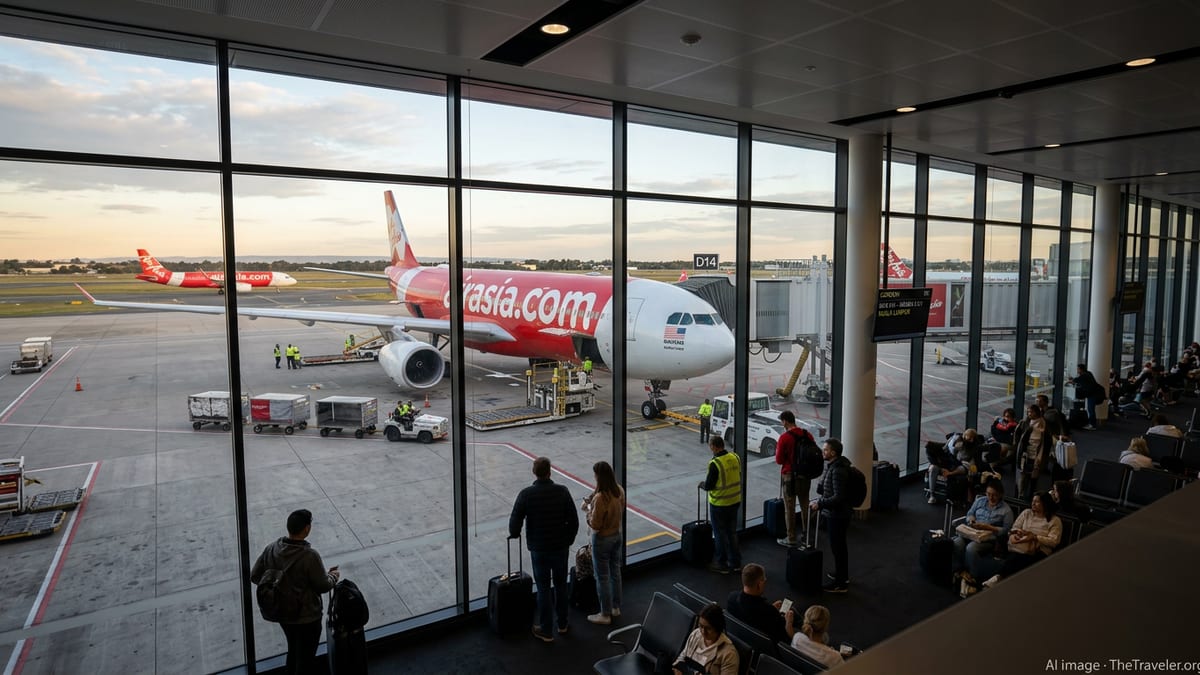
Daily Kuala Lumpur–Seoul flights to change operator in October 2026
According to published schedule data, Malaysia-based AirAsia (flight code AK) is due to take over the daily Kuala Lumpur International–Seoul Incheon service currently flown by AirAsia X (flight code D7) from 25 October 2026. The move shifts the route from the group’s long-haul widebody unit to its short- and medium-haul arm while retaining a daily nonstop link between the Malaysian and South Korean capitals.
Route information compiled by industry analysts indicates that the change will coincide with the start of the Northern Winter 2026 season. AirAsia is expected to roster its latest Airbus A321neo LR aircraft on the sector, in place of AirAsia X’s Airbus A330-300 widebodies that have long been a fixture on the city pair.
Timetable data on airline and travel platforms currently continues to show AirAsia X as the operator for 2026 departures up to late October, with the AK-coded narrowbody service appearing from the winter schedule onwards. The published shift suggests a continuity of daily capacity in frequency terms, even as the aircraft size decreases.
From A330 widebodies to A321neo LR: what changes for travelers
The operator change also brings a major fleet swap. AirAsia X has generally deployed 377-seat Airbus A330-300 aircraft on Kuala Lumpur–Seoul, a configuration geared toward high-density leisure traffic on six- to seven-hour sectors. With the transfer, AirAsia plans to use the longer-range variant of its Airbus A321neo family, sometimes designated A321LR or A321-200NX(LR), which offers extended range with a single-aisle layout.
Fleet strategy material and manufacturer information describe the A321neo LR as a narrowbody capable of flights of up to around eight hours, with improved fuel burn and lower emissions compared with previous-generation models. AirAsia Group has been steadily growing its narrowbody fleet and has highlighted the type’s role in serving longer “thin” routes where a widebody may no longer be necessary.
For passengers, the shift is likely to be most visible in the cabin layout. The A330-300 has typically offered a 2-4-2 economy configuration, while AirAsia’s A321neo LR uses a 3-3 single-aisle layout. While overall seat count on each flight will decline, the newer aircraft type usually features modern cabin fittings, larger overhead bins and enhanced connectivity options, in line with AirAsia’s broader narrowbody refresh.
Part of a wider AirAsia Group network and fleet recalibration
The Kuala Lumpur–Seoul reshuffle fits into a broader reorganisation of the AirAsia-branded airlines. Company information for AirAsia Group Berhad notes that, from early 2026, the group consolidated its various AirAsia operations under a single aviation platform, combining short- and medium-haul carriers with the former AirAsia X unit within one structure. This has allowed the group to simplify network planning and asset deployment across markets.
Publicly available financial and corporate filings outline a strategy focused on moving away from widebody operations toward a predominantly narrowbody fleet. In 2026, the group announced a major order for Airbus A220 aircraft, complementing its large A320 and A321 portfolio and underlining an ambition to create what it has described in investor materials as a “global low-cost network carrier” built around single-aisle jets.
Within this context, transferring the Kuala Lumpur–Seoul route to AirAsia’s A321neo LR fleet aligns with a pattern seen elsewhere in the region, where group carriers have been progressively trimming or reshaping long-haul widebody flying in favor of smaller-gauge aircraft. Market observers note that similar shifts have occurred on other routes to North Asia and Australia, as the airline family responds to cost pressures and changing demand patterns.
Implications for capacity, competition and fares on the Korea–Malaysia corridor
The Kuala Lumpur–Seoul market is served by multiple airlines, including full-service and low-cost competitors. Schedules data indicate that AirAsia X has historically held a significant share of low-fare capacity on the route, supported by its high-density A330 configuration. The move to a narrower A321neo LR will reduce the number of seats per flight, even as daily frequency is maintained.
A reduction in per-flight capacity could support higher average fares if demand remains firm, although the use of more fuel-efficient aircraft may help the airline manage operating costs and maintain competitive pricing. The group’s focus on lower unit costs with new-generation narrowbodies, highlighted in investor presentations and fleet announcements, suggests that the operator is seeking flexibility to adjust capacity without withdrawing from key markets.
For travelers in both Malaysia and South Korea, the continued daily service maintains a vital link for tourism, business travel and onward connections across Southeast Asia. The change also comes as AirAsia X resumes and builds up its separate Kuala Lumpur–Busan service, reinforcing the group’s presence in South Korea while redistributing aircraft resources across its network.
What passengers should watch as the transition approaches
With the operational handover planned near the start of the Northern Winter 2026 schedule, passengers booked on Kuala Lumpur–Seoul flights later in the year are likely to see flight numbers, operating carrier designators and aircraft type updated in their itineraries as systems are refreshed. Industry experience suggests that airlines typically complete such transitions gradually across booking channels, including their own websites, travel agencies and online travel platforms.
Travelers who value specific seat types or who are sensitive to cabin layout may wish to review seating plans once the A321neo LR operation is fully loaded into reservation systems. The shift from a twin-aisle to a single-aisle aircraft can influence boarding, movement in the cabin and perceptions of space, even if flight times and core service offerings remain similar.
As with any network change, industry observers recommend that passengers monitor booking confirmations and email notifications for any schedule adjustments in the months leading up to the switchover date. With AirAsia Group actively recalibrating its wider route map, including in other Asia-Pacific markets, further fine-tuning of timings and frequencies on the Kuala Lumpur–Seoul pairing cannot be ruled out as October 2026 approaches.
https://www.aeroroutes.com/eng/260826-aknw26icn
https://www.ch-aviation.com/news/171141-airasia-to-take-over-airasia-xs-seoul-route-in-early-4q26
https://www.airasiagroup.com/company-overview.html
https://newsroom.airasia.com/news/airasia-x-makes-history-with-record-order-for-150-airbus-a220s