

More news on this day
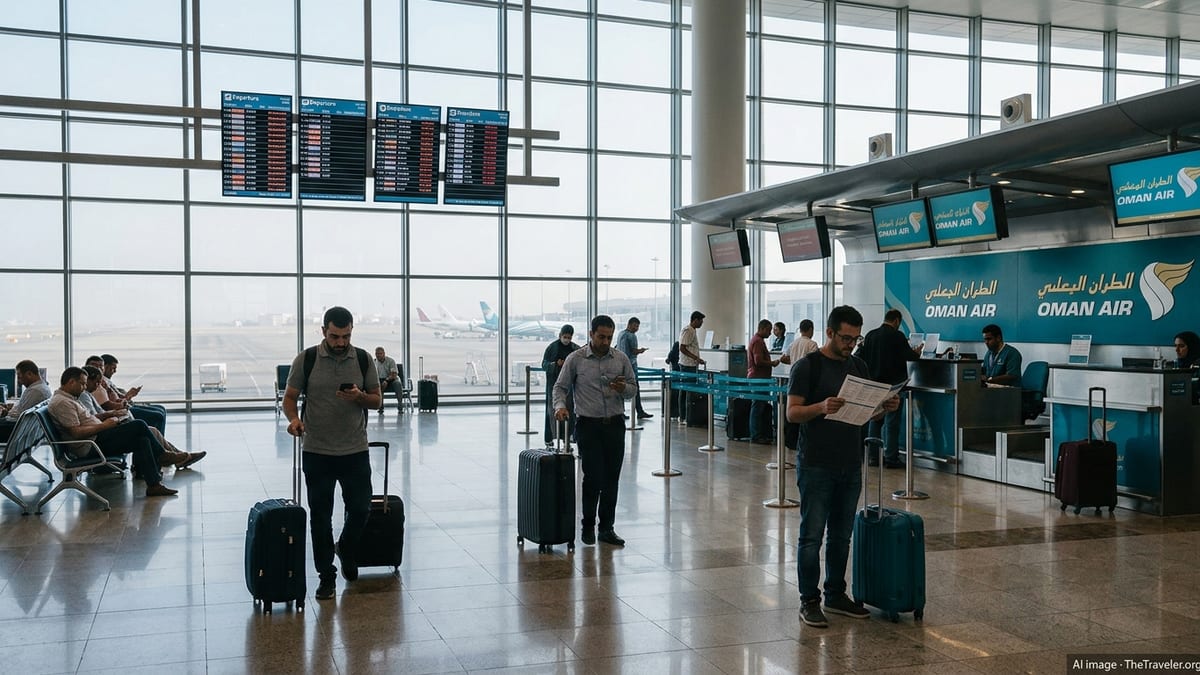
Oman Air is sharply expanding flight cancellations across key regional routes through March 2026 as intensified conflict and airspace restrictions sweep the Middle East, creating fresh uncertainty for travelers who rely on Muscat as a Gulf hub.
Get the latest news straight to your inbox!
Expanded Cancellations Hit Core Regional Network
Publicly available schedules and recent travel advisories indicate that Oman Air has suspended services on a cluster of short- and medium-haul routes, particularly within the Gulf and wider Middle East. Earlier notices pointed to cancellations on flights linking Muscat with Amman, Dubai, Bahrain, Doha, Dammam, Kuwait, Copenhagen, Baghdad and Khasab in early March. More recent updates show that some of these suspensions have been extended deeper into the month as the regional security situation remains volatile.
Coverage in regional travel media reports that flights to and from Kuwait, Sharjah, Doha and Dammam are now suspended until at least March 20, while services to Iraq, Lebanon and Iran are halted until at least March 28. In parallel, Oman Air has continued to adjust frequencies and timings on other routes, warning of potential last-minute changes as airspace availability shifts.
The widening timetable of cancellations means that passengers booked on Muscat-centric itineraries, including many who use the Omani capital as a connection point between South Asia, the Middle East and Europe, now face rolling disruptions. Ticket-holders are being urged to monitor their booking status closely and prepare for short-notice re-routing or travel date changes.
Despite the extensive cuts, Oman Air is maintaining some operations beyond the most affected corridors. Industry bulletins describe the carrier as operating with restrictions rather than a full shutdown, with long-haul and select regional services still running where safe routing is available and permitted.
Regional Airspace Closures Reshape Flight Paths
The airline’s moves are unfolding against a backdrop of unprecedented airspace constraints across the Middle East and Persian Gulf. Conflict-related closures and severe restrictions now affect multiple Flight Information Regions, notably over Iran, Iraq, Israel, Jordan, Lebanon, Bahrain, Kuwait, Qatar and parts of the Gulf. European aviation safety advisories have urged operators to avoid these airspaces at all altitudes, citing risks from missile activity, air defence systems and potential interception.
Operational analyses from aviation tracking and pilot briefings describe two main detour corridors emerging for Europe–Asia traffic: a northern path via the Caucasus and an elongated southern arc via Egypt, Saudi Arabia and Oman. Both options add several hours to typical flight times and compress traffic into narrower lanes, raising fuel burn, costs and congestion as airlines compete for safe, available routings.
Within this constrained environment, Omani airspace and Muscat’s role have become particularly sensitive. While Oman remains more open than some neighbours, the need to route around closed or high-risk zones has complicated approach and departure paths, especially for flights that previously transited Iranian or Iraqi airspace. The cumulative result is a shrinking pool of viable routes for carriers such as Oman Air, which must balance safety, regulatory guidance and commercial viability.
Industry risk assessments published this month suggest that even if limited corridors reopen, operators may continue to avoid certain skies for an extended period due to lingering security concerns and insurance implications. That outlook increases the likelihood that Oman Air’s route map will remain in flux well beyond the initial suspension dates.
Knock-On Impact for Travelers and Gulf Hubs
The ripple effects of Oman Air’s cancellations are being felt across the wider Gulf, where several carriers are simultaneously scaling back or freezing operations on overlapping city pairs. Regional coverage notes that other airlines have also curbed flights to and from hubs such as Dubai, Doha, Bahrain and Kuwait, concentrating what limited capacity remains on evacuation efforts and a handful of long-haul links.
For leisure travelers and expatriate workers, the sudden withdrawal of multiple Muscat frequencies has narrowed options for reaching destinations such as Amman, Baghdad or Beirut, which already faced limited connectivity even before the latest crisis. Many itineraries that previously connected seamlessly via the Omani capital now require complex re-routing, often involving overnight stops in alternative hubs or extended detours through Europe or South Asia.
Travel advisories from risk consultancies and logistics providers emphasize that schedules across the region are changing day by day, and sometimes hour by hour. Passengers are being encouraged to avoid speculative trips to airports without confirmed rebooking, to retain flexibility on dates and routings, and to keep contact details updated with airlines so that last-minute changes can be communicated quickly.
Muscat’s role as a resilience hub is also under scrutiny. Some transport and infrastructure analyses highlight the city’s potential as one of the few relatively stable gateways near the Strait of Hormuz. At the same time, constrained air corridors and high demand mean that any remaining Oman Air and foreign-carrier seats out of the sultanate are in short supply, pushing up fares and limiting immediate alternatives for stranded travelers.
Operational Adjustments and Limited Capacity Additions
In response to the disruption, Oman Air has introduced targeted capacity increases on certain long-haul and regional routes not directly affected by the heaviest airspace closures. According to published schedules and regional news coverage, the airline has added extra flights to destinations such as London Heathrow, Istanbul, Bangkok, Kuala Lumpur, Cairo and Mumbai during the second week of March, with the aim of moving stranded passengers onward where possible.
These additional services are described as temporary measures, aligned with specific dates and subject to adjustment if the security picture or regulatory guidance changes again. They provide some relief for passengers attempting to connect from Muscat to major global gateways, but the extra capacity is limited relative to the scale of cancellations across the airline’s short-haul Middle East network.
Aviation operations bulletins also point to ongoing delays and schedule reshuffles even on flights that are technically operating. Longer routings around restricted airspace can disrupt crew rotations, aircraft positioning and turnaround times, prompting rolling knock-on delays throughout the day. Travelers are therefore being warned to expect extended journey times even when flights do depart as planned.
Industry observers note that Oman Air’s pattern of limited additions on certain trunk routes, combined with deeper cuts on politically exposed or overflight-dependent sectors, is broadly in line with the strategies of other regional carriers. The focus remains on preserving core connectivity while avoiding routes that intersect or rely on the most volatile airspaces.
Uncertain Outlook Through Late March 2026
With several advisories and airline notices now stretching into mid and late March 2026, the prospects for a rapid normalization of Oman Air’s network appear slim. Safety bulletins affecting the broader Middle East and Persian Gulf region have been issued on an open-ended basis, and operational summaries from cargo and passenger operators alike describe the environment as highly dynamic.
Analysts tracking route announcements expect that Oman Air may continue to adjust its plans in stages, extending some suspensions, restoring others on a trial basis and potentially introducing ad hoc services where demand and safety considerations allow. The carrier’s published end dates for suspensions are therefore widely viewed as provisional markers rather than firm commitments.
For now, travelers planning to transit Muscat or fly point-to-point with Oman Air in March are facing an environment where flexibility is essential. Industry guidance stresses the importance of checking flight status repeatedly in the days leading up to departure, monitoring airline and airport communications, and considering alternative routings that bypass the most affected Middle Eastern hubs.
Until the underlying regional security situation stabilizes and regulators ease restrictions on key airspaces, Oman Air’s network is likely to remain constrained, and the current round of flight disruptions could shape travel patterns to and from the Gulf well beyond March 2026.